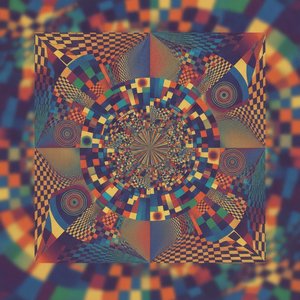
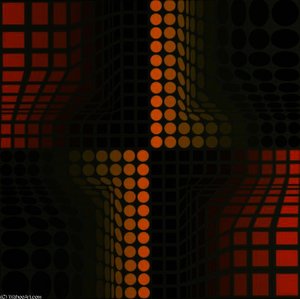
KST – Geometry’s Dance of Color
Victor Vasarely's KST, a mesmerizing geometric abstraction, transcends mere visual appeal; it embodies the spirit of Op Art—Optical Art—a movement that revolutionized perception in the mid-20th century. This artwork, executed with meticulous precision, captures the essence of dynamism and illusion within seemingly static forms. The photograph showcases a vibrant tapestry of hues – sapphire blue, emerald green, radiant yellow, fiery red, regal purple, tangerine orange, and pristine white – arranged in an intricate interplay of circles and squares. These shapes aren’t randomly scattered; they are strategically positioned to create a captivating kaleidoscope effect that shifts subtly as the viewer moves their gaze across the canvas.
- Style: Op Art (Optical Art)
- Technique: Acrylic paint on canvas
- Dimensions: Unknown
- Date: Unknown
The genesis of KST lies firmly rooted in the Bauhaus aesthetic—a German design school that championed functionalism and geometric abstraction. Vasarely’s formative years at Műhely, alongside Sándor Bortnyik, instilled within him a profound understanding of how visual stimuli influence our subconscious mind. This intellectual foundation fueled his artistic exploration into mathematical principles and their application to art creation. He sought to liberate painting from representational constraints, prioritizing the pure language of form—specifically geometric shapes—to evoke emotional responses without resorting to explicit imagery.
Symbolism & Emotional Impact: Vasarely’s deliberate use of repetition and symmetry speaks volumes about his fascination with order and harmony. The circles and squares, recurring motifs throughout his oeuvre, represent stability and balance – concepts antithetical to the anxieties of post-war Europe. However, the vibrant colors aren't merely decorative; they are carefully calibrated to stimulate visual perception and generate a feeling of movement and excitement. KST invites contemplation on how our eyes perceive reality, prompting viewers to question assumptions about visual experience and embracing the beauty inherent in mathematical precision.
Vasarely’s Contribution to Kinetic Art
Beyond Op Art's immediate impact, Vasarely’s work paved the way for kinetic art—a genre that incorporates movement into artistic expression. Influenced by developments in engineering and psychology, Vasarely aimed to create artworks that actively engage the viewer’s senses, blurring the boundaries between perception and reality. His exploration of optical illusions demonstrated a commitment to challenging conventional notions of visual representation and pushing the limits of artistic innovation.
Exploring Vasarely's Artistic Legacy
Victor Magariños D., an Argentine abstract artist, similarly championed geometric abstraction, reflecting the broader trends shaping 20th-century art. His work at Buenos Aires Museum of Modern Art exemplifies the enduring fascination with simplified forms and chromatic harmony—a legacy directly traceable to Vasarely’s pioneering vision. Furthermore, Víctor Lucero (Víctor Alberto Trujillo Matamoros), the Mexican actor & comedian known for ‘Brozo el Payaso Tenebroso,’ demonstrates how artistic sensibilities can permeate diverse creative pursuits. His distinctive clown persona embodies a playful engagement with visual expression—a testament to Vasarely’s influence on contemporary culture.
A Temple Dedicated to Art and Literature
Finally, Biblioteca Museu Víctor Balaguer in Vilaverdana – Catalonia – stands as a beacon of cultural heritage, showcasing stunning Catalan art & literature housed in a Neo-Egyptian temple designed by Antoni Gaudí. This architectural marvel celebrates Balaguer’s unwavering belief in the transformative power of artistic endeavors—a sentiment perfectly aligned with Vasarely's dedication to redefining visual experience and inspiring future generations of artists.
Pytania i odpowiedzi
Czy „KST” autorstwa Wiktór Wasaryli to dzieło o jasnej czy ciemnej kolorystyce?
„KST” charakteryzuje się ogólną jasnością na poziomie cień, a jej luminancja wynosi Miękki cień.
Jaki jest dominujący odcień dzieła „KST” autorstwa Wiktór Wasaryli?
„KST” skłania się ku Spektrum od zieleni do fioletu tonacji.
Gdzie mogę kupić ręcznie malowaną reprodukcję dzieła „KST” autorstwa Wiktór Wasaryli?
"KST" jest dostępny jako ręcznie malowana reprodukcja olejowa na płótnie lnianym. Zamówienie można złożyć na stronie Ręcznie malowana reprodukcja, wybierając preferowany rozmiar.



 Zobacz w skali 1:1
 Przełącz na wersję drukowaną
 Wyślij
 Udostępnij
 Szczegóły
 Przewodnik

 Pobierz plik obrazu
 Podobne obiekty
 RTG
RTG Pokaz slajdów
 Statystyki
 Czytaj więcej






































 Opcja ze szkłem jest dostępna wyłącznie w rozmiarach poniżej 110 cm