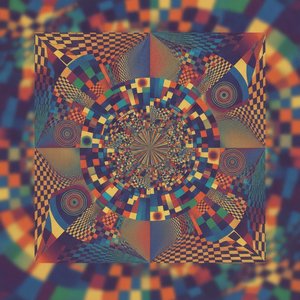
A Symphony in Blue and White: Exploring Victor Vasarely’s “GYK”
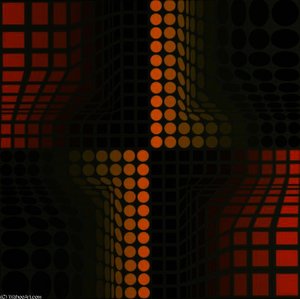
Victor Vasarely's "GYK" is not merely a painting; it’s an invitation into the heart of Op Art, a visual exploration of perception itself. This captivating work, dominated by a central blue circle punctuated with meticulously placed white dots, embodies the core principles that defined Vasarely’s groundbreaking career – a dedication to geometric abstraction and the manipulation of optical illusion. The painting's deceptively simple composition belies a complex intellectual framework rooted in the burgeoning scientific understanding of visual phenomena at the mid-20th century.
The Genesis of Optical Art
Born in 1906 in Pécs, Croatia (then part of Austria-Hungary), Károly Vaszary – later Victor Vasarely – initially pursued a medical career before embracing the transformative power of art. His journey began with formal training at the Podolini-Volkmann Academy and crucially, within the influential workshop of Sándor Bortnyik, where he was immersed in the principles of functional design and the radical ideas emerging from the Bauhaus movement. This exposure ignited his fascination with how the human eye perceives form and space – a fascination that would become the foundation for his revolutionary approach to painting. “GYK” directly reflects this early influence, echoing the emphasis on precise geometric forms and their dynamic effects as explored by pioneers like Josef Albers.
Technique and Illusion: A Dance of Perception
Vasarely’s technique in "GYK" is characterized by a remarkable precision and control. The blue circles, rendered with meticulous attention to detail, are not simply painted; they are constructed through layers of carefully applied paint, creating subtle variations in tone and texture that heighten the illusion of depth and movement. The white dots, strategically positioned, act as focal points, drawing the viewer’s eye across the canvas and further disrupting the sense of static space. This deliberate manipulation of visual cues is a hallmark of Op Art – an artistic movement dedicated to stimulating optical illusions through abstract forms.
- Color Theory: The use of blue evokes feelings of tranquility, stability, and intellectual contemplation, aligning with Vasarely’s interest in the psychological effects of color.
- Geometric Precision: The perfectly formed circles represent a fundamental building block of visual perception, reflecting the artist's belief that art could reveal underlying mathematical truths.
- Layered Technique: Vasarely employed multiple layers of paint to create depth and optical complexity, a technique central to Op Art’s success.
Symbolism and Emotional Impact
"GYK" transcends mere visual stimulation; it invites contemplation on the nature of reality itself. The circular forms, often associated with wholeness and unity, combined with the fragmented arrangement, suggest a tension between order and chaos, stability and movement. Vasarely’s work isn't about depicting recognizable objects but rather exploring the fundamental building blocks of visual experience. The painting evokes a sense of calm contemplation alongside an underlying feeling of dynamic energy – a testament to Vasarely’s ability to capture both intellectual rigor and emotional resonance within his abstract compositions.
A Legacy in Reproduction
WahooArt offers meticulously crafted hand-painted reproductions of “GYK,” ensuring that the full impact of Vasarely's vision is faithfully preserved. Each reproduction utilizes archival quality materials and techniques, guaranteeing lasting beauty and a faithful representation of this iconic work. Whether adorning a contemporary interior or becoming a cherished addition to an art collection, "GYK" continues to captivate and inspire, solidifying Victor Vasarely’s place as one of the most influential figures in 20th-century art.
Pytania i odpowiedzi
Jakie miejsce w historii sztuki zajmuje „GYK” autorstwa Wiktór Wasaryli?
„GYK” autorstwa Wiktór Wasaryli należy do nurtu Op Art, przypadającego na okres Modern. Razem nadają one dziełu jego miejsce w historii sztuki.
Jaki to rodzaj dzieła sztuki: „GYK” autorstwa Wiktór Wasaryli?
W katalogu dzieło „GYK” autorstwa Wiktór Wasaryli zostało sklasyfikowane jako WallArt. Kategoria ta ułatwia odnajdywanie podobnych prac.
W jaki sposób tematyka dzieła "GYK" odnosi się do typowych motywów twórczości Wiktór Wasaryli?
„GYK” przedstawia abstract art, geometric shapes, circles, op art, visual perception, color field, victor vasarely, podczas gdy utrwalone motywy Wiktór Wasaryli to bauhaus, geometric abstraction, visual perception studies, op art pioneer role, recurring circular motifs, early kinetic art. Porównanie tych dwóch elementów ukazuje, jak dzieło odnosi się do typowej dla tego artysty tematyki.



 Zobacz w skali 1:1
 Przełącz na wersję drukowaną
 Wyślij
 Udostępnij
 Szczegóły
 Przewodnik

 Pobierz plik obrazu
 Podobne obiekty
 RTG
RTG Pokaz slajdów
 Statystyki

 Czytaj więcej






































 Opcja ze szkłem jest dostępna wyłącznie w rozmiarach poniżej 110 cm