Unlocking the Visual Pulse: An Exploration of Victor Vasarely’s *DVA-DVA*
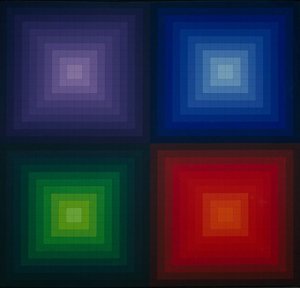
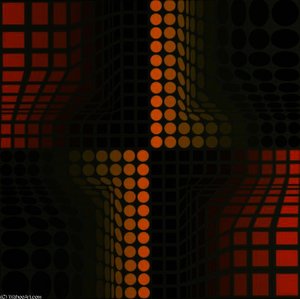
Victor Vasarely's DVA-DVA is more than just a colorful square; it’s a meticulously crafted portal into the heart of Op Art and a testament to the revolutionary approach Vasarely took towards understanding perception. Painted in 1960s, this work embodies the artist’s core philosophy: to translate mathematical principles – specifically, the way our eyes perceive movement and vibration – directly onto the canvas. The painting's deceptively simple composition—four distinct squares of red, green, blue, and yellow—immediately draws the viewer in, inviting a deeper engagement than mere aesthetic appreciation.
The Genesis of Optical Art
Born Károly Vaszary in 1906 in Pécs, Croatia (then part of Austria-Hungary), Vasarely’s artistic trajectory was initially rooted in medicine before he decisively embraced the burgeoning world of abstraction. His formative years were profoundly shaped by the Bauhaus movement and Sándor Bortnyik's “Műhely” workshop, where he absorbed the principles of functional design and geometric abstraction. This wasn’t simply about creating pretty pictures; it was a rigorous scientific investigation into how our brains process visual information. Vasarely sought to create art that actively *stimulated* perception, challenging traditional notions of representation and inviting viewers to become active participants in the artwork's creation.
A Symphony of Color and Movement
The technique employed in DVA-DVA is a masterclass in controlled illusion. Each square isn’t painted with broad strokes but rather with precise, overlapping geometric shapes – lines, circles, and curves – meticulously arranged to create the impression of movement and vibration. The artist's deliberate use of contrasting colors amplifies this effect, further manipulating our visual system. The subtle variations within each color field—the delicate shading and layering—are crucial to generating the optical illusion that defines Op Art. It’s a technique demanding immense precision and control, reflecting Vasarely’s dedication to translating mathematical concepts into tangible artistic forms.
Symbolism and Emotional Resonance
While ostensibly abstract, DVA-DVA resonates with deeper symbolic meanings. The four primary colors – red, green, blue, and yellow – are often associated with fundamental energies and emotions. Vasarely’s work isn't about depicting a specific scene or narrative; instead, it aims to evoke a visceral response within the viewer—a sense of dynamism, excitement, and perhaps even a slight disorientation. The painting’s impact is profoundly psychological, tapping into our innate sensitivity to visual stimuli. It invites contemplation on the nature of perception itself, prompting us to question how we see the world around us.
A Legacy in Reproduction
WahooArt offers meticulously crafted hand-painted reproductions of DVA-DVA, ensuring that you experience the full impact of Vasarely’s groundbreaking work. Each reproduction is created using archival quality materials and techniques, faithfully capturing the original's intricate details and vibrant colors. Whether adorning a contemporary space or serving as an investment in art history, this piece offers a unique opportunity to engage with one of the 20th century’s most influential artists.
Pytania i odpowiedzi
Czy mogę zamówić olejną reprodukcję "DVA-DVA"?
Ręcznie malowane kopie dzieła „DVA-DVA” autorstwa Wiktór Wasaryli można nabyć na stronie ta strona: ręcznie malowana reprodukcja olejowa na płótnie lnianym, zamawiając je bezpośrednio przez zakładkę Ręcznie malowana reprodukcja.
Jaki rozmiar "DVA-DVA" jest sugerowany do Living Room?
W pomieszczeniu typu Living Room sugerowany jest wydruk dzieła „DVA-DVA” w rozmiarze Large.
Jakie miejsce w historii sztuki zajmuje „DVA-DVA” autorstwa Wiktór Wasaryli?
„DVA-DVA” autorstwa Wiktór Wasaryli należy do nurtu Op Art, przypadającego na okres Modern. Razem nadają one dziełu jego miejsce w historii sztuki.



 Zobacz w skali 1:1
 Kup ręcznie malowany obraz
 Wyślij
 Udostępnij
 Szczegóły
 Przewodnik

 Pobierz plik obrazu
 Podobne obiekty
 RTG
RTG Pokaz slajdów
 Statystyki

 Czytaj więcej






































 Opcja ze szkłem jest dostępna wyłącznie w rozmiarach poniżej 110 cm