A Dance of Geometry: Exploring Victor Vasarely’s ‘Abstract Composition 9’
Victor Vasarely's “Abstract Composition 9” is more than just a painting; it’s an invitation to experience the world through the lens of perception itself. Created by one of the foremost figures in Op Art, this striking work embodies the core tenets of kinetic and optical art – a movement that sought to manipulate visual sensation rather than simply represent reality. Born in 1906 in Pécs, Croatia, Vasarely’s artistic trajectory began unexpectedly with medical studies before he decisively embraced the power of abstraction, ultimately shaping his legacy as a pioneer who fundamentally altered our understanding of how we see.
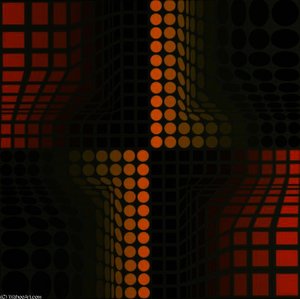
- Subject Matter: The artwork centers around a meticulously rendered sphere, its surface punctuated by a complex grid pattern. This seemingly simple arrangement is deliberately constructed to create an illusion of movement and depth, a hallmark of Op Art’s technique.
- Style & Technique: Vasarely's signature style – characterized by precise geometric forms and vibrant color contrasts – is fully realized here. The sphere isn't merely painted; it’s built up through layers of carefully applied paint, creating subtle variations in tone that enhance the illusion of three-dimensionality. The grid pattern, executed with remarkable accuracy, adds a dynamic tension to the composition, drawing the eye across the surface and further stimulating visual perception.
The Rise of Op Art and Vasarely’s Vision
“Abstract Composition 9” emerged from a pivotal moment in art history – the mid-20th century's fascination with optical illusions and the exploration of how the eye perceives space. Influenced heavily by the Bauhaus movement, particularly its emphasis on functional design and geometric abstraction, Vasarely sought to translate scientific theories about visual perception into tangible artistic forms. He was deeply interested in the work of M.C. Escher and other artists exploring similar themes, but he developed a uniquely rigorous approach, utilizing mathematical principles to construct his compositions. This dedication to precision is evident in every element of “Abstract Composition 9,” contributing to its enduring impact.
The creation of this piece reflects the broader cultural context of the time – a period marked by rapid technological advancements and an increasing awareness of the power of visual stimuli. Vasarely’s work anticipated many of the concerns raised by later movements in art and design, exploring the relationship between technology, perception, and the human experience.
Symbolism and Emotional Impact
While ostensibly abstract, “Abstract Composition 9” resonates with profound symbolic meaning. The sphere itself can be interpreted as representing wholeness, unity, or even the cosmos – a fundamental building block of existence. The grid pattern, conversely, suggests order, structure, and perhaps even control. The interplay between these two elements creates a dynamic tension that invites contemplation.
Vasarely’s work isn't about creating pretty pictures; it’s about provoking a visceral response in the viewer. The illusion of movement, the shifting perspectives, and the bold color contrasts all contribute to an experience that is both intellectually stimulating and emotionally engaging. The piece invites us to question our own perceptions and to consider the ways in which we construct reality.
A Timeless Masterpiece – Perfect for Your Space
"Abstract Composition 9" by Victor Vasarely represents a cornerstone of modern art, offering a captivating blend of geometric precision and perceptual illusion. Its bold aesthetic and intellectual depth make it an ideal addition to any discerning collection or interior design scheme. WahooArt offers meticulously crafted hand-painted reproductions that faithfully capture the essence of this iconic work, allowing you to bring its dynamic energy into your home or office.



 Zobacz w skali 1:1
 Przełącz na wersję drukowaną
 Wyślij
 Udostępnij
 Szczegóły
 Przewodnik

 Pobierz plik obrazu
 Podobne obiekty
 RTG
RTG Pokaz slajdów
 Statystyki

 Czytaj więcej






































 Opcja ze szkłem jest dostępna wyłącznie w rozmiarach poniżej 110 cm