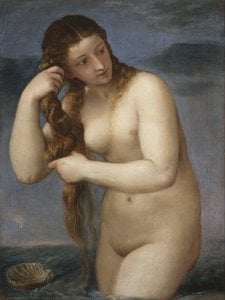
A Renaissance Echo in American Shores: Titian Ramsay Peale II’s “St. Gregory the Great”
Titian Ramsay Peale II's "St. Gregory the Great" is more than just a portrait; it’s a fascinating intersection of artistic lineage, historical reverence, and a distinctly American interpretation of European Renaissance ideals. Painted by an artist deeply embedded in a family tradition of art – as the son of renowned portraitist Charles Willson Peale – this work reveals a dedication to classical form and meticulous detail that sets it apart within the landscape of 19th-century American painting. The image presents Pope Gregory I, a pivotal figure of the early Church, depicted with an air of scholarly contemplation. He is shown crowned, signifying his papal authority, yet his gaze is directed downwards, focused on the book – likely a Bible – held in his hands. This gesture isn’t one of ostentatious power, but rather of quiet devotion and intellectual pursuit. The inclusion of two birds, subtly placed within the composition, adds an intriguing layer to the scene; often symbolizing peace or spiritual aspiration, their presence invites contemplation on themes of faith and divine connection.
The Peale Legacy and a High Renaissance Revival
To understand “St. Gregory the Great,” one must consider the artistic environment from which it emerged. The Peale family were pioneers in American art, establishing a dynasty that spanned generations and encompassed portraiture, still life, and natural history illustration. Titian Ramsay Peale II, however, distinguished himself through his deliberate embrace of the High Renaissance aesthetic – a style characterized by its emphasis on balance, harmony, and idealized forms. This wasn’t merely imitation; it was a conscious effort to bring the grandeur of Italian masters like Raphael and Leonardo da Vinci to American canvases. Peale's technique demonstrates a mastery of oil paint, applied with precision to create a sense of depth and realism. The careful rendering of fabrics, the subtle modeling of the face, and the delicate details within the book all speak to an artist thoroughly versed in classical principles. While his father was known for capturing the likenesses of prominent Americans, Titian Ramsay Peale II often turned towards religious subjects, imbuing them with a quiet dignity and spiritual resonance.
Symbolism and Spiritual Resonance
The choice of St. Gregory the Great as a subject is itself significant. Gregory I was not only a powerful pope but also a prolific writer, theologian, and reformer who played a crucial role in shaping medieval Europe. He’s often credited with standardizing Gregorian chant, which continues to be central to Catholic liturgy today. The painting subtly alludes to these facets of Gregory's life. His focused study suggests his intellectual contributions, while the crown acknowledges his leadership within the Church. The birds, as mentioned earlier, introduce a delicate symbolism of peace and spiritual freedom – qualities often associated with Gregory’s pastoral care and theological teachings. It is important to note that Peale was also a naturalist, deeply interested in the natural world; this sensitivity likely informed his inclusion of these avian details, imbuing them with symbolic weight beyond mere decorative elements. The overall effect isn't one of grand spectacle but rather of intimate devotion, inviting viewers into a moment of quiet contemplation alongside the saint.
Rediscovering a Forgotten Voice
For many years, Titian Ramsay Peale II remained somewhat overshadowed by his more famous father and brother, Rembrandt Peale. However, recent scholarship has begun to illuminate his unique contributions to American art. His dedication to the High Renaissance style, combined with his skill as a naturalist and portraitist, created a distinctive artistic voice that deserves greater recognition. “St. Gregory the Great” stands as a testament to this talent – a beautifully executed painting that embodies both classical ideals and a distinctly American sensibility. It’s a work that speaks not only to the power of faith but also to the enduring legacy of art and its ability to connect us with the past, offering moments of beauty and contemplation in an increasingly complex world.



 Zobacz w skali 1:1
 Przełącz na wersję drukowaną
 Wyślij
 Udostępnij
 Szczegóły
 Przewodnik

 Pobierz plik obrazu
 Podobne obiekty
 RTG
RTG Pokaz slajdów
 Statystyki


 Czytaj więcej