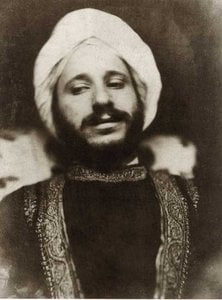
Biografia artysty
A Life Shrouded in Beauty and Scandal: The World of Simeon Solomon
Simeon Solomon, a name whispered with both reverence and regret within the annals of Victorian art, occupies a unique and often tragic position amongst the Pre-Raphaelites. Born in London in 1840 into a prominent Jewish family – the eighth and final child of merchant Michael (Meyer) Solomon and artist Catherine (Kate) Levy – his life was one of remarkable artistic promise tragically curtailed by societal prejudice and personal demons. Unlike many of his contemporaries who enjoyed long and celebrated careers, Solomon’s trajectory was abruptly altered by scandal, yet his work continues to captivate with its delicate beauty, evocative symbolism, and poignant exploration of themes often considered taboo for the era. He wasn't merely a painter; he was a cultural mirror reflecting the complexities of Victorian England, grappling with faith, desire, and identity in a rapidly changing world.
Early Influences and Artistic Development
Solomon’s artistic education began within his own family circle. His mother possessed an amateur talent for miniature painting, while his elder siblings, Abraham and Rebecca Solomon, were both established artists exhibiting at the Royal Academy. It was from them, particularly his brother Abraham, that Simeon received his initial training, learning the fundamentals of draftsmanship and composition. He formally studied at Carey’s Art Academy in 1852 before entering the prestigious Royal Academy Schools in 1856. This period proved pivotal, as it introduced him to the burgeoning Pre-Raphaelite Brotherhood through Dante Gabriel Rossetti. The encounter with Rossetti, along with friendships forged with Edward Burne-Jones and Algernon Charles Swinburne, profoundly shaped Solomon’s artistic sensibilities. He embraced their commitment to detailed realism, vibrant color palettes, and a fascination with literature, mythology, and religious narratives. Early works like *Isaac Offered* (1858) demonstrate this initial influence, showcasing a meticulous attention to detail and a dramatic narrative style characteristic of the Pre-Raphaelites. However, Solomon quickly began to forge his own path, infusing his paintings with a distinctly personal vision.
The Pre-Raphaelite Brotherhood and Artistic Exploration
Solomon’s involvement with Rossetti and Burne-Jones cemented his place within the influential Pre-Raphaelite Brotherhood. This group championed artistic ideals rooted in medieval art—a rejection of academic conventions favoring instead meticulous observation and expressive color—and drew inspiration from literature, folklore, and biblical stories. Solomon's paintings frequently incorporated these elements, reflecting a deep engagement with both religious iconography and classical mythology. He skillfully blended realism with imaginative embellishment, creating scenes imbued with spiritual depth and emotional resonance. His artistic explorations extended beyond mere representation; he sought to convey profound psychological states and philosophical ideas through his canvases. Consider *Moses* (1860), where Solomon captures the solemn dignity of Moses confronting God—a testament to the Brotherhood’s fascination with biblical narratives and its dedication to conveying spiritual truth. Similarly, *Shadrach, Meshach, and Abednego* (1863) exemplifies his masterful use of color and composition to depict a dramatic episode from Daniel, highlighting themes of faith and perseverance.
Themes of Faith, Desire, and Identity – A Bold Vision
Solomon’s artistic output was remarkably diverse, encompassing biblical scenes, classical mythology, and genre paintings depicting Jewish life and rituals. He found particular inspiration in the Hebrew Bible, creating works such as *Moses* (1860) and *Shadrach, Meshach, and Abednego* (1863), which resonated with his own cultural heritage. Yet, it was his exploration of classical themes that truly set him apart. Paintings like *In the Temple of Venus* (1863) and *Bacchus* (1867) reveal a fascination with sensuality and beauty, often imbued with an undercurrent of melancholy and longing. These works also hint at Solomon’s growing interest in same-sex desire, a theme he would explore more explicitly – and dangerously – throughout his career. His association with Algernon Charles Swinburne, whose poetry celebrated unconventional love and challenged Victorian morality, undoubtedly fueled this exploration. Solomon's art became a subtle yet powerful commentary on the constraints of Victorian society, hinting at hidden passions and unspoken desires. He was one of the first artists to openly depict homoerotic themes, albeit often veiled in classical allegory or biblical narrative.
Scandal and Decline – A Tragic Finale
The year 1873 marked a devastating turning point in Solomon’s life. His arrest in a public urinal for attempting to commit sodomy brought swift and brutal consequences. Though he received a relatively light fine, the scandal shattered his reputation and effectively ended his career as a publicly exhibited artist. A subsequent arrest in Paris in 1874 led to a three-month prison sentence. Shunned by much of the art establishment, Solomon descended into alcoholism and poverty. Despite these hardships, he continued to paint, albeit often under difficult circumstances. He found support from a small circle of admirers – including Oscar Wilde, John Addington Symonds, and Walter Pater – who recognized his talent and collected his works in private. He spent time in the St Giles Workhouse, continuing to create art even amidst hardship. His death in 1905, resulting from complications related to alcoholism, went largely unnoticed by the wider public. However, Solomon’s legacy persists—a testament to artistic courage and a poignant reminder of the fragility of freedom. His paintings now reside in prominent collections such as the Victoria and Albert Museum, Wightwick Manor, and Leighton House, ensuring that his unique vision continues to inspire and provoke thought for generations to come. His story serves as a tragic illustration of how societal prejudice can extinguish brilliant talent and diminish an artist’s contribution to cultural history



 Podgląd w skali 1:1
 Zamów ręcznie malowaną reprodukcję
 Wyślij jako kartkę
 Udostępnij
 Szczegóły dzieła
 Przewodnik

 Pobierz obraz
 Podobne obiekty
 RTG
RTG Pokaz slajdów
 Statystyki


 Rozwiń treść






































 Opcja ze szkłem jest dostępna wyłącznie w rozmiarach poniżej 110 cm