The Weight of Judgment: Rogier van der Weyden’s “The Last Judgment” – A Descent into Emotion
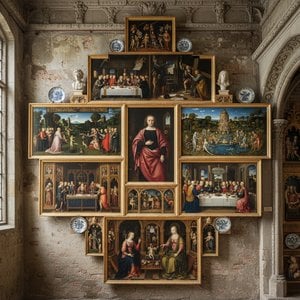
Rogier van der Weyden's "The Last Judgment," a pivotal detail from the monumental Polyptych housed in Beaune, France, isn’t merely a depiction of divine retribution; it’s a visceral exploration of human despair and the terrifying weight of mortality. Completed around 1446-47, this fragment captures a moment suspended between earthly suffering and eternal consequence – a scene rendered with an unprecedented level of psychological realism for its time. Van der Weyden, already renowned for his emotionally charged portraits, elevates the theological subject matter to a profoundly human experience, forcing the viewer to confront their own potential fate.
The image itself is dominated by a group of figures caught in varying states of anguish and terror. Naked bodies writhe and scream, not with violent defiance, but with a palpable sense of helplessness and regret. The composition isn’t one of triumphant judgment; instead, it's a chaotic swirl of souls being drawn towards an unseen abyss. Notice the subtle shifts in expression – the wide-eyed horror, the desperate pleas, the resigned acceptance – each conveying a unique narrative of individual guilt and sorrow. Van der Weyden masterfully utilizes color to heighten this emotional intensity: the stark contrast between the pale flesh of the damned and the darker hues surrounding them emphasizes their separation from salvation.
A Masterclass in Anatomical Detail and Emotional Resonance
Van der Weyden’s technical skill is immediately apparent. He was a goldsmith before becoming a painter, and this training instilled within him an unwavering dedication to meticulous detail – a trait that shines through in every brushstroke. The musculature of the figures is rendered with astonishing accuracy, reflecting his deep understanding of human anatomy. However, it's not merely anatomical precision that defines his style; it’s the way he uses form to convey emotion. The strained muscles, the contorted faces, and the desperate gestures all contribute to a powerful sense of drama and immediacy.
The background, a turbulent expanse of clouds, serves as a visual metaphor for the chaos and uncertainty of judgment day. These aren’t idealized heavens; they are dark, ominous, and filled with an unsettling energy. The use of atmospheric perspective – the subtle blurring of details in the distance – further enhances the sense of depth and drama. Van der Weyden's innovative approach to depicting light and shadow creates a truly immersive experience for the viewer, drawing them into the heart of this harrowing scene.
Symbolism and Spiritual Weight: The Polyptych’s Broader Context
"The Last Judgment" is but one panel within the larger Beaune Polyptych, commissioned by Nicolas Rolin, a wealthy Burgundian chancellor seeking salvation for himself and his family. The entire polyptych functions as a visual sermon, guiding viewers through the stages of human existence and ultimately towards divine grace. The reverse side of this panel, depicting the Annunciation, offers a stark contrast – a scene of hope and new beginnings, highlighting the cyclical nature of life and death.
The central figure, Christ, seated on a rainbow, embodies both judgment and mercy. His gaze is direct and unwavering, yet there’s also an expression of profound sorrow as he witnesses the suffering of humanity. The scales held by Michael, the Archangel, represent the weighing of souls – a potent symbol of divine justice. The inclusion of saints like Saint Sebastian and Saint Lawrence, each bearing the marks of their martyrdom, reinforces the theme of sacrifice and redemption. This polyptych wasn’t intended to be passively observed; it was designed to provoke contemplation and inspire a deep sense of spiritual awareness.
Bringing “The Last Judgment” Home: A WahooArt Reproduction
WahooArt offers meticulously crafted, hand-painted reproductions of Rogier van der Weyden's "The Last Judgment" that capture the essence of this extraordinary artwork. Using traditional oil painting techniques and archival-quality materials, our artists recreate Van der Weyden’s masterful details and emotional depth with unparalleled accuracy. Whether you seek a stunning addition to your art collection or a captivating centerpiece for your interior design scheme, a WahooArt reproduction provides an authentic and enduring representation of this iconic masterpiece. Explore the full artwork on our website to discover the perfect size and canvas option for your space.



 Zobacz w skali 1:1
 Przełącz na wersję drukowaną
 Wyślij
 Udostępnij
 Szczegóły
 Przewodnik

 Pobierz plik obrazu
 Podobne obiekty
 RTG
RTG Pokaz slajdów
 Statystyki


 Czytaj więcej






































 Opcja ze szkłem jest dostępna wyłącznie w rozmiarach poniżej 110 cm