Zobacz w skali 1:1 Zobacz w AR Kup ręcznie malowany obraz Przełącz na wersję cyfrową Wyślij
Szczegóły Przewodnik Dodaj do ulubionych Pobierz plik obrazu Podobne obiekty RTG Pokaz slajdów Statystyki

Concrete Cabin

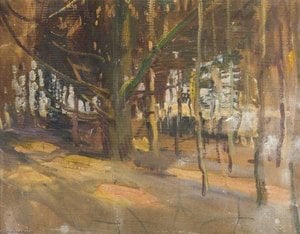
Peter Doig's 'Concrete Cabin' (1992) blends nature & human presence. A forest scene with twisted trees and a stark concrete structure creates an intriguing narrative of memory, landscape, and the transient impact on our environment.

Peter Doig – słynny szkocki malarz znany z melancholijnych krajobrazów i figuratywnych obrazów inspirowanych wspomnieniami, fotografią i sztuką historyczną. Jego surrealistyczne pejzaże Kanady i Trinidada definiują współczesny styl.

Dzieło sztuki prezentowane na tej stronie podlega ochronie prawem autorskim, co oznacza, że nie mamy prawa do tworzenia ani sprzedaży jego identycznej reprodukcji. Ochrona ta jest egzekwowana na mocy umów międzynarodowych, takich jak Konwencja berneńska oraz przez przepisy prawa krajowego, w tym te określone w Prawo autorskie USA – Tytuł 17.

Metoda ta jest w pełni zgodna z przepisami prawa autorskiego, ponieważ nie polega na kopiowaniu ani powielaniu chronionego dzieła. Stanowi ona kreatywną reinterpretację – nowy obraz, który czerpie inspirację z oryginału, ale nie jest z nim tożsamy.

Giclée / Wydruk artystyczny

Wydruki giclée lub płótna o jakości muzealnej, szybka realizacja i szeroki wybór opcji wykończenia. ( Kup ręcznie malowany obraz Przełącz na wersję cyfrową)

Corner sample of the P118B picture frame: polistyren formowany, 5 cm wide and 3 cm thick
P118B zł10
Corner sample of the P118H picture frame: polistyren formowany, 5 cm wide and 3 cm thick
P118H zł10
Corner sample of the P118W picture frame: polistyren formowany, 5 cm wide and 3 cm thick
P118W zł10
Corner sample of the P438Z picture frame: polistyren formowany, 5.5 cm wide and 3.5 cm thick
P438Z zł10
Corner sample of the P508JH picture frame: polistyren formowany, 7 cm wide and 3.5 cm thick
P508JH zł12
Corner sample of the P508YH picture frame: polistyren formowany, 7 cm wide and 3.5 cm thick
P508YH zł12
Corner sample of the P805H picture frame: polistyren formowany, 5 cm wide and 3.5 cm thick
P805H zł10
Corner sample of the P805Z picture frame: polistyren formowany, 5 cm wide and 3.5 cm thick
P805Z zł10
Corner sample of the P919BZ picture frame: polistyren formowany, 7 cm wide and 3.5 cm thick
P919BZ zł10
Corner sample of the P919G picture frame: polistyren formowany, 7 cm wide and 3.5 cm thick
P919G zł10
Corner sample of the P919XJ picture frame: polistyren formowany, 7 cm wide and 3.5 cm thick
P919XJ zł10
Corner sample of the P959ZH picture frame: polistyren formowany, 5 cm wide and 3 cm thick
P959ZH zł10
Corner sample of the P968JZ picture frame: polistyren formowany, 6 cm wide and 4 cm thick
P968JZ zł12
Corner sample of the W106C picture frame: lite drewno, 5 cm wide and 3 cm thick
W106C zł8
Corner sample of the W218G picture frame: lite drewno, 5 cm wide and 3 cm thick
W218G zł10
Corner sample of the W218JH picture frame: lite drewno, 5 cm wide and 3 cm thick
W218JH zł8
Corner sample of the W218Y picture frame: lite drewno, 5 cm wide and 3 cm thick
W218Y zł10
Corner sample of the W307PJ picture frame: lite drewno, 6 cm wide and 3 cm thick
W307PJ zł10
Corner sample of the W316G picture frame: lite drewno, 6 cm wide and 3 cm thick
W316G zł10
Corner sample of the W316PJ picture frame: lite drewno, 6 cm wide and 3 cm thick
W316PJ zł8
Corner sample of the W316Y picture frame: lite drewno, 6 cm wide and 3 cm thick
W316Y zł10
Corner sample of the W398PJ picture frame: lite drewno, 5 cm wide and 3 cm thick
W398PJ zł8
Corner sample of the W4111J picture frame: lite drewno, 6.5 cm wide and 3.5 cm thick
W4111J zł10
Corner sample of the W500HY picture frame: lite drewno, 7 cm wide and 5 cm thick
W500HY zł15
Corner sample of the W500JH picture frame: lite drewno, 7 cm wide and 5 cm thick
W500JH zł15
Corner sample of the W692G picture frame: lite drewno, 8 cm wide and 4 cm thick
W692G zł12
Corner sample of the W849H picture frame: lite drewno, 5 cm wide and 3 cm thick
W849H zł8
Corner sample of the W940BG picture frame: lite drewno, 7.5 cm wide and 4.5 cm thick
W940BG zł15
Corner sample of the W953PJ picture frame: lite drewno, 6 cm wide and 3.5 cm thick
W953PJ zł8

Standardowy
na zamówienie
CM
INCH

Wybierz spośród naszych standardowych rozmiarów, które zachowują oryginalne proporcje dzieła sztuki.

szerokość
wysokość

Wpisz wymaganą szerokość i wysokość, aby dopasować grafikę do ramy lub ściany. Wydruk można jedynie przyciąć, nigdy nie powiększając go poza oryginalny obraz, dlatego format o innym proporcji spowoduje utratę części kompozycji. Przed rozpoczęciem druku prześlemy Ci cyfrowy podgląd do zatwierdzenia. Obraz wyświetlany na tej stronie nie pokazuje rzeczywistego przycięcia — jedynie podgląd oddaje ten efekt.

Dostawa na cały świat () w ciągu 2 tygodni zamiast standardowych 4/5 tygodni. (24 Październik)

Bezpłatna ekspresowa wysyłka na cały świat
Wysokiej jakości płótno lniane
Pełne ubezpieczenie transportowe
Gwarancja zwrotu należności celnych i podatków importowych
Gwarancja idealnego odwzorowania barw
100-dniowy okres na zwrot dzieła w przypadku wykrycia wad produkcyjnych
Gwarancja 100% zwrotu pieniędzy
Oferta przy zakupie wielu sztuk

Cena całkowita

zł 261

Concrete Cabin

Giclée / Wydruk artystyczny

Rozmiar reprodukcji

-

Suma do zapłaty

zł 261

Kluczowe informacje

  • Dimensions: 201 x 241 cm
  • Subject or theme: Nature and human habitation
  • Medium: Oil on canvas
  • Title: Concrete Cabin
  • Notable elements or techniques:
    • Twisted tree trunks
    • Dense foliage
    • Contrast of natural/man-made

Concrete Cabin: A Landscape of Memory and Modernity

Peter Doig’s "Concrete Cabin," painted in 1992, is more than just a depiction of a forest scene; it's an exploration of memory, the interplay between nature and human intervention, and the subtle anxieties of modernity. The canvas presents a dense woodland, rendered with a distinctive looseness that evokes both the vibrancy of Impressionism and the unsettling ambiguity of Magic Realism. Towering trees, their trunks twisted and gnarled like ancient sentinels, dominate the foreground, painted in deep browns and blacks punctuated by hints of decay – a visual testament to the relentless passage of time and the forces of nature. The background dissolves into a tapestry of greens, suggesting an impenetrable canopy that stretches far beyond the viewer's gaze. This isn’t merely a representation of a forest; it’s a feeling—a sense of being enveloped by something vast, ancient, and slightly unknowable.

The Intrusion of the Man-Made

What truly sets "Concrete Cabin" apart is its unexpected element: a stark concrete structure nestled amongst the trees. This isn't a rustic log cabin blending seamlessly into its surroundings; it’s a blocky, almost brutalist form that clashes with the organic curves and textures of the forest. The contrast is deliberate, highlighting the uneasy relationship between humanity and the natural world. It speaks to our tendency to impose order and structure onto landscapes, often at the expense of their inherent wildness. Is this a refuge? A symbol of isolation? Or perhaps a commentary on the encroachment of modern life upon pristine environments? Doig offers no easy answers, leaving the interpretation open to the viewer's own experiences and anxieties. The concrete itself is rendered with more rigid lines and solid blocks of color than the surrounding foliage, emphasizing its artificiality and further amplifying the sense of discord.

Doig’s Technique: Evoking Atmosphere Through Paint

Doig’s artistic technique plays a crucial role in conveying the painting's emotional weight. He employs a distinctive layering of paint, allowing brushstrokes to remain visible—a hallmark of his style. This isn’t about meticulous detail; it’s about capturing the *essence* of the scene through texture and color. The loose application of paint creates a sense of movement and vitality, as if the forest itself is breathing. Light filters through the canopy in dappled patterns, adding depth and dimension to the composition. Doig's use of color isn't purely representational; he manipulates hues to evoke specific moods—the somber browns and blacks conveying a sense of mystery and introspection, while the vibrant greens suggest both life and an underlying tension. The overall effect is one of atmospheric immersion – drawing the viewer into the heart of this enigmatic landscape.

A Landscape Rooted in Memory and Place

Born in Edinburgh but shaped by his experiences living in Trinidad and Canada, Doig’s work often draws upon personal memories and a sense of displacement. "Concrete Cabin" can be seen as reflecting these themes—a meditation on the places that linger within us long after we've left them. The painting isn't necessarily about a specific location; it's about the feeling of being both connected to and alienated from one’s surroundings. It resonates with a broader sense of unease about our place in the world, particularly as we grapple with the consequences of environmental change and the relentless march of progress. Ultimately, "Concrete Cabin" is a powerful and evocative work that invites us to contemplate the complex relationship between humanity, nature, and memory—a timeless theme rendered with remarkable skill and sensitivity by one of contemporary art's most compelling voices.

Pytania i odpowiedzi

Jaki to rodzaj dzieła: "Concrete Cabin"?

"Concrete Cabin" to dzieło typu WallArt.

Któremu artyście przypisuje się "Concrete Cabin"?

Dzieło "Concrete Cabin" przypisuje się Peter Doig.

W jaki sposób "Concrete Cabin" balansuje światło i cień?

Zarejestrowane wartości dla „Concrete Cabin” autorstwa Peter Doig to: jasność deep_shadow, luminancja Dark.


Biografia artysty

Peter Doig - A Life Painted in Memory

Peter Doig (/ˈdɔɪɡ/; born April 17, 1959) is a British painter who has lived and worked between England, Scotland, Trinidad, Canada, the USA and Germany. His work resonates with a quiet power—a haunting beauty that stems from the delicate balance between memory, landscape, and the evocative potential of paint itself. His life has been one of constant relocation, a nomadic existence that profoundly shaped his artistic vision. Early moves took him from Scotland to Trinidad in 1962, followed by Canada in 1966, each shift imprinting upon his developing sensibility a sense of displacement and a fascination with the way places linger within us long after we’ve left them. These weren’t fleeting visits; they were immersive experiences that instilled a deep connection to diverse cultural landscapes—the lush tropicality of Trinidad, the stark, snowy vistas of Canada—both becoming recurring motifs in his art. This early exposure fostered an ability to see beyond the literal, to perceive the emotional weight and psychological resonance embedded within a place. Doig’s formal artistic training began in London, attending Wimbledon School of Art, Saint Martin’s School of Art, and finally Chelsea School of Art where he earned his MA. These years were supplemented by practical work, including a period as a dresser at the English National Opera, experiences that undoubtedly broadened his understanding of performance, narrative, and visual storytelling.

Early Life and Influences

Born in Edinburgh, Scotland, Peter Doig’s father was a shipping merchant, necessitating the Doig family travel frequently—a transitory childhood marked by constant movement. This itinerant upbringing instilled within him a profound sensitivity to place and an awareness of how memory shapes perception. He developed his artistic talent early on, experimenting with drawing and exploring various mediums before embarking on his formal studies at Wimbledon School of Art in 1979-80 and Saint Martin’s School of Art from 1980-83. These formative years exposed him to influential artists whose work captivated his imagination—Edvard Munch's expressive landscapes, Caspar David Friedrich's sublime vistas, Claude Monet's luminous Impressionism—artists who championed the power of observation and the emotional resonance of visual experience. Doig’s artistic trajectory was shaped by a desire to capture not just what he saw but also how it *felt*, prioritizing materiality of the painting medium and rejecting conceptual approaches prevalent in his peers.

The Emergence of Landscape Painting

Doig's breakthrough as a painter began in 1990, while pursuing his MA at Chelsea School of Art—a pivotal moment that solidified his commitment to figurative painting with an emphasis on landscape. He drew inspiration from his own childhood memories of Canada—snowy forests, frozen lakes, isolated cabins—translating these experiences into canvases imbued with a palpable sense of nostalgia and mystery. Doig’s technique is characterized by complex layering of paint and color, creating depth and atmosphere. He skillfully blends abstraction and figuration, allowing forms to dissolve into washes of color or emerge from textured surfaces—a stylistic hallmark that distinguishes his work from many contemporaries. As Doig explained, “There exists a tension…between the often generic representation of a pastoral scene and the investment in my own experiences of the landscape.” This approach allows him to tap into a deeper level of psychological truth, creating landscapes that are not merely seen but *felt*.

Notable Achievements and Recognition

Doig gained international acclaim in 1994 when he was nominated for the prestigious Turner Prize—a recognition that propelled him to prominence within the contemporary art world. His distinctive style—sensuous color palettes and evocative imagery—quickly garnered critical praise and established him as one of Britain’s most celebrated painters. Since then, Doig has continued to refine his craft, exploring themes of memory, displacement, and identity through meticulously rendered landscapes and portraits. He achieved considerable success at auction in 2007 with “White Canoe,” selling for $11.3 million—a record for a living European artist at the time—and further solidified his reputation as an artistic visionary. Major solo exhibitions have been held at Tate Britain, Musée d’Art Moderne de la Ville de Paris, Schirn Kunsthalle Frankfurt, Dallas Museum of Art and the Scottish National Gallery, demonstrating the global reach of his influence. Doig remains active in Düsseldorf, Germany, where he teaches painting at the School of Art—a testament to his enduring passion for artistic exploration and a legacy destined to inspire generations of artists to come.

Peter Doig

Peter Doig

1959 - , Wielka Brytania

Najważniejsze informacje

  • Artistic Movement Or Style: Figurative painting
  • Artists Who Influenced This Artist:
    • Edvard Munch
    • Caspar David Friedrich
    • Claude Monet
  • Date Of Birth: 1959
  • Full Name: Peter Doig
  • Nationality: Scottish
  • Notable Artworks:
    • White Canoe
    • Ski Jacket
    • Border House
  • Place Of Birth: Edinburgh, UK
Odkryj dzieła sztuki uporządkowane według tematów, stylów i cech charakterystycznych.