Zobacz w skali 1:1 Zobacz w AR Przełącz na wersję drukowaną Przełącz na wersję cyfrową Wyślij
Szczegóły Przewodnik Dodaj do ulubionych Pobierz plik obrazu Podobne obiekty RTG Pokaz slajdów Statystyki

Untitled

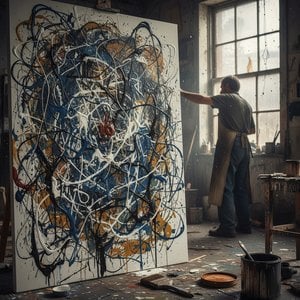
Jackson Pollock’s ‘Untitled’ (1941) explodes with dynamic energy & raw emotion. Explore this abstracted expressionist piece featuring swirling lines, red accents, and fragmented figures. A captivating work by a legendary artist.

Paul Jackson Pollock (1912-1956) – amerykański malarz, pionier ekspresjonizmu abstrakcyjnego i techniki "dripping". Znany z dynamicznych, spontanicznych obrazów, które rewolucjonizowały sztukę XX wieku. #Pollock #sztukaabstraktna

Ręcznie malowana reprodukcja olejowa

Ręcznie malowany obraz olejny na płótnie, wykonany na zamówienie przez naszych artystów w wybranym przez Ciebie wymiarze i oprawie. ( Przełącz na wersję drukowaną Przełącz na wersję cyfrową)

Corner sample of the P118B picture frame: polistyren formowany, 5 cm wide and 3 cm thick
P118B 10
Corner sample of the P118H picture frame: polistyren formowany, 5 cm wide and 3 cm thick
P118H 10
Corner sample of the P118W picture frame: polistyren formowany, 5 cm wide and 3 cm thick
P118W 10
Corner sample of the P438Z picture frame: polistyren formowany, 5.5 cm wide and 3.5 cm thick
P438Z 10
Corner sample of the P508JH picture frame: polistyren formowany, 7 cm wide and 3.5 cm thick
P508JH 12
Corner sample of the P508YH picture frame: polistyren formowany, 7 cm wide and 3.5 cm thick
P508YH 12
Corner sample of the P805H picture frame: polistyren formowany, 5 cm wide and 3.5 cm thick
P805H 10
Corner sample of the P805Z picture frame: polistyren formowany, 5 cm wide and 3.5 cm thick
P805Z 10
Corner sample of the P919BZ picture frame: polistyren formowany, 7 cm wide and 3.5 cm thick
P919BZ 10
Corner sample of the P919G picture frame: polistyren formowany, 7 cm wide and 3.5 cm thick
P919G 10
Corner sample of the P919XJ picture frame: polistyren formowany, 7 cm wide and 3.5 cm thick
P919XJ 10
Corner sample of the P959ZH picture frame: polistyren formowany, 5 cm wide and 3 cm thick
P959ZH 10
Corner sample of the P968JZ picture frame: polistyren formowany, 6 cm wide and 4 cm thick
P968JZ 12
Corner sample of the W106C picture frame: lite drewno, 5 cm wide and 3 cm thick
W106C 8
Corner sample of the W218G picture frame: lite drewno, 5 cm wide and 3 cm thick
W218G 10
Corner sample of the W218JH picture frame: lite drewno, 5 cm wide and 3 cm thick
W218JH 8
Corner sample of the W218Y picture frame: lite drewno, 5 cm wide and 3 cm thick
W218Y 10
Corner sample of the W307PJ picture frame: lite drewno, 6 cm wide and 3 cm thick
W307PJ 10
Corner sample of the W316G picture frame: lite drewno, 6 cm wide and 3 cm thick
W316G 10
Corner sample of the W316PJ picture frame: lite drewno, 6 cm wide and 3 cm thick
W316PJ 8
Corner sample of the W316Y picture frame: lite drewno, 6 cm wide and 3 cm thick
W316Y 10
Corner sample of the W398PJ picture frame: lite drewno, 5 cm wide and 3 cm thick
W398PJ 8
Corner sample of the W4111J picture frame: lite drewno, 6.5 cm wide and 3.5 cm thick
W4111J 10
Corner sample of the W500HY picture frame: lite drewno, 7 cm wide and 5 cm thick
W500HY 15
Corner sample of the W500JH picture frame: lite drewno, 7 cm wide and 5 cm thick
W500JH 15
Corner sample of the W692G picture frame: lite drewno, 8 cm wide and 4 cm thick
W692G 12
Corner sample of the W849H picture frame: lite drewno, 5 cm wide and 3 cm thick
W849H 8
Corner sample of the W940BG picture frame: lite drewno, 7.5 cm wide and 4.5 cm thick
W940BG 15
Corner sample of the W953PJ picture frame: lite drewno, 6 cm wide and 3.5 cm thick
W953PJ 8

Standardowy
na zamówienie
CM
INCH

Wybierz spośród naszych standardowych rozmiarów, które zachowują oryginalne proporcje dzieła sztuki.

szerokość
wysokość

Wpisz wymaganą szerokość i wysokość, aby obraz pasował do Twojej ramy lub ściany. Ponieważ jest to dzieło malowane ręcznie, w przypadku rozmiaru o innym proporcji artysta może domalować nieco więcej wokół obrazu lub przyciąć fragmenty — wybór należy do Ciebie. Przed rozpoczęciem pracy prześlemy Ci cyfrową wizualizację do zatwierdzenia. Obraz widoczny na tej stronie nie przedstawia rzeczywistego efektu — jedynie wizualizacja oddaje realny rezultat.

Przykłady możliwych zmian: Zamień twarz na zdjęcie klienta; Dodaj zwierzę domowe (np. zamień kota na psa); Ukryj wiadomość w tle; Zmień krajobraz lub elementy tła.
Po złożeniu zamówienia zespół WahooArt.com skontaktuje się z klientem drogą mailową w celu uzyskania instrukcji i prześle wizualizację projektu

Dostawa na całym świecie () w ciągu 3–4 tygodni zamiast standardowych 5 tygodni. (20 Październik). Bez kompromisów w kwestii jakości.

Bezpłatna ekspresowa wysyłka na cały świat
Wysokiej jakości płótno lniane
Pełne ubezpieczenie transportowe
Gwarancja zwrotu należności celnych i podatków importowych
Gwarancja idealnego odwzorowania barw
100-dniowy okres na zwrot dzieła w przypadku wykrycia wad produkcyjnych
Gwarancja 100% zwrotu pieniędzy
Oferta przy zakupie wielu sztuk

Cena całkowita

zł 1031

Untitled

Technika wykonania

Rozmiar reprodukcji

-

Suma do zapłaty

zł 1031

Kluczowe informacje

  • artist: Jackson Pollock
  • dimensions: 35 x 279 cm
  • medium: Charcoal and colored pencils (potentially)
  • subject: Intimate embrace, close relationship (possibly romantic or familial)

Quiz wiedzy o sztuce

Do każdego pytania dotyczy tylko jedna poprawna odpowiedź.

Pytanie 1:
Based on the description, what artistic movements most strongly influenced this work by Jackson Pollock?
Pytanie 2:
What is a prominent characteristic of the composition described in the artwork's analysis?
Pytanie 3:
The description notes a limited color palette. Which colors are specifically highlighted as being used in the artwork?
Pytanie 4:
Considering Pollock's later work, how does this piece (created in 1941) differ from his famous 'drip paintings'?
Pytanie 5:
What is suggested as the primary focus of this artwork, according to the description?

A Moment Suspended: Exploring Jackson Pollock’s 1941 Untitled Work

This striking work by Jackson Pollock, created in 1941, offers a fascinating glimpse into the artist's formative years – a period bridging traditional figuration and the revolutionary abstract style he would later pioneer. Measuring an expansive 35 x 279 cm, this piece is not merely a drawing; it’s a visceral exploration of human connection rendered through a burgeoning artistic vocabulary.

Subject & Composition: Intimacy in Fragmentation

The artwork depicts two figures locked in a close embrace. However, Pollock deliberately eschews realistic representation. Instead, he presents us with an *impression* of intimacy – a swirling vortex of lines and fragmented shapes that suggest bodies intertwined rather than explicitly defining them. The composition is dynamic, almost violently so, conveying a sense of passionate energy. There’s no background to speak of; the figures exist within a flattened plane, intensifying the focus on their interaction and emotional state. This lack of spatial definition contributes to the work's unsettling yet captivating quality.

Style & Technique: Echoes of Expressionism and Cubism

Dating from 1941, this piece predates Pollock’s famed “drip” paintings. Here, we see a clear influence of Expressionism and early Cubism. The distorted forms, jagged lines, and emphasis on emotional expression are hallmarks of the former, while the fragmented planes and multiple perspectives hint at the latter's revolutionary approach to form. Pollock employs charcoal and potentially colored pencils with a masterful hand, building up layers of texture through varying line weights and shading. The technique is intensely physical; one can almost feel the energy of his hand moving across the surface.

Historical Context: A Nation on the Brink

1941 was a pivotal year globally, with the United States poised to enter World War II. This historical backdrop subtly informs the artwork’s emotional intensity. The sense of unease and fragmentation could be interpreted as reflecting the anxieties and uncertainties of the time. While not explicitly political, the work embodies a broader cultural mood of disruption and change. It's important to remember Pollock was still developing his unique voice; this piece represents a crucial step in that evolution.

Symbolism & Emotional Impact: Beyond Representation

The limited color palette – dominated by dark tones punctuated by bursts of red – is deeply symbolic. Red often signifies passion, love, but also violence and danger. Its strategic placement draws the eye and amplifies the emotional charge of the embrace. The ambiguity of the figures’ identities allows for multiple interpretations: lovers, family members, or even representations of internal psychological states. Ultimately, Pollock isn't interested in *what* we see, but rather *how* we feel. The artwork evokes a complex range of emotions – tenderness, vulnerability, anxiety, and perhaps even a hint of desperation.

For Collectors & Designers

This work offers a unique opportunity to acquire or reproduce a piece from a critical period in Pollock’s development. Its dramatic composition and emotionally resonant imagery would make a powerful statement in any collection. For interior designers, the artwork's dark palette and dynamic energy can add depth and sophistication to modern spaces. A high-quality reproduction captures not only the visual impact but also the raw emotionality that defines this compelling work of art.

Pytania i odpowiedzi

Jak intensywne są kolory w „Untitled” autorstwa Jackson Pollock?

Untitled” autorstwa Jackson Pollock charakteryzuje się Balanced intensywnością kolorów.

Jaką harmonię kolorów prezentuje „Untitled” autorstwa Jackson Pollock?

Kolory dzieła „Untitled” autorstwa Jackson Pollock wykazują Balanced Harmony harmonię. Harmonia opisuje wzajemne relacje między kolorami.

Czy „Untitled” autorstwa Jackson Pollock należy do najbardziej pożądanych dzieł w nurcie Abstract Expressionism?

W ramach nurtu Abstract Expressionism, dzieło „Untitled” cechuje się poziomem popularności Iconic.


Biografia artysty

Early Life and the Seeds of Innovation

Paul Jackson Pollock, born in Cody, Wyoming, in 1912, was a restless spirit from the outset. His early life was marked by frequent relocation as his father pursued work as a land surveyor across the vast landscapes of the American West. This itinerant existence instilled in young Pollock a deep connection to the natural world and an exposure to diverse cultures, particularly through encounters with Native American art during those surveying trips – impressions that would subtly permeate his artistic vision later in life. Though he never explicitly imitated Indigenous styles, the raw energy and spiritual resonance of these early experiences undoubtedly left their mark.

Pollock’s formal artistic training began at the Manual Arts High School in Los Angeles, followed by studies at the Art Students League of New York under the tutelage of Thomas Hart Benton. Benton, a prominent figure in the Regionalist movement, emphasized rhythmic composition and narrative themes rooted in American life. While Pollock initially absorbed these lessons, his inherent inclination leaned toward more abstract explorations. He was also profoundly impacted by Mexican muralists like José Clemente Orozco, whose powerful depictions of social struggle resonated deeply with him. These early influences laid a foundation, but it was the burgeoning world of Surrealism that truly unlocked Pollock’s artistic potential.

The Birth of Action Painting and a Revolutionary Technique

The 1930s saw Pollock experimenting with various techniques, seeking alternatives to traditional brushwork. He began pouring paint, exploring its fluidity and unpredictable nature. However, it was around 1947 that his artistic trajectory underwent a radical transformation. Abandoning the easel altogether, Pollock laid canvases directly on the floor, initiating what would become known as his “drip technique.” He then proceeded to drip, splash, and fling paint onto the canvas from above, orchestrating a dynamic dance between artist, medium, and surface.

This wasn’t merely about applying paint; it was about embodying the act of creation itself. Pollock's canvases became arenas for physical expression, capturing the immediacy of his gestures and emotions. The resulting paintings are characterized by their “all-over” composition – a lack of central focus that invites the viewer to explore the entire surface as a unified field of energy. Intricate networks of lines and colors intertwine, creating a visual complexity that is both captivating and challenging. He employed unconventional tools—sticks, knives, even syringes—to manipulate the paint in unpredictable ways, further emphasizing the spontaneous nature of his process.

Pollock’s approach was deeply influenced by Jungian psychology, seeking to tap into universal symbols and primal energies. The paintings became a record of this performance, imbued with the artist's physical presence and emotional intensity. The dynamic energy that emanates from these canvases is palpable, drawing viewers into a world of pure abstraction.

Iconic Works and Lasting Legacy

Pollock’s most celebrated works—such as Number 1, 1950 (Lavender Mist), One: Number 31, 1950, Blue Poles: Number 11, 1952, and Convergence—are testaments to his revolutionary technique. These paintings are not simply images; they are records of a performance, imbued with the artist’s physical presence and emotional intensity. The dynamic energy that emanates from these canvases is palpable, drawing viewers into a world of pure abstraction.

His style transcends mere aesthetics; it's an exploration of process over product. Pollock sought to capture the immediacy of his actions and emotions on canvas, rejecting traditional notions of composition and representation. He delved into Jungian psychology, exploring archetypes and the subconscious in his art, seeking to tap into universal symbols and primal energies.

Influence and Recognition

Pollock’s work quickly gained recognition within the burgeoning Abstract Expressionist movement, challenging established artistic norms and paving the way for future generations of artists. His innovative approach influenced a wide range of painters, including Lee Krasner, his wife and collaborator, who played a crucial role in shaping his artistic vision. Despite initial skepticism from some critics, Pollock’s reputation steadily grew throughout the 1950s, culminating in a landmark retrospective exhibition at the Museum of Modern Art in New York City in 1967. This event solidified his place as one of the most important and influential artists of the 20th century.

His legacy extends beyond the art world, impacting popular culture and inspiring countless individuals to embrace creativity and self-expression. Jackson Pollock’s daring experimentation with materials and techniques continues to resonate today, reminding us of the power of art to transcend boundaries and capture the essence of human experience.

Jackson Pollock

Jackson Pollock

1912 - 1956 , Stany Zjednoczone

Najważniejsze informacje

  • Artistic Movement Or Style: Ekspresjonizm abstrakcyjny
  • Artists Or Movements Influenced By This Artist: ['Color Field painting']
  • Artists Who Influenced This Artist: ['Thomas Hart Benton']
  • Date Of Birth: 28 stycznia 1912
  • Date Of Death: 11 sierpnia 1956
  • Full Name: Paul Jackson Pollock
  • Nationality: Amerykański
  • Notable Artworks:
    • Number 1, 1950
    • Blue Poles
    • Convergence
  • Place Of Birth: Cody, Wyoming
Odkryj dzieła sztuki uporządkowane według tematów, stylów i cech charakterystycznych.