Acrylic On CanvasWallArtCubist Still Life
 1890
1890 30.0 x 45.0 cm
 Fondazione Magnani-Rocca
Kup wysokiej rozdzielczości, ulepszony obraz cyfrowy o znacznie wyższej jakości niż podgląd online.
Każdy plik jest starannie przygotowywany przez naszych specjalistów przy użyciu zaawansowanych narzędzi oraz profesjonalnej, ręcznej retuszy. Dbamy o to, aby każdy obraz cechował się wyjątkową ostrością, precyzyjnym odwzorowaniem kolorów i subtelnymi detalami.
Ostateczny plik dostarczany jest drogą mailową w ciągu 72 godzin, zoptymalizowany do natychmiastowego wykorzystania w profesjonalnych zastosowaniach redakcyjnych i poligraficznych. To ta sama jakość, której ufają czołowe studia projektowe, wydawnictwa oraz galerie sztuki.
Pobierz plik o wysokiej rozdzielczości do osobistego wyświetlania, druku oraz projektów kreatywnych. ( Zamów wydruk Zamów ręcznie malowaną reprodukcję)
Wybierając WahooArt.com, nie otrzymujesz jedynie obrazu – otrzymujesz profesjonalnie udoskonalone cyfrowe dzieło sztuki, stworzone z najwyższą precyzją i objęte gwarancją satysfakcji. Oto wszystko, co automatycznie dołączane jest do Twojego zamówienia:

Plik z obrazem cyfrowym w wysokiej rozdzielczości zostanie przesłany na Twój adres e-mail w ciągu 72 godzin od złożenia zamówienia – gotowy do natychmiastowego użycia.

Twoja grafika została profesjonalnie zoptymalizowana przy użyciu zaawansowanych narzędzi AI oraz ręcznej edycji, co zapewnia maksymalną szczegółowość, klarowność i wierność kolorów.

Przypadkowo usunąłeś lub zgubiłeś swój plik? Bez obaw – prześlemy go Tobie ponownie w dowolnym momencie, bez żadnych opłat.

Ciesz się swoją sztuką natychmiast, bez żadnych opłat celnych, należności ani kosztów dostawy – pliki cyfrowe są zawsze wolne od podatku.

Dzięki zastosowaniu profesjonalnych narzędzi i procesów zarządzania barwą zapewniamy, że Twoje cyfrowe zdjęcie odzwierciedla oryginalne kolory tak wiernie, jak to tylko możliwe.

Jeśli nie będziesz zadowolony ze swojego cyfrowego obrazu, poprawimy go lub zwrócimy 100% kosztów w ciągu 100 dni – bez zbędnych pytań.

Nie jesteś zadowolony? Otrzymaj pełny zwrot kosztów w ciągu 100 dni od otrzymania pliku cyfrowego – bez zbędnych pytań.

Kup 3 obrazy, oszczędź 10% - Kup 5, oszczędź 15% - Kup 10+, oszczędź 20%. Idealne do projektów kreatywnych, galerii i agencji.
Paul Cézanne (1839–1906), arguably the most influential artist of the late nineteenth century, stands as a pivotal figure bridging the gap between Impressionism's fleeting sensations and Cubism's fractured perspectives. His artistic journey wasn’t one of immediate acclaim; instead, it was marked by periods of self-doubt and critical dismissal—a narrative that ultimately yielded a legacy reshaping modern art.
Born in Aix-en-Provence to a prosperous family – his father initially a hatmaker who later became a banker – Cézanne enjoyed an unusual level of financial security, affording him the freedom to dedicate himself wholly to his passion without the pressures of commercial success. Though initially steered toward legal studies by his father’s ambitions, Cézanne’s innate inclination towards artistic expression proved irresistible, leading him to abandon law and embrace painting.
Early influences included Émile Bernard and Camille Pissarro, who championed Impressionistic principles of capturing light and atmosphere. However, Cézanne swiftly moved beyond mere optical representation, embarking on a profound exploration of form and structure—a quest that would define his distinctive style.
Cézanne’s artistic vision rejected the Impressionists' preoccupation with capturing transient moments; instead, he sought to distill nature into its essential geometric forms. He famously declared, “I do not paint what I see but what I remember,” reflecting his commitment to reconstructing visual experience through abstracted shapes and planes.
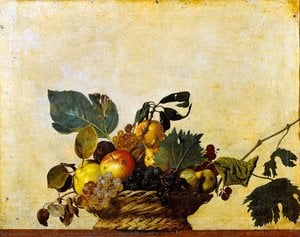
This approach is vividly evident in *Corbeille de Fruits*, where Cézanne dismantles the illusion of three-dimensionality, presenting a flattened composition that prioritizes underlying structure. The basket itself isn’t depicted as a solid object but rather as a series of interlocking planes—a technique anticipating Cubism's radical fragmentation.
Cézanne employed a distinctive brushstroke technique characterized by thick, impasto strokes that build up texture on the canvas surface. These bold marks aren’t intended to mimic natural contours but rather to convey solidity and volume—creating an illusion of depth through color and tonal variation.
The palette is dominated by earthy hues—ochres, browns, and greens—harmoniously blended to evoke a sense of stillness and contemplation. Cézanne meticulously observed the interplay of light and shadow, capturing subtle nuances that contribute to the painting’s overall atmosphere. The luminous oranges and yellows of the fruit create striking contrasts against the darker tones of the basket and tablecloth.
*Corbeille de Fruits*, painted circa 1893, exemplifies Cézanne's engagement with Post-Impressionist ideas—particularly those championed by Georges Seurat and Paul Gauguin. It represents a decisive break from Impressionistic conventions, signaling the emergence of a new artistic language focused on formal exploration.
Beyond its stylistic innovations, the basket itself carries symbolic weight. Fruit has long been associated with abundance, fertility, and nourishment—themes that resonate throughout Cézanne’s oeuvre. The carefully arranged composition suggests an attempt to capture not just the visual appearance of the fruit but also its essence—a reflection of Cézanne's belief in art as a conduit for conveying deeper truths about the natural world.
Despite its bold technique, *Corbeille de Fruits* exudes an aura of serene contemplation. Cézanne’s masterful handling of color and form invites viewers to pause and consider the painting's underlying harmony—a testament to his unwavering dedication to capturing not merely what is seen but what is felt.
The painting’s stillness contrasts sharply with the dynamism of Impressionism, offering a profound meditation on the beauty and permanence inherent in simple forms. It remains an enduring symbol of Cézanne's artistic genius—a cornerstone of modern art history.


1839 - 1906 , Francja

 Podgląd w skali
 Wyślij jako kartkę
 Udostępnij
 Szczegóły dzieła

 Pobierz
 Podobne obiekty
 RTG
RTG Pokaz slajdów
 Rozwiń treść