O artyście
Early Life and Artistic Foundations
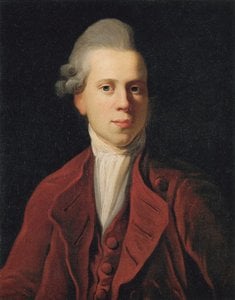
Nicolai Abraham Abildgaard, born in Copenhagen on September 11th, 1743, emerged from a family deeply immersed in the world of art and scholarship. His father, Søren Abildgaard, was a respected antiquarian draughtsman, instilling in young Nicolai an early appreciation for classical forms and meticulous observation. This familial influence proved foundational as Abildgaard embarked on his artistic journey, receiving initial training with a local painting master before formally enrolling at the New Royal Danish Academy of Art in 1764. His talent quickly became apparent; from 1764 to 1767, he consistently earned accolades and medallions recognizing his burgeoning skill. These early successes culminated in a travel stipend awarded in 1767 – a pivotal opportunity that would shape the course of his artistic development, though it was five years before he could finally utilize it. During these formative years at the Academy, Abildgaard benefited from the tutelage of Johan Edvard Mandelberg and Johannes Wiedewelt, absorbing their techniques and perspectives while simultaneously forging his own unique path. He diligently studied anatomy alongside painting, mastering the human form with an accuracy that would characterize much of his later work. This dedication to scientific observation was not merely a technical skill; it reflected a broader intellectual curiosity—a desire to understand the world through both artistic expression and rigorous analysis.
The Roman Awakening: A Shift in Perspective
In 1772, Nicolai Abildgaard finally realized his long-awaited dream of traveling to Rome. This five-year sojourn proved transformative, marking a crucial turning point in his artistic evolution. Immersed in the heart of classical antiquity, he dedicated himself not only to studying sculpture but also architecture, decoration, and the magnificent frescoes adorning Palazzo Farnese. A visit to Naples in 1776 with fellow artist Jens Juel further broadened his horizons. Rome wasn’t merely a place for technical study; it was an intellectual awakening. Abildgaard delved into history painting, seeking to master its complexities and narrative power. He drew inspiration from the masters – Annibale Carracci, Raphael, Titian, and Michelangelo – absorbing their compositional strategies, dramatic use of light, and profound understanding of human anatomy. However, his exposure wasn’t limited to strict classicism. The influence of artists like Johan Tobias Sergel and Johann Heinrich Füssli began to subtly shift his aesthetic sensibilities, introducing a nascent Romantic sensibility into his work. He meticulously documented the ruins of Pompeii and Herculaneum, capturing their grandeur and decay with remarkable precision—a testament to his commitment to both observation and artistic representation. This meticulous attention to detail would become a hallmark of his style, informing his approach to portraying historical scenes and mythological narratives alike.
Royal Commissions and National Narratives
Returning to Copenhagen in December 1777, Abildgaard was immediately recognized as a rising star. He swiftly secured a professorship at the Academy in 1778 and soon after, around 1780, ascended to the prestigious position of royal historical painter. This appointment brought with it a monumental commission from the Danish government: to create a series of paintings depicting the history of Denmark for the Knights’ Room (Riddersal) at Christiansborg Palace. This project became the defining undertaking of his career. These weren’t simply historical illustrations; they were carefully constructed narratives designed to glorify the monarchy and instill a sense of national pride. Abildgaard masterfully combined accurate historical depictions with allegorical elements and mythological references, creating visually stunning and intellectually stimulating compositions. He employed a palette rich in color—particularly crimson and gold—to convey grandeur and majesty, reflecting the aspirations of the Danish court. His meticulous attention to detail extended beyond mere visual representation; he painstakingly researched archival documents and consulted with historians to ensure that his paintings accurately reflected the events and personalities of Denmark’s past. The resulting murals were a triumph of artistic ambition and scholarly rigor—a symbol of Denmark's cultural heritage and its commitment to preserving its traditions.
A Synthesis of Styles: Neoclassicism and Romanticism
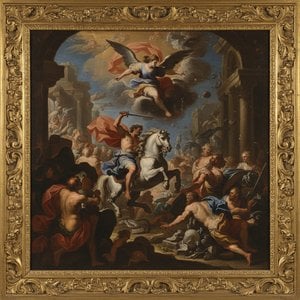
Nicolai Abildgaard's artistic style represents a fascinating synthesis of Neoclassical rigor and emerging Romantic sensibilities. While grounded in the principles of classical composition, clarity, and anatomical accuracy—influenced by artists like Michelangelo and Raphael—his works are infused with dramatic lighting, rich color palettes, and meticulous attention to detail that hint at a deeper emotional undercurrent. Notable paintings such as “Christian I Elevates Holstein to a Duchy in 1474” exemplify this blend – a stately historical scene rendered with classical precision yet imbued with a sense of grandeur and theatricality. He skillfully utilized chiaroscuro—the interplay of light and shadow—to heighten the emotional impact of his compositions, creating dramatic contrasts that drew viewers into the narrative. Simultaneously, Abildgaard embraced elements of Romanticism, exploring themes of emotion, imagination, and spirituality—a departure from the rational idealism of earlier artistic movements. His exploration extended beyond history painting; “The Nightmare” showcases his skill in portraying supernatural events with dramatic intensity, capturing the terror and apprehension of the human psyche. Pieces like “The Wounded Philoctetes” reveal a sensitivity to human suffering and vulnerability, reflecting the Romantic preoccupation with moral dilemmas and psychological complexity. He wasn’t merely replicating historical or mythological scenes; he was interpreting them through the lens of his own artistic vision, imbuing them with layers of symbolic meaning accessible to a refined audience. His pictorial allegory became a hallmark of his style, using symbols as visual shorthand for complex ideas and emotions.
Legacy and Enduring Influence
Abildgaard served as director of the Academy during 1789–1791 and again from 1795 until his death in Frederiksdal near Copenhagen on November 14th, 1809. Throughout his career, he nurtured a generation of talented artists, including Asmus Jacob Carstens, Bertel Thorvaldsen, J. L. Lund, and perhaps most significantly, Christoffer Wilhelm Eckersberg—who would become Denmark’s foremost painter. Eckersberg, often hailed as the “father of Danish painting,” built upon Abildgaard's foundational principles, establishing a new aesthetic tradition that continues to inspire artists today. Abildgaard’s influence extended beyond his direct students; he fundamentally shaped the artistic landscape of Denmark, bridging the gap between Neoclassicism and Romanticism. His work not only reflected the cultural values of his time but also anticipated future artistic trends—a testament to his enduring legacy as one of Denmark's most celebrated artists. He remains a pivotal figure in understanding the transition from Enlightenment ideals to the emotional intensity of the 19th century, securing his place among the giants of European art history.



 Podgląd w skali
 Zamów ręcznie malowaną reprodukcję
 Wyślij jako kartkę
 Udostępnij
 Szczegóły dzieła

 Pobierz
 Podobne obiekty
 RTG
RTG Pokaz slajdów


 Rozwiń treść






































 Opcja ze szkłem jest dostępna wyłącznie w rozmiarach poniżej 110 cm