Biografia artysty
A Life Immersed in Romantic Visions: Moritz Stifter and the Allure of Intimate Scenes
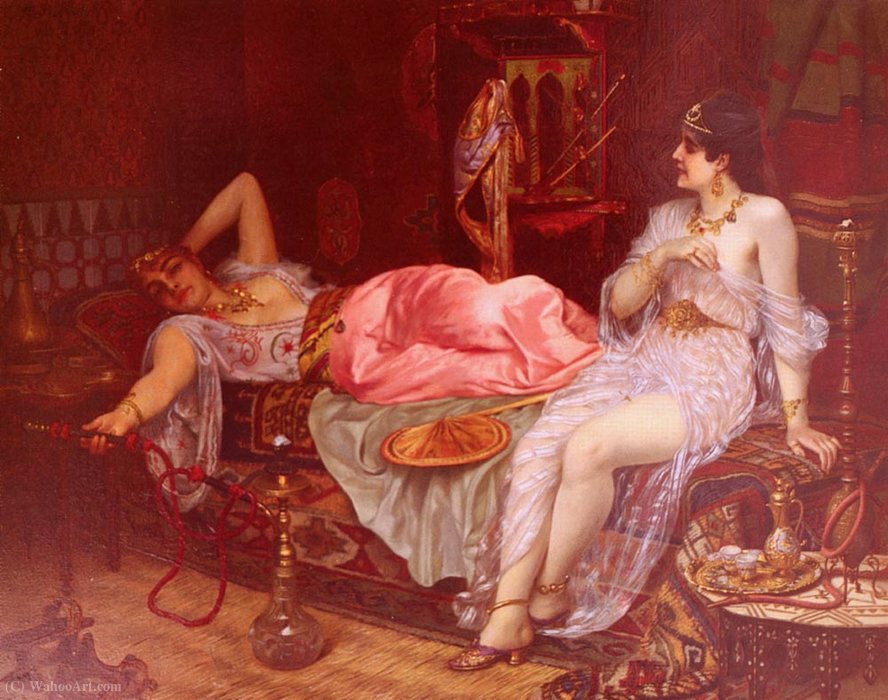
Moritz Stifter, born in Vienna in 1857 and passing away in Mauer-Öhling in 1905, was an Austrian genre painter whose work embodies the spirit of late 19th-century Romanticism. While not a household name like some of his contemporaries, Stifter carved out a distinctive niche for himself with his captivating depictions of beautiful women, often set within the exotic and alluring confines of harem interiors or the vibrant streets of Italy. His paintings are characterized by a smooth brushstroke, an attention to detail that borders on meticulousness, and a palpable sense of intimacy that draws viewers into the private worlds he created. Stifter’s journey began with a surprising detour; initially pursuing a career as an officer, he eventually succumbed to the pull of artistic expression, enrolling at the Academy of Fine Arts in Munich in 1882 and studying under the esteemed Carl von Piloty. This foundational training instilled in him a mastery of Italian chiaroscuro—the dramatic interplay of light and shadow—which would become a defining feature of his style.
From Military Aspirations to Orientalist Fantasies
The influence of Stifter’s uncle, the renowned writer Adalbert Stifter, is believed to have played a role in his early artistic development, though the precise nature of this mentorship remains somewhat elusive. What *is* clear is that Stifter quickly gravitated towards genre painting, specifically scenes featuring women in seductive poses and opulent settings. He became particularly known for his orientalist works—paintings depicting life within the harems of the Ottoman Empire or imagined worlds inspired by Middle Eastern cultures. However, it’s crucial to understand Stifter's approach to this subject matter. Unlike some of his peers who strived for documentary accuracy in their depictions of the Orient, Stifter’s vision was more fantastical and idealized. His harems are not spaces of harsh reality but rather realms of beauty, sensuality, and quiet contemplation. This distinction sets him apart within the broader context of 19th-century Orientalism, suggesting a focus on aesthetic pleasure and emotional resonance over strict ethnographic representation. He moved to Haag bei Neulengbach in 1899, continuing his work until his death six years later.
Technique and Influences: A Munich School Aesthetic
Stifter’s artistic technique is marked by a refined elegance and precision. His brushwork is remarkably smooth, creating surfaces that are almost porcelain-like in their delicacy. He possessed a keen eye for color and composition, skillfully arranging his figures within richly decorated interiors or bustling street scenes to create harmonious and visually arresting images. The influence of the Munich School is readily apparent in his work—particularly in his use of light and shadow, which he employed to dramatic effect, highlighting the beauty of his subjects and creating a sense of depth and atmosphere. While drawing inspiration from artists like Rudolf Ernst, Leopold Carl Müller, and Ludwig Deutsch who focused on realistic depictions of oriental life, Stifter’s style remained uniquely his own, characterized by a romantic sensibility and an emphasis on intimate moments.
Themes and Legacy: Portraits of a Bygone Era
Stifter's oeuvre encompasses a range of subjects typical of the 19th century—female figures, costume portraits, mythological scenes, and historical vignettes. However, it is his depictions of women in orientalist settings that remain his most recognizable contribution to art history. These paintings offer a glimpse into a world of exotic beauty and sensual allure, inviting viewers to escape the constraints of everyday life and indulge in a realm of fantasy and imagination. While his work may not be widely celebrated today, Stifter’s paintings continue to captivate audiences with their exquisite detail, romantic atmosphere, and evocative power. His legacy lies in his ability to create intimate portraits of a bygone era—images that transport us to another time and place, inviting us to contemplate the beauty, mystery, and allure of the human form.
Rediscovering Stifter: A Modern Appreciation
Today, Moritz Stifter’s work is experiencing a renewed appreciation among collectors and art enthusiasts. His paintings are increasingly sought after for their aesthetic qualities and historical significance, offering a unique perspective on 19th-century Romanticism and Orientalist painting. WahooArt, along with other platforms dedicated to fine art reproduction, plays a vital role in making Stifter’s work accessible to a wider audience, allowing viewers around the world to experience the beauty and intimacy of his evocative scenes. His paintings serve as a reminder of the power of art to transport us to another time and place—to evoke emotions, inspire imagination, and celebrate the enduring allure of human beauty. Exploring Stifter’s artwork is an invitation to delve into a world of romantic fantasies, exquisite detail, and captivating storytelling.



 Zamów wydruk
 Udostępnij
 Udostępnij
 Szczegóły dzieła

 Pobierz
 Podobne obiekty
 RTG
RTG Pokaz slajdów
 Rozwiń treść






































 Opcja szkła jest dostępna wyłącznie w rozmiarach poniżej 110 cm





