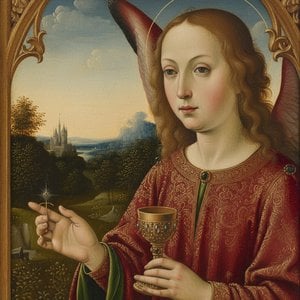
A Divine Encounter in the Golden Age of Bruges
In the quiet, hallowed stillness of Hans Memling’s The Annunciation, completed in 1480, time seems to suspend itself. This masterpiece, a jewel of the Early Netherlandish tradition, invites the viewer into a private, sacred moment where the earthly and the divine intersect with breathtaking intimacy. As one gazes upon this work, currently held within the prestigious Metropolitan Museum of Art, there is an immediate sense of being a silent witness to a miracle. Memling, a master who flourished during the golden age of Bruges, does not merely depict a biblical event; he orchestrates a profound emotional experience through a delicate balance of light, texture, and spiritual grace.
The scene captures the pivotal moment when the Archangel Gabriel delivers his celestial message to the Virgin Mary. Departing from the more rigid, monumental iconographies of his predecessors, Memling introduces a tender, human vulnerability to the composition. Rather than a formal throne room, we find Mary in the soft sanctuary of a bedchamber, reclining gently upon a mattress as if caught in a moment of peaceful swoon. This innovative approach, likely inspired by the works of Rogier van der Weyden, softens the theological weight of the event with a layer of profound compassion, making the divine encounter feel deeply personal and tangibly real.
The Mastery of Light and Symbolic Detail
Memling’s technical prowess is nothing short of extraordinary, utilizing the medium of oil paint to achieve a luminosity that feels as though it radiates from within the canvas itself. The artist employs a meticulous realism, a hallmark of the Flemish school, to render every surface with exquisite precision. From the subtle sheen of the gold trim on Mary’s white robe to the intricate patterns of the tiled floor, the painting celebrates the tactile beauty of the material world. This attention to detail serves a higher purpose, as Memling weaves a complex web of symbolism throughout the domestic setting.
Every object within this chamber whispers a sacred truth. The lily held by the angel stands as an eternal emblem of purity and innocence, while the carafe of water, catching the soft light, speaks to the clarity of the Virgin's soul. Even the small bird perched upon the windowsill adds a pulse of life to the stillness, reminding the viewer of the interconnectedness of all creation. For the discerning collector or interior designer, these layers of meaning offer an intellectual depth that rewards repeated viewing, making the piece not just a decoration, but a subject for contemplation.
An Eternal Inspiration for the Modern Space
Beyond its historical and religious significance, The Annunciation possesses a timeless aesthetic appeal that transcends the centuries. The harmonious color palette—dominated by the striking contrast of pristine whites and regal reds—creates a visual balance that is both calming and commanding. The composition, characterized by its structured architectural elements and centered figures, provides a sense of stability and peace, making it an ideal focal point for a sophisticated interior.
Whether displayed in a sunlit gallery or as a centerpiece in a curated home collection, a high-quality reproduction of this work brings with it the prestige of the Northern Renaissance. It offers more than just visual beauty; it provides an atmosphere of serenity and intellectual richness. To possess such a piece is to invite the quiet majesty of 15th-century Bruges into one's personal environment, fostering a space where art, history, and spirit converge in perfect, everlasting harmony.
Pytania i odpowiedzi
Czy „Zwiastowanie” – Hans Memling to obraz, rysunek czy grafika?
"Zwiastowanie" to Sztuka ścienna.
Czy dostępna jest prezentacja w formie pokazu slajdów dla „Zwiastowanie” – Hans Memling?
Dostępna jest prezentacja zdjęć: strona Prezentacja slajdów dzieła „Zwiastowanie” – Hans Memling.
Na którym etapie kariery Hans Memling znajduje się dzieło „Zwiastowanie”, biorąc pod uwagę jego datę powstania?
"Zwiastowanie", powstałe w 1480, należy do Okres dojrzały w twórczości Hans Memling.



 Podgląd w skali 1:1
 Zamów ręcznie malowaną reprodukcję
 Wyślij jako kartkę
 Udostępnij
 Szczegóły dzieła
 Przewodnik

 Pobierz obraz
 Podobne obiekty
 RTG
RTG Pokaz slajdów
 Statystyki


 Rozwiń treść






































 Opcja ze szkłem jest dostępna wyłącznie w rozmiarach poniżej 110 cm