Biografia artysty
A Spanish Visionary of Cubism: The Life and Art of Juan Gris
José Victoriano González-Pérez, born in Madrid in 1887, embarked on a remarkable artistic journey that would cement his place as one of the most significant figures of early 20th-century art. Initially pursuing an engineering degree at the School of Arts and Sciences, a keen analytical mind hinted at a future far removed from blueprints and calculations. Even during these formative years, a creative spark ignited – contributions to local periodicals showcased a burgeoning talent for visual observation. It was in 1905 that he adopted the evocative pseudonym Juan Gris, a name resonating with newfound identity and purpose as he began his formal studies in painting under José Moreno Carbonero. This pivotal shift marked the beginning of his artistic transformation, setting him on a course toward groundbreaking innovation.
Parisian Awakening and the Embrace of Cubism
The year 1906 witnessed a transformative relocation to Paris, a city then brimming with unparalleled artistic energy. Gris immersed himself completely in this vibrant milieu, forging enduring friendships with luminaries such as Henri Matisse, Georges Braque, and Fernand Léger. Initially engaged in satirical illustration for publications like *L'Assiette au Beurre*, he honed his observational skills and developed a sharp wit – a foundation that would later inform his artistic approach. However, the profound influence of Pablo Picasso proved particularly compelling. Around 1910, Gris began to dedicate himself wholeheartedly to painting, deliberately distancing himself from caricature and embracing the burgeoning language of Cubism. This wasn’t mere imitation; it was a deliberate quest to distill the essence of form and space, seeking a new visual order – a radical departure from traditional representation. His early explorations were characterized by a conscious rejection of conventional perspective, embracing abstraction as a means of capturing reality's underlying structure.
The Geometry of Perception: Style and Key Works
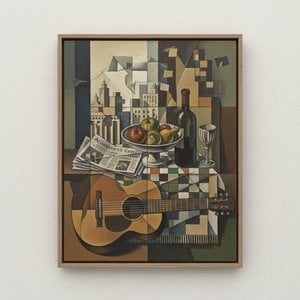
Juan Gris’s artistic output is distinguished by an exceptional clarity and intellectual rigor. He didn’t simply deconstruct objects; he meticulously reconstructed them, emphasizing geometric forms and a carefully considered palette. This approach led to what became known as his “crystal period,” exemplified in masterpieces such as *Still Life Before an Open Window* (1912) and *Place Ravignan* (1915). These works showcase a remarkable interplay of planes and angles, creating a sense of depth and solidity while simultaneously challenging conventional notions of perspective. The fragmented forms, rendered with precise lines and vibrant colors, invite the viewer to actively participate in reconstructing the image. Following this period, Gris moved towards Synthetic Cubism, pioneering the innovative use of *papier collé* – collage – incorporating real-world materials like newspaper clippings and textured papers into his compositions. This technique added a layer of complexity and tactile richness to his work, blurring the boundaries between painting and sculpture. Notable examples include *Guitar in front of the sea* (1925), a testament to his simplified forms and adherence to cubist principles, and *Homage à Pablo Picasso* (1912), which signaled his growing recognition within the avant-garde art world.
Influences and Development
Gris’s artistic development was profoundly shaped by a confluence of influences. The early impact of Pablo Picasso, with his exploration of fractured forms and multiple perspectives, is undeniable. However, he also drew inspiration from Henri Matisse's use of color and Georges Braque's analytical approach to deconstructing objects. Crucially, Gris developed a unique style that transcended mere imitation, incorporating elements of Spanish tradition – particularly the vibrant colors and geometric patterns found in Moorish architecture – into his compositions. His move to Paris provided access to a diverse range of artistic ideas and movements, including Futurism and Constructivism, which further broadened his creative horizons. The intellectual rigor evident in his work reflects his engineering background, demonstrating a systematic approach to visual representation.
Legacy and Lasting Influence
Juan Gris’s contribution to Cubism extends far beyond mere stylistic innovation; he brought a unique intellectual depth and structural clarity to the movement. He moved past the analytical phase, towards a more organized and synthetic approach, emphasizing order and precision. His work profoundly influenced the Purist style championed by Amédée Ozenfant and Charles Edouard Jeanneret (Le Corbusier), advocating for a return to classical principles of form and composition. Gris’s emphasis on geometric forms, harmonious color palettes, and the integration of everyday objects into his art established him as a pivotal figure in 20th-century art. His legacy continues to inspire artists today, demonstrating the enduring power of Cubism and the visionary genius of Juan Gris – a Spanish master who reshaped our understanding of perception and representation.



 Zobacz w skali 1:1
 Kup ręcznie malowany obraz
 Wyślij
 Udostępnij
 Szczegóły

 Pobierz plik obrazu
 Podobne obiekty
 RTG
RTG Pokaz slajdów
 Statystyki


 Czytaj więcej






































 Opcja ze szkłem jest dostępna wyłącznie w rozmiarach poniżej 110 cm