Podgląd w skaliPodgląd w skali Podgląd ARPodgląd AR Zamów ręcznie malowaną reprodukcję Zamów ręcznie malowaną reprodukcjęPrzełącz na obraz cyfrowy Przełącz na obraz cyfrowy Wyślij jako kartkęWyślij jako kartkę
Szczegóły dziełaSzczegóły dzieła Dodaj do ulubionych Dodaj do ulubionych PobierzPobierz Podobne obiektyPodobne obiekty RTGRTG Pokaz slajdówPokaz slajdów StatystykiStatystyki

Guitar on the Table

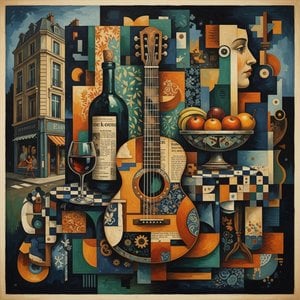
A masterful display of Synthetic Cubism featuring a fragmented guitar on a table by Spanish visionary Juan Gris, this 1913 oil painting invites you to explore the geometric beauty of a true modern masterpiece.

Juan Gris (1887-1927) – hiszpański malarz kubista, znany z geometrycznych form i kolorytu. Jego dzieła rewolucjonizują percepcję i są inspiracją dla współczesnego sztuki.

Giclée / Wydruk artystyczny

Druk giclée lub płótno o jakości muzealnej, szybka realizacja i szeroki wybór opcji wykończenia. (Zamów ręcznie malowaną reprodukcję Zamów ręcznie malowaną reprodukcjęPrzełącz na obraz cyfrowy Przełącz na obraz cyfrowy)

P118B $10
P118H $10
P118W $10
P438Z $10
P508JH $12
P508YH $12
P805H $10
P805Z $10
P919BZ $10
P919G $10
P919XJ $10
P959ZH $10
P968JZ $12
W106C $8
W218G $10
W218JH $8
W218Y $10
W307PJ $10
W316G $10
W316PJ $8
W316Y $10
W398PJ $8
W4111J $10
W500HY $15
W500JH $15
W692G $12
W849H $8
W940BG $15
W953PJ $8

Standardowy rozmiar
na wymiar
CM
INCH

Wybierz spośród naszych standardowych rozmiarów, które zachowują oryginalne proporcje dzieła sztuki.

szerokość
wysokość

Możesz wprowadzić własne wymiary, aby dopasować dzieło do konkretnej ramy lub przestrzeni. Jeśli wybrany rozmiar nie będzie odpowiadał proporcjom oryginalnego obrazu, przytniecie dzieło lub rozszerzymy obraz za pomocą odbicia lustrzanego lub jednolitego wypełnienia krawędzi. Przed rozpoczęciem produkcji prześlemy cyfrową wizualizację do Twojej akceptacji.
Prosimy pamiętać, że podgląd na ekranie nie odzwierciedla faktycznego przycinania ani rozszerzania. Tylko wizualizacja dokładnie pokaże końcową kompozycję.
Mimo dostępności niestandardowych rozmiarów, zalecamy wybór wymiaru z listy zdefiniowanej, aby zachować oryginalne proporcje.

Dostawa na cały świat () w ciągu 2 tygodni zamiast standardowych 4/5 tygodni. (9 Wrzesień)

why_choose_icon
Bezpłatna ekspresowa wysyłka na cały świat
why_choose_icon
Wysokiej jakości płótno lniane
why_choose_icon
Pełne ubezpieczenie przesyłki
why_choose_icon
Gwarancja zwrotu należności celnych i podatków importowych
why_choose_icon
Gwarancja wiernego odwzorowania kolorów
why_choose_icon
100-dniowa polityka zwrotów (tylko w przypadku wad)
why_choose_icon
Gwarancja 100% zwrotu kosztów
why_choose_icon
Zniżka przy zamówieniu wielu produktów

Suma całkowita

$ 68

reproduction

Guitar on the Table

Giclée / Wydruk artystyczny

Wymiary reprodukcji

-

Cena całkowita

$ 68

Szybki podgląd

  • Dimensions: 60 x 73 cm
  • Year: 1913
  • Movement: Cubism
  • Location: Museo Thyssen-Bornemisza, Madrid
  • Artist: Juan Gris
  • Medium: Oil on canvas
  • Notable elements or techniques: Overlapping shapes and textured patterns

A Symphony of Geometry: The Essence of Juan Gris

In the pantheon of early twentieth-century modernism, few names resonate with as much analytical precision and poetic grace as Juan Gris. His masterpiece, Guitar on the Table, created in 1913, serves as a breathtaking window into the heart of Synthetic Cubism. This oil on canvas work is not merely a depiction of an instrument; it is a profound exploration of how reality can be dismantled and reconstructed through the lens of geometric abstraction. As one contemplates this piece, the eye is immediately drawn to the central motif—a guitar that appears both solid and ephemeral, its form broken into a rhythmic dance of overlapping planes and intersecting lines. The painting captures a moment where the physical world dissolves into a sophisticated arrangement of shapes, inviting the viewer to participate in the intellectual reconstruction of the subject.

The technical mastery displayed in this work lies in Gris's ability to balance complexity with a restrained, almost meditative palette. Eschewing the chaotic fragmentation seen in earlier Analytic Cubism, Gris employs a harmonious blend of blues, browns, and whites, punctuated by subtle greens and intricate speckled patterns. These textures do more than provide visual interest; they create a tactile depth that mimics the grain of wood or the weave of fabric. The background, adorned with decorative motifs reminiscent of fine wallpaper or draped cloth, provides a soft counterpoint to the structural rigidity of the guitar. This interplay between the organic and the geometric, the flat and the dimensional, is what gives the composition its enduring vitality.

Historical Resonance and Interior Elegance

To possess or display a reproduction of Guitar on the Table is to bring a piece of art history into the contemporary living space. Created during the height of the Parisian avant-garde movement, this work stands as a testament to the era when artists like Picasso and Braque were redefining the very boundaries of sight. The painting carries with it the intellectual weight of the Museo Thyssen-Bornemisza, where such treasures are preserved, yet its aesthetic appeal is remarkably versatile for modern interior design. For the discerning collector or interior designer, this piece offers a sophisticated focal point that complements both minimalist contemporary settings and richly textured, classical environments.

Beyond its formal qualities, the painting evokes a sense of quiet introspection. The presence of secondary guitars and the subtle, abstracted figures in the periphery suggest a larger, bustling social scene—perhaps a Parisian café or a private studio—yet all is distilled into a singular, focused harmony. This creates an emotional impact of calm stability amidst complexity. Whether placed in a sunlit gallery or a moody, dimly lit study, Guitar on the Table acts as a conversation starter, prompting reflections on the nature of perception and the enduring beauty of structured abstraction. It is an investment in a legacy of innovation, offering a timeless elegance that transcends the decades.


O artyście

A Spanish Visionary of Cubism: The Life and Art of Juan Gris

José Victoriano González-Pérez, born in Madrid in 1887, embarked on a remarkable artistic journey that would cement his place as one of the most significant figures of early 20th-century art. Initially pursuing an engineering degree at the School of Arts and Sciences, a keen analytical mind hinted at a future far removed from blueprints and calculations. Even during these formative years, a creative spark ignited – contributions to local periodicals showcased a burgeoning talent for visual observation. It was in 1905 that he adopted the evocative pseudonym Juan Gris, a name resonating with newfound identity and purpose as he began his formal studies in painting under José Moreno Carbonero. This pivotal shift marked the beginning of his artistic transformation, setting him on a course toward groundbreaking innovation.

Parisian Awakening and the Embrace of Cubism

The year 1906 witnessed a transformative relocation to Paris, a city then brimming with unparalleled artistic energy. Gris immersed himself completely in this vibrant milieu, forging enduring friendships with luminaries such as Henri Matisse, Georges Braque, and Fernand Léger. Initially engaged in satirical illustration for publications like *L'Assiette au Beurre*, he honed his observational skills and developed a sharp wit – a foundation that would later inform his artistic approach. However, the profound influence of Pablo Picasso proved particularly compelling. Around 1910, Gris began to dedicate himself wholeheartedly to painting, deliberately distancing himself from caricature and embracing the burgeoning language of Cubism. This wasn’t mere imitation; it was a deliberate quest to distill the essence of form and space, seeking a new visual order – a radical departure from traditional representation. His early explorations were characterized by a conscious rejection of conventional perspective, embracing abstraction as a means of capturing reality's underlying structure.

The Geometry of Perception: Style and Key Works

Juan Gris’s artistic output is distinguished by an exceptional clarity and intellectual rigor. He didn’t simply deconstruct objects; he meticulously reconstructed them, emphasizing geometric forms and a carefully considered palette. This approach led to what became known as his “crystal period,” exemplified in masterpieces such as *Still Life Before an Open Window* (1912) and *Place Ravignan* (1915). These works showcase a remarkable interplay of planes and angles, creating a sense of depth and solidity while simultaneously challenging conventional notions of perspective. The fragmented forms, rendered with precise lines and vibrant colors, invite the viewer to actively participate in reconstructing the image. Following this period, Gris moved towards Synthetic Cubism, pioneering the innovative use of *papier collé* – collage – incorporating real-world materials like newspaper clippings and textured papers into his compositions. This technique added a layer of complexity and tactile richness to his work, blurring the boundaries between painting and sculpture. Notable examples include *Guitar in front of the sea* (1925), a testament to his simplified forms and adherence to cubist principles, and *Homage à Pablo Picasso* (1912), which signaled his growing recognition within the avant-garde art world.

Influences and Development

Gris’s artistic development was profoundly shaped by a confluence of influences. The early impact of Pablo Picasso, with his exploration of fractured forms and multiple perspectives, is undeniable. However, he also drew inspiration from Henri Matisse's use of color and Georges Braque's analytical approach to deconstructing objects. Crucially, Gris developed a unique style that transcended mere imitation, incorporating elements of Spanish tradition – particularly the vibrant colors and geometric patterns found in Moorish architecture – into his compositions. His move to Paris provided access to a diverse range of artistic ideas and movements, including Futurism and Constructivism, which further broadened his creative horizons. The intellectual rigor evident in his work reflects his engineering background, demonstrating a systematic approach to visual representation.

Legacy and Lasting Influence

Juan Gris’s contribution to Cubism extends far beyond mere stylistic innovation; he brought a unique intellectual depth and structural clarity to the movement. He moved past the analytical phase, towards a more organized and synthetic approach, emphasizing order and precision. His work profoundly influenced the Purist style championed by Amédée Ozenfant and Charles Edouard Jeanneret (Le Corbusier), advocating for a return to classical principles of form and composition. Gris’s emphasis on geometric forms, harmonious color palettes, and the integration of everyday objects into his art established him as a pivotal figure in 20th-century art. His legacy continues to inspire artists today, demonstrating the enduring power of Cubism and the visionary genius of Juan Gris – a Spanish master who reshaped our understanding of perception and representation.
Juan Gris

Juan Gris

1887 - 1927 , Hiszpania

Krótka nota

  • Artistic Movement Or Style: Kubizm, Kubizm syntetyczny
  • Artists Or Movements Influenced By This Artist:
    • Purizm
    • Amédée Ozenfant
  • Artists Who Influenced This Artist:
    • Pablo Picasso
    • Henri Matisse
  • Date Of Birth: 23 marca 1887
  • Date Of Death: 11 maja 1927
  • Full Name: José Victoriano González-Pérez
  • Nationality: Hiszpański
  • Notable Artworks:
    • Hommage à Pablo Picasso
    • Śniadanie
    • Guitar na morzu
  • Place Of Birth: Madryt, Hiszpania
Odkryj dzieła sztuki uporządkowane według tematów, stylów i cech charakterystycznych.