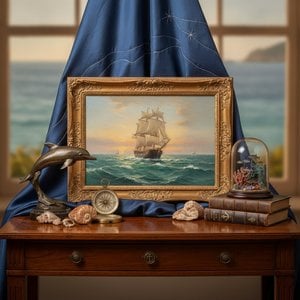
A Life Forged by Sea and Canvas
John Wilson Carmichael, a name resonating with the dramatic power of 19th-century British marine painting, emerged from the shipbuilding heartland of Newcastle upon Tyne in 1800. His life’s trajectory was an unusual one—a compelling transition from the practical world of crafting vessels to the evocative realm of artistic expression. Born into a family steeped in maritime tradition as the son of a shipwright, Carmichael didn't merely observe the sea; he intrinsically understood its mechanics, its capricious moods, and inherent dangers. This intimate familiarity, gleaned during an apprenticeship constructing ships, set him apart from many contemporaries, imbuing his canvases with a realism and authenticity rarely matched by those lacking such hands-on experience. Initially following in his father’s footsteps, Carmichael soon discovered a compelling pull towards art, beginning as a drawing master and honing his skills in the meticulous discipline of miniature painting—a foundation that demanded precision and an acute eye for detail. This early training proved invaluable as he transitioned to larger scales and more ambitious compositions, allowing him to seamlessly blend technical proficiency with burgeoning artistic talent.
Rising Tide: Early Successes and Establishing a Reputation
Carmichael’s ascent within the art world was marked by both dedication and fortunate opportunity. Early works, such as *The Fight Between the Shannon and Chesapeake*, showcased his developing ability to capture dramatic maritime events with compelling narrative force. These paintings weren't simply depictions of naval battles; they were dynamic stories brought to life on canvas, filled with tension, action, and a palpable sense of historical significance. The meticulous detail in depicting the ships’ rigging, the expressions of the sailors, and the chaotic energy of combat demonstrated his growing mastery of composition and storytelling. His talent quickly garnered recognition, leading to commissions from prestigious institutions like Trinity House in Newcastle. Depicting coastal scenes and maritime infrastructure solidified his reputatio – particularly *View of Newcastle*, a panoramic vista capturing the city’s skyline and harbor—and provided the financial stability needed to fully pursue his artistic ambitions. He exhibited regularly at the Northern Academy of Arts, gaining local acclaim before expanding his reach to London’s prominent art circles—a crucial step in establishing himself as a rising star within the British art scene, laying the groundwork for even greater achievements.
The Crimean War and National Recognition
A pivotal moment arrived with the outbreak of the Crimean War (1853-1856). Carmichael’s skills were sought after by the *Illustrated London News*, commissioning him to document the conflict, focusing specifically on naval engagements. This assignment transported him to the Baltic Sea, where he witnessed firsthand the bombardment of Sveaborg (Suomenlinna) in 1855—an event immortalized in one of his most celebrated works, *The Bombardment of Sveaborg*. The painting, a masterful depiction of naval warfare and explosive power, was exhibited at the Royal Academy to widespread acclaim. The sheer scale and dramatic intensity of the scene, combined with Carmichael’s meticulous attention to detail—from the billowing smoke to the splintered wood—captivated audiences and cemented his reputation as a leading marine artist. *HMS Erebus and Terror in the Antarctic (1847)*, another significant work from this period, further demonstrated his versatility, capturing the stark beauty of the icy landscape and the resilience of the ships navigating treacherous waters. This experience also refined his technique, providing invaluable insight into depicting large-scale maritime scenes with accuracy and emotional impact.
A Legacy of Technique and Inspiration
Carmichael’s artistic style was characterized by a remarkable realism, meticulous attention to detail, and an ability to capture both the beauty and raw power of the sea. He wasn't merely interested in representing ships; he sought to convey their essence—their strength, their vulnerability, and their connection to the vastness of the ocean. His use of light and shadow was particularly noteworthy, creating a sense of depth and atmosphere that drew viewers into his paintings. He also developed a distinctive approach to color, employing a rich palette of blues, greens, and grays to evoke the moods of the sea—from the calm serenity of a summer afternoon to the violent fury of a storm. Beyond his technical skill, Carmichael was a generous mentor, sharing his knowledge and expertise with aspiring artists through influential guides on marine painting: *The Art of Marine Painting in Water-Colours* (1859) and *The Art of Marine Painting in Oil-Colours* (1864). These manuals, meticulously detailed and insightful, demonstrate his commitment to fostering artistic growth and preserving the techniques he had so diligently mastered.
Later Years and Enduring Influence
Carmichael spent the last years of his life in Scarborough, not far from his birthplace, continuing to paint seascapes and coastal views. He didn’t confine his knowledge solely to his practice; he generously shared it with aspiring artists through influential guides on marine painting: *The Art of Marine Painting in Water-Colours* (1859) and *The Art of Marine Painting in Oil-Colours* (1864). These manuals, meticulously detailed and insightful, demonstrate his commitment to fostering artistic growth and preserving the techniques he had so diligently mastered. Carmichael’s work is characterized by a remarkable realism, meticulous attention to detail, and an ability to capture both the beauty and raw power of the sea. He stands alongside E.W. Cooke and Clarkson Stanfield as one of the most significant Victorian maritime artists, leaving behind a legacy that continues to inspire and captivate audiences today.
- Technical Mastery: His paintings are renowned for their meticulous detail and realistic portrayal of marine life and ships.
- Dramatic Composition: Carmichael excelled at capturing the drama and intensity of naval battles and stormy seas.
- Historical Accuracy: He meticulously researched historical events and accurately depicted them in his works.



 Zobacz w skali 1:1
 Kup ręcznie malowany obraz
 Wyślij
 Udostępnij
 Szczegóły
 Przewodnik

 Pobierz plik obrazu
 Podobne obiekty
 RTG
RTG Pokaz slajdów
 Statystyki
 Czytaj więcej






































 Opcja ze szkłem jest dostępna wyłącznie w rozmiarach poniżej 110 cm