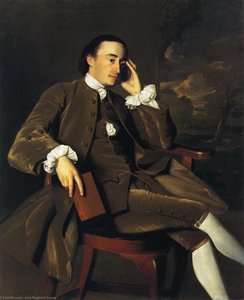
Biografia artysty
A Pioneer Bridging Worlds: The Life and Art of John Vanderlyn
John Vanderlyn, born in Kingston, New York, on October 15, 1775, occupies a unique position in the narrative of American art. He wasn’t merely a painter; he was a cultural bridge, forging a path for American artists to embrace European training—specifically, the burgeoning Neoclassical style emanating from Paris—rather than defaulting to the established artistic centers of London. His story is one of ambition, talent, and ultimately, a poignant struggle against financial hardship, yet his contributions remain significant in shaping the early landscape of American painting. Vanderlyn’s lineage itself hinted at an artistic destiny; he was the grandson of Pieter Vanderlyn, a respected colonial portraitist, inheriting not just a name but also a foundational understanding of form and representation. Early employment with a New York print seller provided practical exposure to the art world, while initial instruction under Archibald Robinson honed his fundamental skills. However, it was through copying portraits by Gilbert Stuart—and crucially, spending time within Stuart’s studio—that Vanderlyn truly began to cultivate his own portraiture abilities, absorbing the techniques of a master already renowned for capturing likeness and character.
Early Life and Artistic Foundations
Born into a family with roots in Dutch colonial artistry, John Vanderlyn's early life instilled a deep appreciation for visual representation. His grandfather, Pieter Vanderlyn, was a well-regarded portraitist in New York, providing the young John with an initial connection to the world of art. Following in his family’s footsteps, John initially worked as a printer’s assistant, gaining valuable experience in reproduction and design – skills that would later prove useful in his own artistic endeavors. Crucially, he received formal instruction from Archibald Robinson, a Scottish-born painter who served as one of the directors of the American Academy of Fine Arts. Robinson's guidance provided Vanderlyn with a solid foundation in classical techniques and principles, laying the groundwork for his future development. However, it was his apprenticeship under Gilbert Stuart that truly ignited his artistic passion. Spending time within Stuart’s bustling studio offered Vanderlyn an unparalleled opportunity to observe and learn from one of America’s most celebrated portraitists. He meticulously studied Stuart's methods, absorbing not only his technical skills but also his understanding of capturing the essence of a subject – their personality, character, and social standing.
Parisian Refinement and the Embrace of Neoclassicism
A pivotal moment arrived in 1796 when Aaron Burr, recognizing Vanderlyn’s potential, dispatched him to Paris to study art. This decision was revolutionary; it marked a deliberate shift away from the traditional British artistic influence that had long dominated American training. For five years, Vanderlyn immersed himself in the Parisian art scene, absorbing the principles of Neoclassicism—an aesthetic movement emphasizing classical forms, order, and thematic content drawn from ancient Greece and Rome. This exposure profoundly shaped his style, instilling a sense of clarity, balance, and idealized beauty into his work. He studied diligently at the *École des Beaux-Arts*, mastering techniques in composition, perspective, and color theory. He was particularly influenced by the works of Jacques-Louis David, whose monumental historical paintings exemplified the Neoclassical ideal. Vanderlyn’s time in Paris wasn't just about technical training; it was a transformative experience that fundamentally altered his artistic vision. He began to see America through the lens of European history and culture, seeking to create art that reflected both his American identity and his newfound appreciation for classical ideals.
Major Works and Artistic Versatility
Vanderlyn’s career was remarkably diverse, encompassing portraiture, landscape painting, and even large-scale panoramic works. He secured commissions from prominent figures—James Monroe, John C. Calhoun, and Andrew Jackson all sat for his portraits—demonstrating his ability to capture the likenesses of important individuals with remarkable accuracy and sensitivity. However, it was his ventures beyond traditional portraiture that truly distinguished him. In 1802, he created two striking views of Niagara Falls, which were subsequently engraved and published in London, bringing the majesty of the American landscape to a European audience. These works showcased Vanderlyn’s burgeoning skills as a topographical painter, capturing the dramatic scale and beauty of the natural world with impressive detail. His ambition reached new heights with *Caius Marius Amid the Ruins of Carthage*, exhibited at the Paris Salon of 1808, where it earned him a coveted gold medal—a testament to his mastery of Neoclassical technique and composition. This success propelled Vanderlyn to international recognition, solidifying his position as one of America’s leading artists. Later, he experimented with panoramic paintings, including “Panoramic View of the Palace and Gardens of Versailles” (1818-19), demonstrating an innovative approach to immersive art experiences – a relatively new concept at the time.
Legacy and Enduring Significance
John Vanderlyn’s legacy extends beyond his individual artworks. He was a true pioneer, challenging the established norms of American artistic training by championing the study of art in Paris. This opened doors for future generations of artists to explore new influences and develop their own unique styles. His commitment to Neoclassical principles contributed significantly to the development of this aesthetic movement within American art, influencing subsequent painters with its emphasis on form, clarity, and historical subject matter. Furthermore, his paintings served as a visual record of early American history, capturing the likenesses of important figures and depicting pivotal events. As one of the founding members of the National Academy of Design, Vanderlyn played an active role in establishing a professional organization dedicated to promoting American art. Despite facing financial difficulties later in life—he died in relative obscurity on September 23, 1852, in Kingston, New York, and is buried at Wiltwyck Rural Cemetery—his contributions to the development of American painting remain undeniable. He was an artist who dared to look beyond established conventions, embracing innovation and leaving an indelible mark on the cultural landscape of his time.