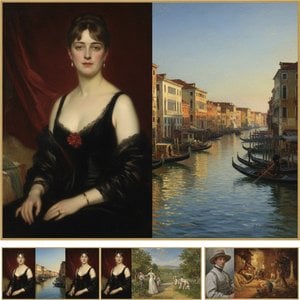
John Henderson (1797 – 1878): A Collector’s Eye and a Legacy of Art
John Henderson, an English collector whose name is inextricably linked to the halls of the British Museum, National Gallery, and University of Oxford, represents more than just a wealthy patron of the arts. He was a pivotal figure in shaping the collections of these venerable institutions during the 19th century, driven by a deep appreciation for beauty, meticulous scholarship, and a profound understanding of artistic technique. Born into a family with roots in both art and philanthropy – his father, an amateur artist, fostered a love of aesthetics from a young age – Henderson’s life was dedicated to amassing a remarkable assemblage of paintings, drawings, ceramics, and antiquities, leaving behind a lasting impact on the cultural landscape of Britain.
His early years were marked by a rigorous education at Balliol College, Oxford, where he immersed himself in classical studies and developed a keen eye for detail. Rather than pursuing a career in law as initially intended, Henderson’s passion lay in the world of art and archaeology. He became a fellow of the Society of Antiquaries, demonstrating his commitment to preserving and understanding historical artifacts. This dedication extended beyond mere acquisition; he actively engaged with the artistic community, fostering relationships with prominent artists like Thomas Girtin and Joseph Mallord William Turner, who frequently worked in his home studio. His family’s modest income from rents on poor houses was supplemented by his father's artistic endeavors, creating a unique environment where art appreciation flourished.
The Formation of a Remarkable Collection
Henderson’s collection wasn’t built overnight; it evolved over decades through careful acquisition and astute judgment. He prioritized quality over quantity, focusing on works that demonstrated technical mastery, historical significance, and aesthetic appeal. His interests spanned a wide range of artistic disciplines, including British watercolors, Italian drawings, Venetian ceramics, and ancient Greek and Roman antiquities. Crucially, he wasn’t simply buying art; he was researching it, studying its provenance, and understanding the context in which it was created. This scholarly approach distinguished him from many wealthy collectors of his time, who often prioritized prestige over genuine knowledge.
His home at 3 Montague Street, Bloomsbury, became a veritable treasure trove, housing an impressive array of objects that reflected his diverse tastes and intellectual curiosity. He meticulously cataloged each piece, documenting its history, materials, and artistic merits. This systematic approach ensured that his collection would be preserved for future generations and readily accessible to scholars and art enthusiasts alike. The legacy of this collection is particularly evident in the British Museum’s holdings, where many of his prized possessions now reside, offering invaluable insights into 18th- and 19th-century artistic practices.
Bequests and Enduring Influence
Upon his death in 1878, Henderson left behind a substantial bequest to the British Museum, National Gallery, and University of Oxford. These generous gifts transformed the collections of these institutions, adding significant depth and breadth to their holdings. The British Museum received a remarkable assortment of watercolours by Turner, Girtin, Cozens, Cox, and Müller, along with Venetian ceramics, oriental arms, and Roman glass – objects that continue to fascinate visitors today. The National Gallery benefited from his collection of Italian drawings, while the University of Oxford gained valuable Greek and Roman antiquities.
Henderson’s influence extends beyond the specific artworks he bequeathed. His commitment to scholarship and preservation set a precedent for future collectors, demonstrating that art collecting could be both a personal passion and a contribution to the wider cultural community. His meticulous cataloging methods also provided a model for museum curators, emphasizing the importance of detailed documentation and research. The legacy of John Henderson is therefore not simply one of wealth and patronage; it’s a testament to his discerning eye, his intellectual curiosity, and his profound appreciation for the enduring power of art.
A Collector's Vision
John Henderson’s story highlights a fascinating intersection of personal passion, scholarly pursuit, and cultural philanthropy. He wasn’t merely accumulating objects; he was actively shaping the artistic landscape of Britain through his collecting activities. His dedication to understanding the history and technique behind each artwork ensured that his collection remained not only aesthetically pleasing but also intellectually stimulating. His legacy continues to resonate today, reminding us of the vital role that collectors play in preserving and promoting cultural heritage for generations to come.



 Zamów wydruk
 Udostępnij
 Udostępnij
 Szczegóły dzieła

 Pobierz
 Podobne obiekty
 RTG
RTG Pokaz slajdów


 Rozwiń treść






































 Opcja szkła jest dostępna wyłącznie w rozmiarach poniżej 110 cm