

Otrzymaj plik gotowy do druku, którego jakość znacznie przewyższa podgląd internetowy. Każdy sprzedawany przez nas obraz cyfrowy pochodzi z wysokorozdzielczego pliku wzorcowego w naszej bazie — zazwyczaj o szerokości od 5 000 do 15 000 pikseli — dzięki czemu możesz drukować w dużym formacie, mocno kadrować lub z pełnym przekonaniem odwzorowywać najdrobniejsze detale.
Żaden plik nie opuszcza naszego studia bez odpowiedniej obróbki. Ekspert ds. cyfrowej edycji sprawdza zgodność kolorów z oryginałem i w razie potrzeby je koryguje, a następnie za pomocą profesjonalnych narzędzi do retuszu poprawia ostrość oraz szczegółowość — zawsze zachowując wierność pociągnięciom pędzla i stylowi artysty. Rezultatem jest obraz, który wygląda jak prawdziwe dzieło, a nie jak przefiltrowany skan.
Zatwierdzasz przed finalizacją zamówienia: nasz ekspert prześle obraz drogą mailową w ciągu 72 godzin do Twojego wglądu. Nie jesteś zadowolony? Poproś o poprawki lub korektę, bądź o zwrot kosztów, jeśli jakość nie spełnia oczekiwań.
To jakość, na której polegają wydawcy, studia projektowe, galerie oraz drukarnie.
Pobierz plik o wysokiej rozdzielczości do osobistego użytku, druku oraz projektów kreatywnych. ( Przełącz na wydania drukowane Zamów ręcznie malowaną reprodukcję)
Wybierając WahooArt.com, nie otrzymujesz jedynie obrazu – otrzymujesz profesjonalnie udoskonalone cyfrowe dzieło sztuki, stworzone z najwyższą precyzją i objęte gwarancją satysfakcji. Oto wszystko, co automatycznie dołączane jest do Twojego zamówienia:
Plik z obrazem cyfrowym w wysokiej rozdzielczości zostanie przesłany na Twój adres e-mail w ciągu 72 godzin od złożenia zamówienia – gotowy do natychmiastowego użycia.
Twoja grafika została profesjonalnie zoptymalizowana przy użyciu zaawansowanych narzędzi AI oraz ręcznej edycji, co zapewnia maksymalną szczegółowość, klarowność i wierność kolorów.
Przypadkowo usunąłeś lub zgubiłeś swój plik? Bez obaw – prześlemy go Tobie ponownie w dowolnym momencie, bez żadnych opłat.
Ciesz się swoją sztuką natychmiast, bez żadnych opłat celnych, należności ani kosztów dostawy – pliki cyfrowe są zawsze wolne od podatku.
Dzięki zastosowaniu profesjonalnych narzędzi i procesów zarządzania barwą zapewniamy, że Twoje cyfrowe zdjęcie odzwierciedla oryginalne kolory tak wiernie, jak to tylko możliwe.
Jeśli nie będziesz zadowolony ze swojego cyfrowego obrazu, dokonamy jego poprawki lub zwrócimy 100% kosztów w ciągu 100 dni – bez zbędnych pytań.
Nie jesteś zadowolony? Otrzymaj pełny zwrot kosztów w ciągu 100 dni od otrzymania pliku cyfrowego – bez zbędnych pytań.
Kup 3 obrazy, oszczędź 10% - Kup 5, oszczędź 15% - Kup 10+, oszczędź 20%. Idealne do projektów kreatywnych, galerii i agencji.
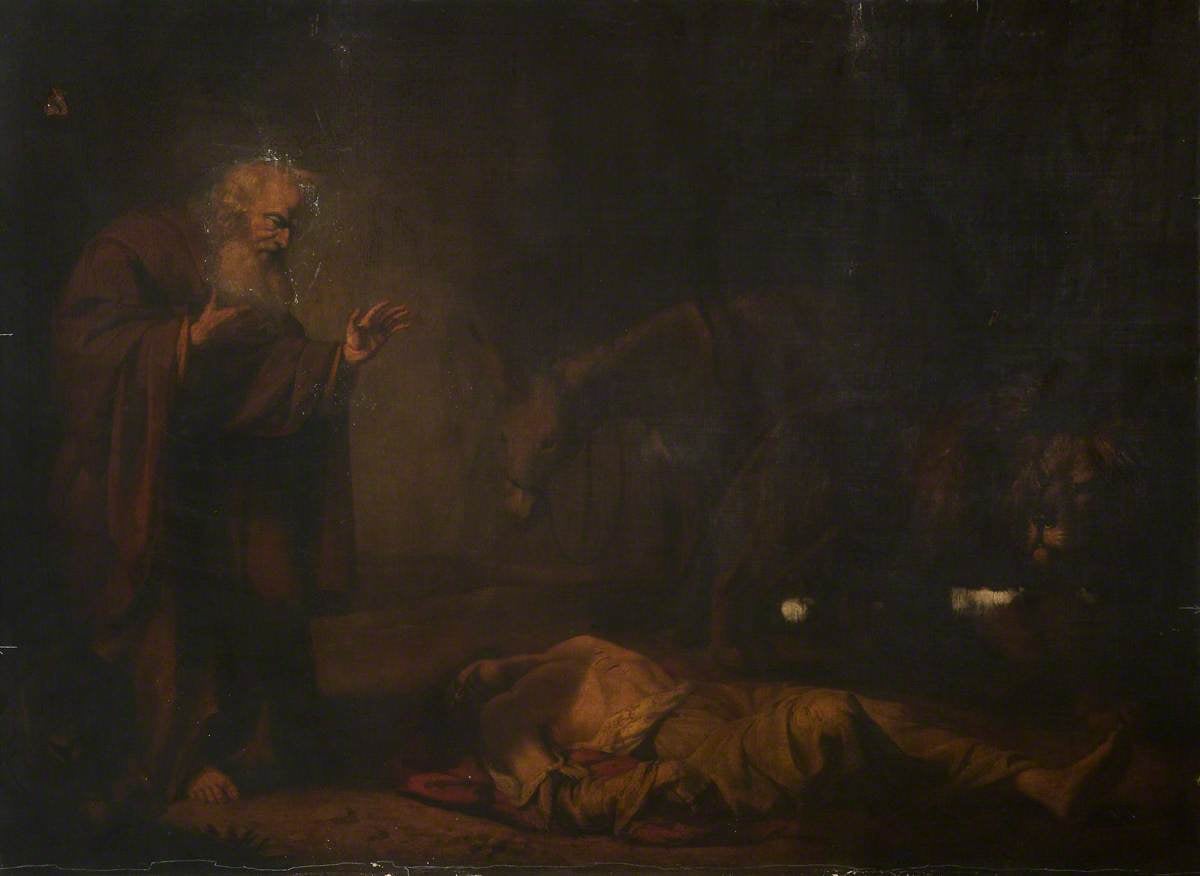
The Disobedient Prophet is an oil on canvas work by John Graham, dating to about 1790. This piece presents a dramatic scene centered on a prophet or messenger of God. The figure is positioned over a person lying on the ground, creating a moment of profound tension. Two horses are also present within the composition, adding to the gravity of the encounter.
Currently, this painting is held at the Royal Scottish Academy of Art - Architecture in Edinburgh, United Kingdom. It remains a significant example of Graham's ability to handle religious subject matter through a lens of intense human emotion. The scale of the work, measuring 243 x 332 cm, allows for a detailed observation of the figures and their interaction.
The arrangement of the figures creates a palpable sense of tension, drawing the eye toward the central interaction. A prophet stands over a person lying on the ground, a positioning that establishes a clear hierarchy within the scene. Two horses are positioned within the frame, adding to the complexity of the spatial arrangement. This careful placement of subjects ensures the viewer feels the weight of the moment being depicted.
Light and shadow are used to define the emotional gravity of the work. A dark background provides a stark contrast, which emphasizes the religious theme and directs attention toward the primary figures. This use of chiaroscuro creates a sense of depth, pulling the viewer into the immediate, dramatic space. The interplay of light helps to isolate the figures from the surrounding darkness, focusing the narrative on the interaction between the messenger and the prone individual.
The work is executed in oil on canvas, a choice that lends a palpable sense of richness to the composition. By utilizing the inherent properties of oil, the artist achieves a depth that allows the light to interact with the surface in a nuanced way. This medium provides the necessary weight to support the dramatic interplay of shadow and illumination seen throughout the scene.
The application of the paint is deliberate and physical. The technique involves layering oil paint in thick strokes, creating a surface that is far from smooth. These textures appear rough and impasto-like, giving the figures and the surrounding environment a tangible, sculptural quality. Such heavy handling of the pigment adds a layer of physicality to the work, emphasizing the tension within the composition through the very substance of the paint itself.
To understand the breadth of this artist's output, one must look toward his other notable compositions. His ability to navigate diverse subject matter is evident when considering works such as An Italian Nobleman. This piece demonstrates a specific command over character and presence that complements the dramatic tension found in his religious narratives. There is a certain poise in his figurative studies that suggests a deep familiarity with the human form and its capacity for expression.
The artist also explored themes of romance and tension through works like The Bandit’s Bride. This piece, alongside John Gibson (1790–1866), highlights a range that extends from historical or character-driven studies to more narrative-focused scenes. Each work reveals a different facet of his technical skill, moving between the quietude of a portrait and the heightened emotion of a dramatic event.
John Graham występuje również pod innymi nazwiskami: Ivan Gratianovitch Dombrowsky, Ivan Gratianovich Dombrowski.
Status praw autorskich do dzieła „The Disobedient Prophet” – John Graham jest jasny: utwór znajduje się w nadal objęte ochroną prawa autorskiego. Jego obecność w Royal Scottish Academy of Art - Architecture nie zmienia tego stanu rzeczy.
Dzięki swojej palecie barw Monochrome, dzieło „The Disobedient Prophet” – John Graham idealnie sprawdzi się w Living Room. Kolorystyka jest jedną z przyczyn tej rekomendacji.

The story of John Graham is one of profound transformation, a narrative that begins far from the bustling studios of New York, amidst the aristocratic elegance and subsequent political turbulence of Kyiv. Born Ivan Gratianovitch Dombrowsky in 1886, his early years were defined by a classical education and a lineage of privilege that seemed destined for a life of law or diplomacy. Yet, the winds of history had other plans. The seismic shifts of the Russian Revolution and the subsequent Bolshevik seizure of power thrust him into a crucible of conflict, leading to his imprisonment as a counterrevolutionary. This period of upheaval served as a spiritual and artistic catalyst; fleeing the chaos of his homeland, he eventually found refuge in the United States in 1920. It was during this migration that he shed his old identity, adopting the name John Graham—a moniker that would come to represent a bridge between the Old World's traditions and the New World's avant-garde energy.
Graham’s arrival in New York City marked the beginning of an extraordinary artistic awakening. Though he did not begin his formal studies in painting until his thirties, his late start was compensated by a voracious intellectual hunger. He immersed himself in the vibrant, gritty reality of the Ashcan School through the mentorship of John F. Sloan, yet his gaze was perpetually fixed on the horizon of modernism. His journey was not merely one of personal discovery but of cultural synthesis, as he navigated the complexities of Cubism, Surrealism, and Abstract Expressionism, weaving these disparate threads into a cohesive visual language that honored classical structure while embracing modern fragmentation.
Beyond his own canvas, Graham functioned as a vital conduit for the burgeoning New York art scene. He was far more than a solitary painter; he was a collector, a writer, and a philosopher of form. His deep engagement with System Theory and dialectics allowed him to view art not just as an aesthetic pursuit, but as a structured argument—a belief encapsulated in his famous assertion that “an abstract painting is an argument drawn to conclusion.” This intellectual rigor made him a central figure in the development of the New York School. As a mentor and advocate, he provided the scaffolding upon which legends like Jackson Pollock and Willem de Kooning could build their revolutionary styles. He possessed the rare ability to champion the radical unknown while maintaining a profound respect for the masters of the past.
His artistic development was characterized by a fascinating tension between the figurative and the abstract. While he was deeply moved by the expressive potential of modern abstraction, his later works returned to a highly sophisticated figurative style. This period saw him drawing inspiration from classical masters to depict subjects such as Russian soldiers with an intensity that felt both ancient and immediate. His brushwork often carried a palpable emotional weight, utilizing vibrant color palettes and a sense of Baroque drama to navigate the tensions of a modern age. Through his work, the heavy shadows of history met the bright, fractured light of the twentieth century.
The historical significance of John Graham lies in his role as a stabilizer and a provocateur within the whirlwind of mid-century modernism. He did not merely witness the birth of Abstract Expressionism; he helped cultivate the environment that made it possible. His legacy is found in several key areas:
Though he passed away in London in 1961, the echoes of Graham's influence remain embedded in the DNA of modern art. He remains a figure of immense mystery and brilliance—a man who survived revolution only to help orchestrate an artistic revolution of his own.

1886 - 1961 , Russia
 Podgląd w skali 1:1
 Wyślij jako kartkę
 Udostępnij
 Szczegóły dzieła
 Przewodnik

 Pobierz obraz
 Podobne obiekty
 RTG
RTG Pokaz slajdów
 Pytania i odpowiedzi
 Statystyki


 Rozwiń treść


