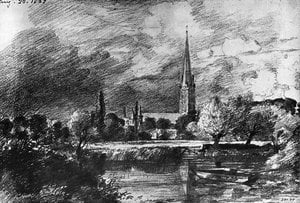
A Moment of Rural Drama: John Constable’s “The Leaping Horse”
John Constable's "The Leaping Horse," painted in 1825, isn’t merely a depiction of a riverside scene; it’s a vibrant distillation of the English countryside and a profound exploration of light, movement, and human interaction with nature. This iconic work, now residing within the Royal Academy’s collection, captures a fleeting moment along the River Stour in Suffolk – a region deeply ingrained in Constable's artistic sensibility and personal history. The painting immediately draws the eye to a dynamic focal point: a tow horse, powerfully straining against its rope, leaping gracefully over a rustic cattle barrier. This isn’t a static landscape; it’s imbued with an undeniable sense of energy and life.
Constable's approach aligns perfectly with the tenets of Romanticism, a movement that prioritized emotional experience and subjective perception over strict adherence to academic realism. He eschews precise detail in favor of capturing the *feeling* of the scene – the cool breeze, the dappled sunlight filtering through the clouds, the palpable sense of rural activity. The loose, expressive brushwork—a hallmark of Constable’s style—creates a remarkable texture, inviting the viewer to almost feel the roughness of the wood and the movement of the horse's muscles. The artist masterfully employs impasto techniques, layering thick strokes of oil paint to build up form and create a tactile surface that practically vibrates with life.
Light, Atmosphere, and the Suffolk Landscape
The painting’s muted color palette—dominated by shades of grey, blue, and ochre—contributes significantly to its evocative atmosphere. Constable skillfully utilizes atmospheric perspective, subtly lightening and desaturating objects in the distance to create a convincing sense of depth. The overcast sky casts a diffused light, softening shadows and lending an air of melancholy to the scene, yet simultaneously highlighting the vibrant greens of the surrounding foliage. This masterful manipulation of light isn’t simply decorative; it's integral to conveying the painting’s emotional core – a blend of tranquility and a subtle awareness of the passage of time.
The choice of subject matter is deeply rooted in Constable’s own life. Born in East Bergholt, Suffolk, he spent his childhood immersed in the rhythms of rural agricultural life along the River Stour. This intimate connection to the land profoundly shaped his artistic vision, informing his meticulous observation of nature and his ability to translate its beauty onto canvas. The inclusion of details like the half-furled sail on the barge, the eel trap beneath the bridge, and even the distant silhouette of Dedham Church—a landmark familiar to Constable—ground the scene in a specific place and time, anchoring it within the artist’s personal experience.
Symbolism and Emotional Resonance
Beyond its picturesque beauty, “The Leaping Horse” carries symbolic weight. The horse's leap represents not just physical exertion but also a dynamic interaction between man and nature. It speaks to the traditional role of horses in rural life – as beasts of burden, essential for transportation and agriculture. The cattle barrier itself symbolizes boundaries and constraints, while the horse’s freedom embodies a desire for movement and escape. The inclusion of figures engaged in various activities—a barge crew, children playing—further emphasizes the theme of human connection to the land.
Ultimately, “The Leaping Horse” is more than just a landscape painting; it's a poignant meditation on the beauty, vitality, and inherent melancholy of rural England. Constable’s masterful technique, combined with his deep understanding of light, atmosphere, and human experience, creates an artwork that continues to resonate with viewers today. A hand-painted reproduction captures not only the visual splendor of this iconic piece but also the emotional depth and artistic genius of its creator.
Technical Details & Reproduction Quality
Executed in oil on canvas, “The Leaping Horse” measures 142 x 187 cm. Constable’s signature loose brushwork is meticulously recreated in our hand-painted reproductions, ensuring that every nuance of the original painting is faithfully preserved. We utilize only the finest pigments and archival materials to guarantee lasting color vibrancy and durability. Our skilled artisans painstakingly replicate Constable's impasto techniques, building up layers of paint to achieve a remarkably tactile surface – mirroring the texture of the original.
Choosing a WahooArt reproduction allows you to bring this masterpiece into your home or office with confidence. Our meticulous attention to detail and commitment to quality ensures that you receive an artwork that not only captures the beauty of Constable’s vision but also stands as a testament to his enduring legacy. Explore our high-resolution images and select the perfect size to complement your space – from intimate prints to grand statement pieces.
Pytania i odpowiedzi
Do jakiego nurtu w sztuce należy „The Leaping Horse” autorstwa John Constable?
„The Leaping Horse” to dzieło należące do nurtu Romanticism. Nurt ten określa tradycję artystyczną, w której osadzone jest dzieło.
Jaka jest data powstania dzieła „The Leaping Horse” autorstwa John Constable?
Dzieło „The Leaping Horse” autorstwa John Constable powstało w 1825.
Czy dzieło „The Leaping Horse” autorstwa John Constable znajduje się w kraju pochodzenia artysty?
Nie – dzieło znajduje się za granicą. Krajem pochodzenia John Constable jest Wielka Brytania, natomiast muzeum przechowujące oryginał dzieła „The Leaping Horse” znajduje się w Zjednoczone Królestwo.



 Zobacz w skali 1:1
 Przełącz na wersję drukowaną
 Wyślij
 Udostępnij
 Szczegóły
 Przewodnik

 Pobierz plik obrazu
 Podobne obiekty
 RTG
RTG Pokaz slajdów
 Statystyki


 Czytaj więcej






































 Opcja ze szkłem jest dostępna wyłącznie w rozmiarach poniżej 110 cm