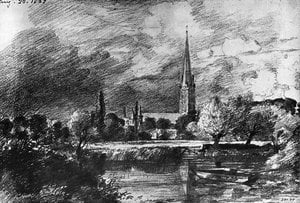
John Constable’s “A Barge below Flatford Lock”: A Symphony of Light and Rural Life
“A Barge below Flatford Lock” by John Constable is more than just a picturesque landscape; it's a deeply felt meditation on the beauty of the English countryside, a testament to the artist’s profound connection with his native Suffolk. Painted in 1816, this iconic work, currently residing at the Yale Center for British Art, captures a fleeting moment along the River Stour, offering a glimpse into the rhythms of rural life and Constable's revolutionary approach to depicting nature. The scene unfolds beneath a serene sky, dominated by rolling hills and the gentle curve of the river – a familiar vista that served as the artist’s constant source of inspiration.
Constable wasn’t simply recording a view; he was striving to capture an *experience*. His meticulous attention to detail—the subtle shifts in color, the play of light on water and foliage, the textures of the riverbank – speaks volumes about his dedication. The barge itself, navigating the calm waters, becomes a focal point, drawing the viewer into this tranquil world. Notice how Constable masterfully employs atmospheric perspective; distant elements fade into a hazy blue, creating a sense of depth and vastness that belies the relatively modest scale of the scene.
The Painter’s Technique: Light, Shadow, and Emotion
Constable's technique is characterized by an extraordinary sensitivity to light. He wasn’t interested in idealized representations; instead, he sought to portray the *actual* effects of sunlight on the landscape – the dappled shade beneath the trees, the shimmering reflections on the water, the golden glow that bathes the scene at dusk. This is achieved through a masterful manipulation of brushstrokes: short, broken strokes create a sense of movement and texture, while broader washes suggest atmospheric depth. The use of complementary colors—the blues and greens of the river contrasting with the warm yellows and browns of the surrounding foliage—further enhances the visual impact.
Crucially, Constable’s approach was revolutionary for his time. He moved away from the rigid conventions of academic landscape painting, prioritizing emotional resonance over precise representation. He embraced a looser, more expressive style, allowing his feelings about the subject matter to inform his brushwork. This is evident in the slightly blurred edges and the sense of spontaneity that permeates the canvas – a deliberate departure from the polished finishes favored by many of his contemporaries.
Historical Context: A Turning Point for an Artist
“A Barge below Flatford Lock” holds significant historical importance within Constable’s career. Prior to this painting, he faced considerable challenges gaining recognition in the English art market. His unconventional style—his willingness to depict ordinary subjects with such emotional intensity—was often met with criticism. However, this work proved to be a turning point, demonstrating his unique vision and solidifying his reputation as one of the leading landscape painters of his generation. It’s a poignant example of an artist finding his voice and establishing his artistic identity.
The painting also reflects the broader social and cultural context of early 19th-century England. The rise of Romanticism—a movement that emphasized emotion, imagination, and the beauty of nature—provided fertile ground for Constable’s work. His depiction of rural life resonated with a growing public interest in the countryside and a desire to escape the confines of urban existence.
Symbolism and Emotional Impact: A Portrait of Peace
Beyond its technical brilliance, “A Barge below Flatford Lock” is imbued with symbolic meaning. The barge represents human activity within the vastness of nature—a small, fleeting presence amidst a timeless landscape. The serene atmosphere evokes a sense of peace and tranquility, inviting the viewer to contemplate the beauty and simplicity of rural life. The painting’s enduring appeal lies in its ability to transport us to this idyllic setting, allowing us to experience Constable's deep appreciation for the natural world.
Consider the subtle details—the figures on the bank, the horses tethered nearby—they add a layer of narrative and invite speculation about the lives of those who inhabit this landscape. Ultimately, “A Barge below Flatford Lock” is not merely a depiction of a scene; it’s an invitation to connect with nature, to appreciate the beauty of the everyday, and to reflect on our place within the larger world.
Pytania i odpowiedzi
Jakiej techniki użyto do wykonania „A Barge below Flatford Lock” autorstwa John Constable?
Technika wykonania dzieła „A Barge below Flatford Lock” autorstwa John Constable to Olej na płótnie. Reprodukcje mają na celu wierne oddanie wyglądu tej techniki.
Do którego etapu rozwoju John Constable należy dzieło „A Barge below Flatford Lock”?
W dorobku artystycznym John Constable, dzieło „A Barge below Flatford Lock” przypada na Mature Period. Ten etap pozwala na zestawienie go z innymi pracami twórcy.
Czy istnieją dzieła podobne do „A Barge below Flatford Lock”?
Strona Podobne dzieła dzieła „A Barge below Flatford Lock” autorstwa John Constable prezentuje powiązane utwory.
W jaki sposób nurt i epoka przenikają się w „A Barge below Flatford Lock” autorstwa John Constable?
"A Barge below Flatford Lock" należy do nurtu Romantic Landscape, a jego twórca tworzył w epoce – Wiek XIX.
Czy mogę obejrzeć "A Barge below Flatford Lock" w formie pełnoekranowej prezentacji slajdów?
Dzieło „A Barge below Flatford Lock” autorstwa John Constable można obejrzeć w formie pokazu slajdów na stronie Pokaz slajdów danego dzieła.
Jak mogę pobrać obraz dzieła „A Barge below Flatford Lock” autorstwa John Constable?
„A Barge below Flatford Lock” autorstwa John Constable można pobrać ze strony Pobierz dzieła jako wysokiej rozdzielczości cyfrowe zdjęcie do pobrania.
Który artysta i jaki styl stoją za "A Barge below Flatford Lock"?
"A Barge below Flatford Lock" powstało autorstwa John Constable w stylu Romantic Landscape. Artysta oraz nurt definiują tradycję tego dzieła.
O czym jest "A Barge below Flatford Lock"?
„A Barge below Flatford Lock” autorstwa John Constable przedstawia: river, landscape, suffolk, barge, constable, rural, harmony, light.



 Zobacz w skali 1:1
 Przełącz na wersję drukowaną
 Wyślij
 Udostępnij
 Szczegóły
 Przewodnik

 Pobierz plik obrazu
 Podobne obiekty
 RTG
RTG Pokaz slajdów
 Statystyki
 Czytaj więcej






































 Opcja ze szkłem jest dostępna wyłącznie w rozmiarach poniżej 110 cm