A Symphony in Teal and Crimson: Unveiling Jane Kim’s “Wood Duck”
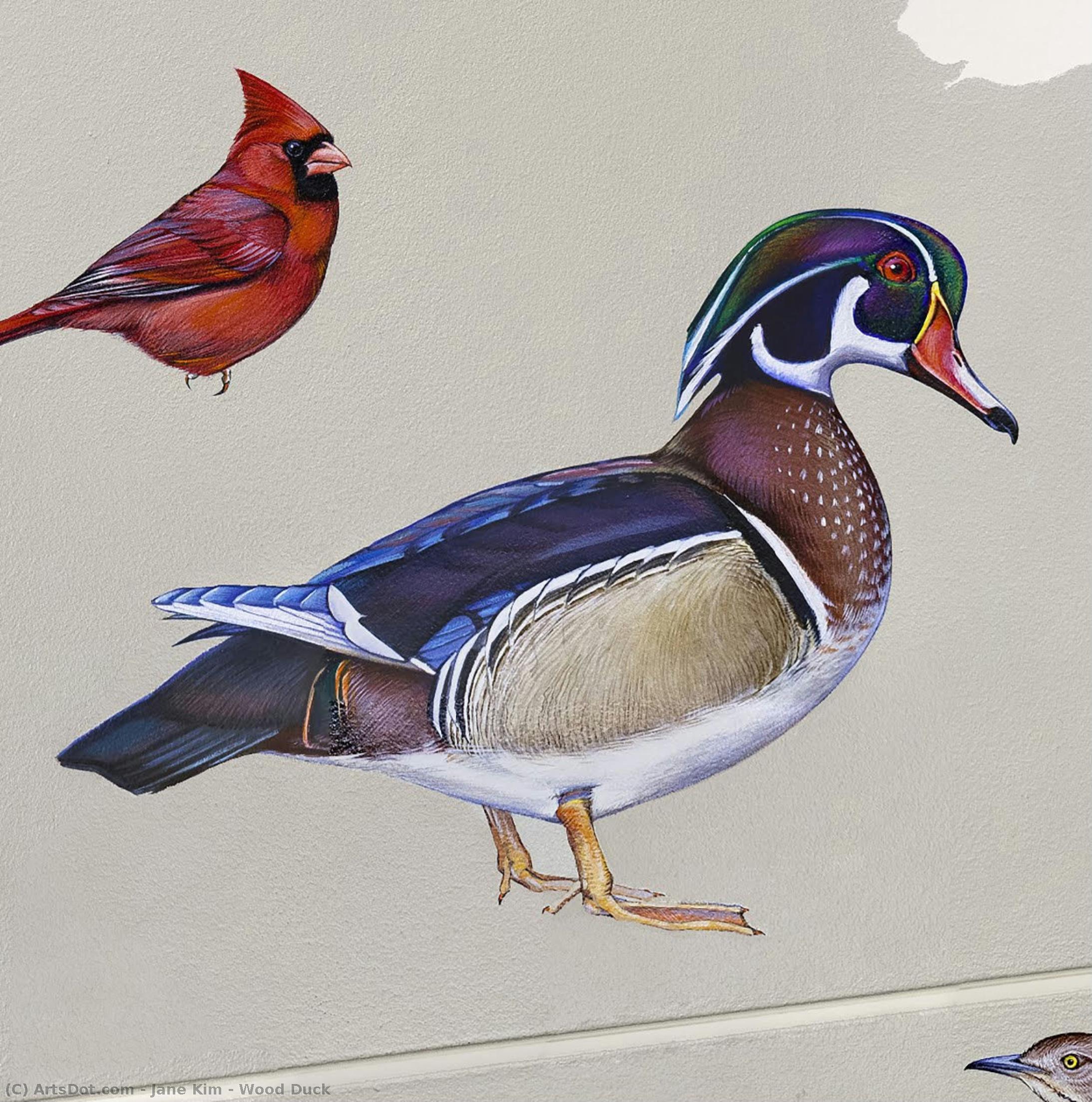
Jane Kim's "Wood Duck," a breathtaking watercolor illustration rendered with the meticulous detail of scientific precision, isn’t merely a depiction of two birds; it’s an immersion into the vibrant heart of North American wildlife. Completed in 2015 as part of a monumental mural commissioned by the Cornell Lab of Ornithology, this piece stands as a testament to Kim's extraordinary talent and her deep-seated passion for celebrating the natural world through art. The painting captures a male wood duck and a cardinal, positioned against a subtly textured beige backdrop that allows their plumage—a riot of blues, greens, browns, creams, and fiery reds—to command immediate attention. It’s an artwork that speaks to both the scientific rigor of observation and the pure joy of witnessing beauty in its most intricate form.
A Masterclass in Observation and Technique
Kim's technique is a captivating blend of realism and illustrative artistry. The piece appears to be executed primarily with colored pencils, or perhaps a similar fine art medium known for layering and blending—a deliberate choice that lends an incredible sense of texture and depth. Each feather is rendered with painstaking detail, capturing the subtle variations in color and tone that define their unique structure. Soft blending creates smooth transitions between hues, avoiding harsh edges and fostering a feeling of softness and fluffiness, as if you could reach out and gently touch the birds’ feathers. The artist's use of line work is equally precise, defining the contours of the bodies with confident strokes while maintaining an overall sense of fluidity. The composition itself—a deliberate placement of the wood duck on the right and the cardinal to its left—creates a dynamic visual dialogue, inviting the viewer to contemplate their relationship within the broader ecosystem.
Echoes of Audubon and the Legacy of Scientific Illustration
“Wood Duck” resonates deeply with the legacy of John James Audubon, one of the most celebrated ornithologists and artists of the 19th century. Like Audubon’s meticulous studies, Kim's work is rooted in a profound understanding of avian anatomy and behavior. The painting draws inspiration from Audubon’s own detailed illustrations of wood ducks, capturing their characteristic coloration and posture with remarkable accuracy. However, Kim transcends mere replication; she imbues the piece with her own artistic sensibility, adding a layer of contemporary beauty and emotional resonance. The influence of scientific illustration is also evident—a commitment to documenting nature with precision and clarity, while simultaneously elevating it to an object of aesthetic appreciation. The painting’s almost photographic quality speaks to this dedication.
Symbolism and the Language of Nature
Beyond its technical brilliance, “Wood Duck” carries a subtle yet powerful symbolic weight. The wood duck itself is often associated with resilience, adaptability, and the quiet beauty of the wilderness. Its vibrant plumage—a complex tapestry of blues, greens, and browns—represents the richness and diversity of the natural world. The cardinal, with its striking red coloration, symbolizes passion, energy, and a connection to the heart. Together, these two birds embody the interconnectedness of life within an ecosystem. The choice to depict them in this specific pose – the wood duck stepping forward, the cardinal partially turned away—suggests movement, interaction, and a fleeting moment captured in time. The painting serves as a gentle reminder of the importance of conservation efforts and our responsibility to protect these remarkable creatures and their habitats.
This stunning reproduction captures the essence of Kim’s original artwork, offering a timeless tribute to the beauty and wonder of North American wildlife.
Pytania i odpowiedzi
Z jakiej techniki wykorzystano "Wood Duck"?
Jane Kim wykorzystał/a technikę Acrylic On Canvas w pracy „Wood Duck”. Technika ta definiuje materię oryginalnego dzieła.
Gdzie mogę obejrzeć „Wood Duck” – Jane Kim w formie pokazu slajdów?
Dzieło „Wood Duck” – Jane Kim można obejrzeć w formie pokazu slajdów na stronie Prezentacja slajdów danego dzieła.
Jak nasycone są kolory w „Wood Duck” – Jane Kim?
Intensywność barw w dziele „Wood Duck” wynosi Monochromatic. Intensywność określa, jak nasycone wydają się kolory.


 Podgląd w skali 1:1
 Przełącz na wydania drukowane
 Wyślij jako kartkę
 Udostępnij
 Szczegóły dzieła
 Przewodnik

 Pobierz obraz
 Podobne obiekty
 RTG
RTG Pokaz slajdów
 Statystyki


 Rozwiń treść






































 Opcja ze szkłem jest dostępna wyłącznie w rozmiarach poniżej 110 cm


