Zobacz w skali 1:1 Zobacz w AR Przełącz na wersję drukowaną Przełącz na wersję cyfrową Wyślij
Szczegóły Przewodnik Dodaj do ulubionych Pobierz plik obrazu Podobne obiekty RTG Pokaz slajdów Statystyki

Acanthostega

A captivating black & white drawing of Acanthostega, a prehistoric fish-like creature swimming above another, showcasing intricate fins and tail details by Jane Kim.

An American painter and science illustrator known for large-scale conservation murals like the Wall of Birds, Jane Kim blends scientific detail with vibrant advocacy to invite you into a thriving natural world.

Dzieło sztuki prezentowane na tej stronie podlega ochronie prawem autorskim, co oznacza, że nie mamy prawa do tworzenia ani sprzedaży jego identycznej reprodukcji. Ochrona ta jest egzekwowana na mocy umów międzynarodowych, takich jak Konwencja berneńska oraz przez przepisy prawa krajowego, w tym te określone w Prawo autorskie USA – Tytuł 17.

Jako pełną szacunku i legalną alternatywę oferujemy personalizowane, malowane ręcznie dzieła sztuki inspirowane oryginałem. Nasi wykwalifikowani i profesjonalni artyści starannie analizują styl, nastrój oraz artystyczną esencję pierwowzoru, aby stworzyć nowe, unikalne dzieło, które przywołuje te same emocje – pozostając jednocześnie w pełni oryginalną kreacją.

Metoda ta jest w pełni zgodna z przepisami prawa autorskiego, ponieważ nie polega na kopiowaniu ani powielaniu chronionego dzieła. Stanowi ona kreatywną reinterpretację – nowy obraz, który czerpie inspirację z oryginału, ale nie jest z nim tożsamy.

Ręcznie malowana reprodukcja olejowa

Ręcznie malowany obraz olejny na płótnie, wykonany na zamówienie przez naszych artystów w wybranym przez Ciebie wymiarze i oprawie. ( Przełącz na wersję drukowaną Przełącz na wersję cyfrową)

Corner sample of the P118B picture frame: polistyren formowany, 5 cm wide and 3 cm thick
P118B zł10
Corner sample of the P118H picture frame: polistyren formowany, 5 cm wide and 3 cm thick
P118H zł10
Corner sample of the P118W picture frame: polistyren formowany, 5 cm wide and 3 cm thick
P118W zł10
Corner sample of the P438Z picture frame: polistyren formowany, 5.5 cm wide and 3.5 cm thick
P438Z zł10
Corner sample of the P508JH picture frame: polistyren formowany, 7 cm wide and 3.5 cm thick
P508JH zł12
Corner sample of the P508YH picture frame: polistyren formowany, 7 cm wide and 3.5 cm thick
P508YH zł12
Corner sample of the P805H picture frame: polistyren formowany, 5 cm wide and 3.5 cm thick
P805H zł10
Corner sample of the P805Z picture frame: polistyren formowany, 5 cm wide and 3.5 cm thick
P805Z zł10
Corner sample of the P919BZ picture frame: polistyren formowany, 7 cm wide and 3.5 cm thick
P919BZ zł10
Corner sample of the P919G picture frame: polistyren formowany, 7 cm wide and 3.5 cm thick
P919G zł10
Corner sample of the P919XJ picture frame: polistyren formowany, 7 cm wide and 3.5 cm thick
P919XJ zł10
Corner sample of the P959ZH picture frame: polistyren formowany, 5 cm wide and 3 cm thick
P959ZH zł10
Corner sample of the P968JZ picture frame: polistyren formowany, 6 cm wide and 4 cm thick
P968JZ zł12
Corner sample of the W106C picture frame: lite drewno, 5 cm wide and 3 cm thick
W106C zł8
Corner sample of the W218G picture frame: lite drewno, 5 cm wide and 3 cm thick
W218G zł10
Corner sample of the W218JH picture frame: lite drewno, 5 cm wide and 3 cm thick
W218JH zł8
Corner sample of the W218Y picture frame: lite drewno, 5 cm wide and 3 cm thick
W218Y zł10
Corner sample of the W307PJ picture frame: lite drewno, 6 cm wide and 3 cm thick
W307PJ zł10
Corner sample of the W316G picture frame: lite drewno, 6 cm wide and 3 cm thick
W316G zł10
Corner sample of the W316PJ picture frame: lite drewno, 6 cm wide and 3 cm thick
W316PJ zł8
Corner sample of the W316Y picture frame: lite drewno, 6 cm wide and 3 cm thick
W316Y zł10
Corner sample of the W398PJ picture frame: lite drewno, 5 cm wide and 3 cm thick
W398PJ zł8
Corner sample of the W4111J picture frame: lite drewno, 6.5 cm wide and 3.5 cm thick
W4111J zł10
Corner sample of the W500HY picture frame: lite drewno, 7 cm wide and 5 cm thick
W500HY zł15
Corner sample of the W500JH picture frame: lite drewno, 7 cm wide and 5 cm thick
W500JH zł15
Corner sample of the W692G picture frame: lite drewno, 8 cm wide and 4 cm thick
W692G zł12
Corner sample of the W849H picture frame: lite drewno, 5 cm wide and 3 cm thick
W849H zł8
Corner sample of the W940BG picture frame: lite drewno, 7.5 cm wide and 4.5 cm thick
W940BG zł15
Corner sample of the W953PJ picture frame: lite drewno, 6 cm wide and 3.5 cm thick
W953PJ zł8

Standardowy
na zamówienie
CM
INCH

Wybierz spośród naszych standardowych rozmiarów, które zachowują oryginalne proporcje dzieła sztuki.

szerokość
wysokość

Wpisz wymaganą szerokość i wysokość, aby obraz pasował do Twojej ramy lub ściany. Ponieważ jest to dzieło malowane ręcznie, w przypadku rozmiaru o innym proporcji artysta może domalować nieco więcej wokół obrazu lub przyciąć fragmenty — wybór należy do Ciebie. Przed rozpoczęciem pracy prześlemy Ci cyfrową wizualizację do zatwierdzenia. Obraz widoczny na tej stronie nie przedstawia rzeczywistego efektu — jedynie wizualizacja oddaje realny rezultat.

Przykłady możliwych zmian: Zamień twarz na zdjęcie klienta; Dodaj zwierzę domowe (np. zamień kota na psa); Ukryj wiadomość w tle; Zmień krajobraz lub elementy tła.
Po złożeniu zamówienia zespół WahooArt.com skontaktuje się z klientem drogą mailową w celu uzyskania instrukcji i prześle wizualizację projektu

Dostawa na całym świecie () w ciągu 3–4 tygodni zamiast standardowych 5 tygodni. (23 Październik). Bez kompromisów w kwestii jakości.

Bezpłatna ekspresowa wysyłka na cały świat
Wysokiej jakości płótno lniane
Pełne ubezpieczenie transportowe
Gwarancja zwrotu należności celnych i podatków importowych
Gwarancja idealnego odwzorowania barw
100-dniowy okres na zwrot dzieła w przypadku wykrycia wad produkcyjnych
Gwarancja 100% zwrotu pieniędzy
Oferta przy zakupie wielu sztuk

Cena całkowita

zł 1047

Acanthostega

Technika wykonania

Rozmiar reprodukcji

-

Suma do zapłaty

zł 1047

Kluczowe informacje

  • Influences:
    • Graffiti culture
    • Basquiat
  • Medium: Ink & Acrylic
  • Notable elements: Fish fins, air-borne pose
  • Movement: Contemporary Art
  • Year: 2015
  • Subject or theme: Aquatic creature

Quiz wiedzy o sztuce

Do każdego pytania dotyczy tylko jedna poprawna odpowiedź.

Pytanie 1:
What is the primary subject depicted in Jane Kim’s painting, ‘Acanthostega’?
Pytanie 2:
The image of ‘Acanthostega’ shows a fish swimming in what manner?
Pytanie 3:
According to the provided text, what is Jane Kim primarily known for in her artistic practice?
Pytanie 4:
The painting ‘Acanthostega’ draws inspiration from which of the following artistic movements?
Pytanie 5:
What does the crown motif frequently represent in Jane Kim’s artwork, as suggested by the text?

The Silent Witness: Jane Kim’s “Acanthostega”

Jane Kim's "Acanthostega" isn’t merely a depiction of a fish; it’s an evocative portal into the distant past, a frozen moment in the evolutionary drama that birthed our own terrestrial existence. The painting, rendered with meticulous detail and a restrained palette of blacks, whites, and subtle grays, captures a creature – Acanthostega gunnari – that lived approximately 365 million years ago during the Famennian age of the Late Devonian period. This remarkable specimen represents one of the earliest known tetrapods, those elusive ancestors from which all land vertebrates ultimately descended. Kim’s work transcends simple representation, instead offering a profound meditation on transition and the slow, incremental steps that led to our dominance on land.
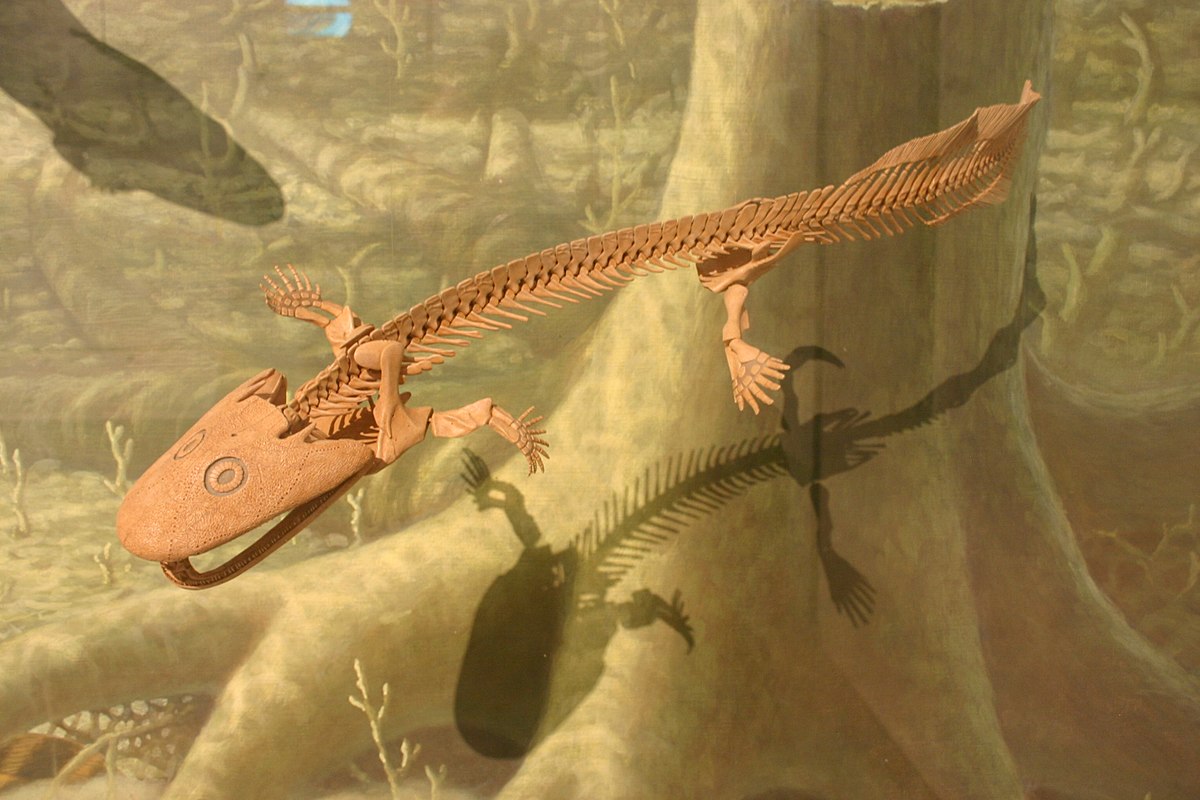
Acanthostega Gunneri Illustration

An Aquatic Ancestor: Morphology and Paleobiology

The painting meticulously portrays Acanthostega’s unique anatomy, a fascinating blend of fish-like and amphibian characteristics. Notice the elongated body, reminiscent of a lobe-finned fish, yet coupled with eight digits on each hand – a crucial evolutionary step towards limb development. The webbing connecting these digits suggests an adaptation for paddling through shallow waters, likely inhabiting weed-choked swamps teeming with life. Jennifer Clack’s extensive research into this species reveals that Acanthostega wasn't a fully terrestrial animal; its shoulder structure and limited ability to bend its elbows indicate it primarily inhabited aquatic environments. The painting subtly conveys this duality – a creature poised on the brink of land, yet firmly rooted in the water.

Kim’s artistic choices are informed by paleontological understanding. She doesn't shy away from depicting the fish-like features—the prominent gills, the streamlined form—but simultaneously highlights the nascent limb structure, hinting at the potential for future locomotion. This delicate balance between familiarity and transformation is central to the artwork’s power.

Symbolism of Transition: Crowns and the Dawn of Potential

Beyond its anatomical accuracy, “Acanthostega” resonates with symbolic weight. The prominent crown adorning the fish's head – a motif frequently employed by Kim – represents not just royalty but also potential and nascent power. It’s a visual metaphor for the evolutionary leap from aquatic to terrestrial life, suggesting that even in this ancient creature, the seeds of future dominance were already being sown. The careful rendering of the scales and fins evokes a sense of vulnerability and fragility, while the crown subtly asserts an inherent strength – a promise of what was yet to come.

Ink Dwell’s Legacy: A Masterful Reproduction

Jane Kim's work, as exemplified by “Acanthostega,” is a testament to her skill and dedication. Her meticulous attention to detail, combined with a deep understanding of paleontology and artistic expression, results in images that are both scientifically accurate and emotionally resonant. WahooArt offers high-quality reproductions of this captivating piece, allowing art lovers to bring this pivotal moment in evolutionary history into their homes or offices. Each reproduction is crafted with the same care and precision as the original, ensuring a faithful representation of Kim’s artistic vision – a silent witness to the dawn of limbs and the unfolding story of life on Earth.

Pytania i odpowiedzi

Ile lat miał Jane Kim, gdy powstało dzieło „Acanthostega”?

Jane Kim stworzył/a "Acanthostega" w wieku 34 lat. Artysta urodził/a się w 1981, a datowanie dzieła to 2015.

Kto stworzył "Acanthostega" i w jakim roku?

Dzieło "Acanthostega" zostało stworzone przez Jane Kim w 2015 roku.

Jaki ładunek emocjonalny niesie ze sobą „Acanthostega” autorstwa Jane Kim?

Emocjonalny ton przypisany do „Acanthostega” autorstwa Jane Kim to Reflective. Podsumowuje on uczucia, jakie wyraża to dzieło.


Odkryj dzieła sztuki uporządkowane według tematów, stylów i cech charakterystycznych.



































