A Hunt Frozen in Time: Jan Weenix’s “Boar Hunt”
Jan Weenix's "Boar Hunt," painted around 1703, isn’t merely a depiction of a hunt; it’s a meticulously crafted tableau of primal instinct, stoic heroism, and the fleeting beauty of a dramatic moment. This remarkable work, housed within the walls of a museum setting – subtly suggested by the diffused lighting and reflective glass – transports us to a world where man and beast engage in a timeless dance of pursuit and consequence. Weenix, a master of Dutch Baroque realism, elevates the commonplace subject of hunting into an exercise in profound observation and emotional resonance.
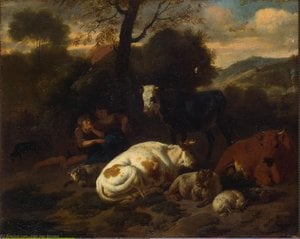
The scene unfolds with startling clarity. A magnificent boar, sprawled on its back in a posture of defeated grandeur, dominates the right side of the composition. Its thick hide, rendered with astonishing detail – each bristling hair meticulously captured – speaks to both its formidable power and its imminent demise. Beside it lies a smaller animal, likely a hare or rabbit, adding a layer of poignant vulnerability to the tableau. To the left, a hunting dog, a breed known for its keen tracking abilities, stands poised, either actively pursuing or having just completed its task. The dog’s posture is one of focused intensity, mirroring the boar's own struggle. The background landscape—rolling hills and scattered trees—provides a sense of depth and reinforces the feeling that this event unfolds within a vast, untamed wilderness.
The Language of Baroque Realism
Weenix’s mastery lies in his ability to fuse meticulous realism with an underlying sense of drama. He employs a technique deeply rooted in the Dutch Golden Age, characterized by its careful observation of light and shadow – *chiaroscuro*—to sculpt form and create a palpable atmosphere. Notice how the light catches on the boar's hide, highlighting its texture and musculature, while simultaneously casting deep shadows that emphasize its vulnerability. The artist’s use of color is restrained yet effective; earthy tones dominate, punctuated by the rich browns and reds of the animal’s fur and the subtle greens of the landscape. This palette contributes to a sense of groundedness and authenticity.
The composition itself is carefully balanced, drawing the eye across the scene with a deliberate rhythm. The placement of the animals—the dominant boar on one side, the pursuing dog on the other—creates a dynamic tension that mirrors the hunt’s inherent drama. Furthermore, Weenix's attention to detail extends beyond mere representation; he captures not just the physical appearance of the animals but also their expressions – the boar’s defiant stance, the dog’s focused gaze – imbuing them with a sense of life and personality.
A Symbolism of Mortality and Triumph
The “Boar Hunt” is rich in symbolic meaning. The hunt itself represents the human desire for mastery over nature, a theme that resonated deeply within the context of 17th-century Europe. However, Weenix doesn’t glorify this pursuit; instead, he presents it with a sobering awareness of mortality and consequence. The fallen boar, lying vulnerable on its back, serves as a potent reminder of the inevitability of death. The dog's role highlights the relationship between hunter and prey, emphasizing the cycle of life and death that governs the natural world.
Moreover, the scene can be interpreted as an allegory for human ambition and the pursuit of glory. The hunters, driven by a desire to prove their skill and courage, engage in a dangerous undertaking with uncertain outcomes. The success of the hunt—represented by the fallen boar—is ultimately tempered by the knowledge that it comes at a cost.
Capturing the Essence: Reproduction and Display
Reproductions of “Boar Hunt” offer a remarkable opportunity to bring this masterpiece into any setting, from a grand salon to a more intimate space. The meticulous detail and evocative atmosphere of the original are faithfully reproduced, allowing viewers to appreciate Weenix’s artistic skill and his profound understanding of human nature. When displayed, consider framing the artwork in a manner that complements its rich colors and dramatic composition. The subdued lighting suggested by the museum setting can be replicated through strategic use of ambient light or accent lighting, further enhancing the work's impact.
Ultimately, “Boar Hunt” is more than just a painting; it’s a window into a bygone era—a testament to the enduring power of art to capture both the beauty and the brutality of the natural world. It invites contemplation on themes of mortality, ambition, and the complex relationship between humanity and its environment.
Pytania i odpowiedzi
Jak technika i ruch łączą się w "Boar Hunt"?
"Boar Hunt" powstało przy użyciu Acrylic On Canvas, w stylu Baroque Painting.
Gdzie mogę kupić cyfrową wersję dzieła „Boar Hunt” – Jan Weenix?
Cyfrową wersję dzieła „Boar Hunt” – Jan Weenix można zakupić na stronie Cyfrowy obraz: wysokiej rozdzielczości cyfrowe zdjęcie do pobrania.
Jaki format i orientacja druku są sugerowane dla „Boar Hunt” – Jan Weenix?
W przypadku "Boar Hunt" zalecanym formatem wydruku jest rozmiar Medium w orientacji Tall.



 Podgląd w skali 1:1
 Przełącz na wydania drukowane
 Wyślij jako kartkę
 Udostępnij
 Szczegóły dzieła
 Przewodnik

 Pobierz obraz
 Podobne obiekty
 RTG
RTG Pokaz slajdów
 Statystyki


 Rozwiń treść