Isaak Soreau: The Quiet Abundance of Frankfurt’s Baroque
Isaak Soreau (1604-1644) remains a quietly compelling figure in the history of 17th-century European painting, particularly within the burgeoning still life tradition of the Dutch Golden Age. Born in Frankfurt, Germany, into a family steeped in both trade and artistic lineage – his father, Daniel Soreau, was a wool merchant and painter – Isaak’s path to becoming a recognized artist unfolded through a complex interplay of familial influence, apprenticeship, and a distinctive visual language. While not commanding the same immediate fame as contemporaries like Jacob van Hulsdonck, whose style he so keenly absorbed, Soreau carved out a significant niche for himself, specializing in meticulously rendered “table-top still lifes” that offered intimate glimpses into the world of fruit, flowers, insects, and domestic objects.
Soreau’s early life was shaped by his father's business ventures. Daniel Soreau’s wool trading company held considerable sway over the textile trade in Hesse and Wetterau, a position that provided both financial stability and exposure to a diverse range of goods – undoubtedly influencing the rich variety of subjects found within Isaak’s paintings. Crucially, however, it was his father's own artistic pursuits that ignited the younger Soreau’s passion. He apprenticed under Daniel, learning not only the technical skills of painting but also an appreciation for the beauty and symbolism inherent in everyday objects. This foundation proved pivotal as he later sought guidance from Georg Flegel, a painter whose works were previously attributed to Osias Beert – a connection that suggests a formative period spent within the artistic circles of Frankfurt.
The stylistic fingerprints of Jacob van Hulsdonck are undeniably present in Soreau’s oeuvre. The meticulous attention to detail, the dramatic use of light and shadow, and the penchant for grouping objects in dynamic compositions all point to a profound influence. However, Soreau wasn't merely a mimic; he developed his own distinct approach, characterized by an almost obsessive focus on capturing the textures and colors of perishable subjects – the velvety skin of peaches, the iridescent sheen of beetle wings, the delicate veins of leaves. His works are not simply depictions of objects but rather carefully constructed meditations on beauty, decay, and the fleeting nature of existence.
The World Within a Table
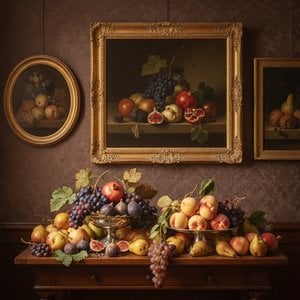
Soreau’s paintings typically feature arrangements confined to small tables or shelves – a deliberate choice that invites close scrutiny and encourages the viewer to engage with each individual element. These “table-top still lifes” are far more than mere inventories of objects; they are carefully orchestrated visual poems, laden with symbolic meaning. Fruits often represent fertility and abundance, while flowers evoke themes of beauty, grace, and mortality. Insects, frequently rendered in exquisite detail, can symbolize transformation, death, or the interconnectedness of all living things. The inclusion of everyday items – a pewter goblet, a loaf of bread, a piece of linen – adds layers of domesticity and reinforces the idea that these scenes are rooted in the rhythms of daily life.
Consider his painting “Still Life with Chinese Bowl and Vase of Flowers” (circa 1635). The arrangement is remarkably balanced, with the vibrant colors of the fruit and flowers contrasting against the dark background. The inclusion of a Chinese bowl – a symbol of exoticism and luxury – further elevates the composition, suggesting a world beyond the confines of Frankfurt. Similarly, in “Still Life with Fruit and Flowers,” the artist’s mastery of light is evident in the way it illuminates the glistening surfaces of the fruit and highlights the delicate folds of the petals. These details are not merely decorative; they contribute to the overall sense of realism and immediacy.
A Regent's Role & Legacy
Beyond his artistic endeavors, Soreau held a position of responsibility within Amsterdam’s civic life. In 1681, he was appointed regent of the Nieuwe Zijds Huiszitten almshouse – a testament to his respected standing in the community. This role underscores the fact that Soreau was not simply an artist but also a man of considerable social influence.
Despite the relative obscurity surrounding his life and work, Isaak Soreau’s legacy endures through his captivating still lifes. His paintings offer a poignant glimpse into the world of 17th-century Europe, revealing a keen eye for detail, a deep appreciation for beauty, and a subtle yet profound understanding of symbolism. While he may not be as widely celebrated as some of his contemporaries, Soreau’s quiet abundance continues to resonate with viewers today, inviting them to contemplate the fleeting nature of life and the enduring power of art.
Further Exploration
References
- Sandrart, Joachim von. *Teutsche Academie*.



 Zobacz w skali 1:1
 Przełącz na wersję drukowaną
 Wyślij
 Udostępnij
 Szczegóły
 Przewodnik

 Pobierz plik obrazu
 Podobne obiekty
 RTG
RTG Pokaz slajdów
 Statystyki

 Czytaj więcej






































 Opcja ze szkłem jest dostępna wyłącznie w rozmiarach poniżej 110 cm