A Dreamscape of Venice: Gustave Moreau’s Enigmatic Vision
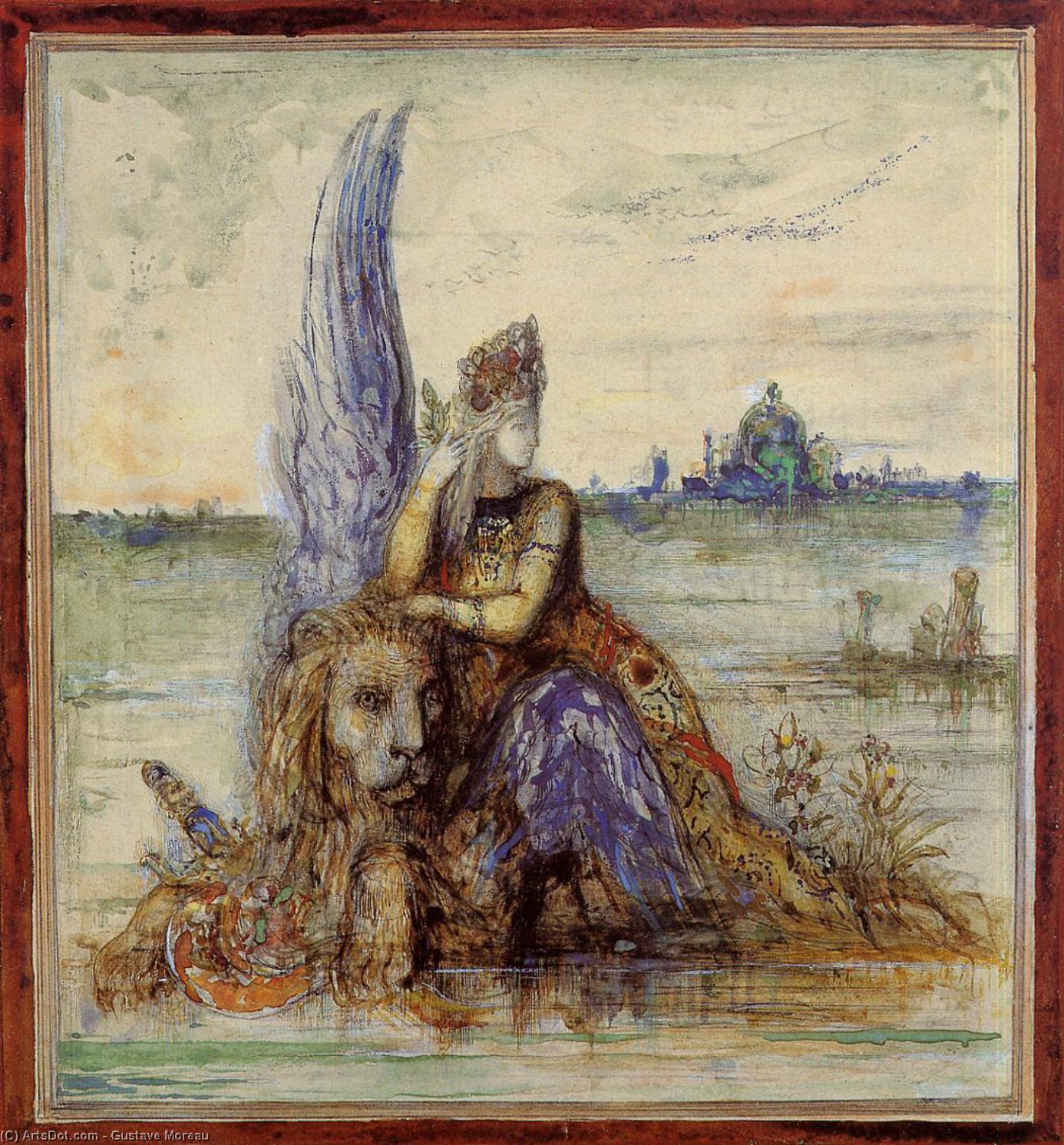
Gustave Moreau's "Venice," painted in 1885, isn’t merely a depiction of a city; it’s an immersion into a realm of myth and emotion. This watercolor, now residing within the hallowed halls of the Musée Gustave Moreau in Paris, embodies the core tenets of Symbolism – a movement that sought to express inner psychological states rather than simply mirroring external reality. Moreau, a master of layering symbolism upon traditional subjects, transforms Venice into an evocative stage for his personal mythology, inviting viewers on a journey through dream and memory.
The painting immediately captivates with its hazy, almost otherworldly atmosphere. The muted palette—dominated by blues, greens, and ochres—creates a sense of distance and timelessness. Moreau’s technique is deliberately loose and fluid, characteristic of watercolor, allowing the colors to bleed into one another and suggesting movement within the water. He employs a broken brushstroke, building up layers of translucent washes that imbue the scene with an ethereal quality. The cityscape itself isn't sharply defined; instead, it appears as a shimmering reflection in the water, further contributing to the dreamlike atmosphere.
The Regal Figure and Symbolic Weight
At the heart of the composition sits a woman seated regally upon the back of a lion – an arresting image that immediately draws the eye. This isn’t a literal representation; it's a carefully constructed symbol. The lion, a potent emblem of strength, power, and royalty throughout history, anchors the figure and elevates her status. Her crown, subtly rendered but undeniably present, reinforces this sense of nobility and perhaps even divinity. Moreau frequently employed female figures from mythology and religious narratives as archetypes in his work, imbuing them with symbolic weight and psychological depth. This woman, positioned within a watery realm, suggests a connection to both the earthly and the spiritual – a figure caught between worlds.
The presence of other individuals adds layers of intrigue to the scene. A solitary figure stands on the left, seemingly observing the tableau, while two others are clustered on the right, their faces obscured by shadow. These figures aren’t merely background elements; they represent potential observers, perhaps even participants in this unfolding dreamscape. The bird perched at the top-left corner adds a touch of lightness and freedom, hinting at transcendence or spiritual aspiration.
A Window into Moreau's World
Understanding Gustave Moreau requires delving into his personal life and artistic philosophy. Born in Paris in 1826, he was deeply influenced by his father’s architectural background, fostering a keen eye for detail and composition. Moreau’s early training at the École des Beaux-Arts provided him with technical skills, but it was his friendship with Théodore Chassériau that truly ignited his Symbolist sensibilities. He rejected the prevailing Realism of the time, instead seeking to express inner emotions and spiritual truths through evocative imagery. His work often explored themes of mythology, religion, and the human psyche, frequently featuring female figures as powerful symbols.
Moreau’s legacy extends beyond this single painting. He was a dedicated teacher, nurturing the talents of artists like Henri Matisse and Georges Rouault, shaping an entire generation of Symbolist painters. His dedication to his craft culminated in the establishment of the Musée Gustave Moreau in 1903, ensuring that his artistic vision would be preserved for posterity. “Venice,” therefore, isn’t just a beautiful artwork; it's a testament to Moreau’s enduring influence and his profound exploration of the human spirit.
Capturing the Essence: A Reproduction for Your Space
WahooArt offers meticulously crafted hand-painted reproductions of Gustave Moreau’s “Venice,” allowing you to bring this captivating dreamscape into your home or office. Our skilled artisans replicate Moreau's delicate watercolor technique and evocative color palette with exceptional precision, ensuring that every detail is faithfully reproduced. Whether you are an art enthusiast, a collector seeking to expand your collection, or simply someone looking for a unique piece of decorative art, our reproduction captures the essence of this iconic work – its mystery, beauty, and profound symbolic depth.
Consider how “Venice” can transform your space. Its ethereal quality will create a sense of tranquility and contemplation, while the rich symbolism invites viewers to engage with the painting on a deeper level. A WahooArt reproduction is more than just an image; it’s a portal into Moreau's world – a world where myth, nature, and urban life converge in a timeless tableau.
Pytania i odpowiedzi
Jakie miejsce w historii sztuki zajmuje „Venice” – Gustaw Moreau?
Pod względem historycznym „Venice” to dzieło z nurtu Symbolist Movement, powstałe w szerszej epoce Early Medieval.
Jaki nastrój oddaje „Venice” – Gustaw Moreau w ramach nurtu Symbolist Movement?
"Venice" emanuje Mysterious emocjonalnym ładunkiem, wpisując się w nurt Symbolist Movement.
Co wyjaśnia sytuację prawną dotyczącą praw autorskich do „Venice” – Gustaw Moreau?
„Venice” – Gustaw Moreau jest należy do domeny publicznej – autorskie prawa majątkowe wygasły. Okres ochrony praw autorskich liczony jest od śmierci artysty, która nastąpiła w 1898.


 Podgląd w skali 1:1
 Przełącz na wydania drukowane
 Wyślij jako kartkę
 Udostępnij
 Szczegóły dzieła
 Przewodnik

 Pobierz obraz
 Podobne obiekty
 RTG
RTG Pokaz slajdów
 Q&A
Q&A Statystyki


 Rozwiń treść


