A Dreamscape of Myth and Memory: Gustave Moreau’s *Prometheus*
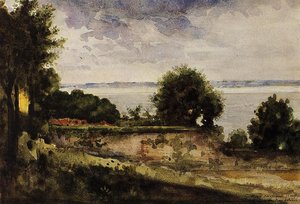
Gustave Moreau's 1868 painting, *Prometheus*, isn’t merely a depiction of the Greek titan; it’s an immersion into a realm of potent symbolism and deeply felt emotion. This oil on canvas, measuring a modest 51 x 87 cm, embodies the core tenets of Symbolism – a movement Moreau helped define – prioritizing evocative suggestion over literal representation. The painting invites us not to simply *see* Prometheus, but to *feel* his burden, his defiance, and the profound consequences of his act of generosity. Moreau masterfully utilizes color and texture to create an atmosphere thick with melancholy and ancient wisdom, drawing the viewer into a world where myth becomes intensely personal.
The Figure at the Heart: Prometheus’s Isolation
At the painting's center sits Prometheus, rendered not as a heroic figure of classical sculpture, but as a man profoundly weary. He is seated upon a rough-hewn rock, his posture suggesting both resignation and stubborn resolve. Moreau deliberately avoids idealized beauty; instead, he presents Prometheus with an almost unsettling stillness, his face etched with the weight of his transgression. The dog at his feet – a recurring motif in Moreau’s work – represents loyalty and perhaps even complicity, while the second dog nearby hints at the duality inherent in the titan's fate: a companion to both reward and punishment. The careful placement of these animals anchors Prometheus within a domestic space, subtly transforming a mythological narrative into a deeply human one.
Symbolic Echoes: Birds, Clouds, and the Weight of Fire
Moreau’s genius lies in his layering of symbols. The two birds are particularly significant; one perched above Prometheus, seemingly observing him with detached wisdom, while the other, positioned near the upper right corner, suggests a distant, unattainable paradise – a reminder of what was lost when fire was stolen from the gods. The swirling clouds that dominate the background aren’t simply atmospheric detail; they represent chaos and the turbulent consequences of Prometheus's actions. They also evoke the heavens themselves, connecting the earthly scene with the divine realm from which the fire originated. The muted palette – dominated by browns, blues, and ochres – reinforces this sense of somber contemplation.
A Window into Symbolism: Moreau’s Technique and Context
Created during a period when Symbolist painting was challenging the conventions of Realism and Impressionism, *Prometheus* exemplifies Moreau's distinctive approach. He eschewed bright colors and fleeting effects in favor of rich, dark tones and meticulous detail. His brushwork is deliberately dense and textured, creating a surface that feels almost sculptural. Moreau’s artistic training at the École des Beaux-Arts provided him with a solid foundation, but his true innovation lay in his ability to infuse traditional academic techniques with intensely personal symbolism. The painting's creation coincided with Moreau’s exploration of themes related to mythology, religion, and the human psyche – subjects he would continue to grapple with throughout his career. His dedication is further evidenced by the existence of the Musée National Gustave-Moreau in Paris, a testament to his profound influence on the art world.
A hand-painted reproduction of *Prometheus* offers an exceptional opportunity to bring this evocative masterpiece into your home or office. WahooArt’s meticulous reproductions capture the painting's rich textures and atmospheric depth with unparalleled accuracy, allowing you to experience the power and beauty of Moreau’s vision firsthand. Consider how this powerful image can add a touch of timeless mystery and intellectual resonance to your space.
Pytania i odpowiedzi
Któremu artyście przypisuje się "Prometheus"?
„Prometheus” zostało stworzone przez Gustaw Moreau. Informacje na tej stronie opisują oryginalne dzieło autorstwa Gustaw Moreau.
Do którego etapu rozwoju Gustaw Moreau należy dzieło „Prometheus”?
„Prometheus” należy do Mature Symbolism w twórczości Gustaw Moreau. Klasyfikacja ta wiąże dzieło z rozwojem artysty.
Jak opisuje się paletę kolorystyczną dzieła „Prometheus” autorstwa Gustaw Moreau?
Kolory dzieła "Prometheus" tworzą Earthy paletę barw. Klasyfikacja ta opisuje dominujące rodziny kolorystyczne.
Jaka jest technika i wymiary dzieła „Prometheus” autorstwa Gustaw Moreau?
Technika wykonania dzieła „Prometheus” autorstwa Gustaw Moreau to Oil On Canvas, a jego wymiary to 51 x 87 cm.
W jakim wieku Gustaw Moreau stworzył(a) "Prometheus"?
Gustaw Moreau miał 42 lat, tworząc „Prometheus” w 1868. Wiek ten został obliczony na podstawie roku urodzenia artysty, 1826.
W którym roku powstało dzieło "Prometheus"?
Dzieło „Prometheus” autorstwa Gustaw Moreau powstało w 1868.
Jaką intensywność kolorów ma „Prometheus” autorstwa Gustaw Moreau?
„Prometheus” autorstwa Gustaw Moreau charakteryzuje się Monochromatic intensywnością kolorów.



 Zobacz w skali 1:1
 Przełącz na wersję drukowaną
 Wyślij
 Udostępnij
 Szczegóły
 Przewodnik

 Pobierz plik obrazu
 Podobne obiekty
 RTG
RTG Pokaz slajdów
 Statystyki


 Czytaj więcej






































 Opcja ze szkłem jest dostępna wyłącznie w rozmiarach poniżej 110 cm