A Descent into Mythic Desire
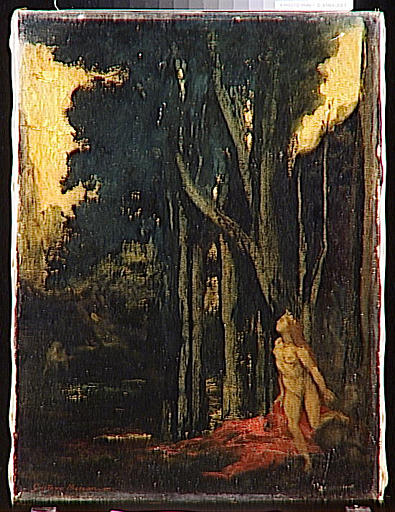
To encounter Gustave Moreau’s Pasiphaé is to step beyond the veil of the tangible world and enter a realm where the boundaries between dream and reality dissolve. This monumental canvas, painted during the height of the Symbolist movement between 1890 and 1895, serves as much more than a mere retelling of Greek mythology; it is an immersive psychological landscape. The painting captures the profound tension of the Phoenician queen of Crete, whose legendary encounter with Zeus's bull birthed a legacy of transgression and monstrous beauty. Moreau does not rely on explicit, jarring storytelling, but instead invites the viewer into a state of quiet, unsettling contemplation, where every shadow and glimmer of light whispers of forbidden longing.
The composition is masterfully orchestrated to evoke an atmosphere of oppressive enchantment. A dense, dreamlike forest dominates the scene, with towering trees whose intertwining branches create a claustrophobic yet majestic canopy. This labyrinthine setting mirrors Pasiphae’s own tormented inner state, trapping her within a visual metaphor for her inescapable fate. As the eye wanders through the muted, atmospheric depths, one might catch glimpses of distant figures that add layers of complexity to this mythic stage, suggesting a world teeming with unseen, archetypal forces.
The Alchemy of Symbolist Technique
Moreau’s technical prowess is on full display through his meticulous use of tempera on canvas, a medium he favored for its ability to achieve an almost supernatural luminosity. He employs a palette rich in golds and deep reds, which glow against more somber, earthy tones, creating a dramatic chiaroscuro effect that breathes life into the mythological figures. His style is characterized by a unique blend of fine, intricate detail and a deliberate flattening of perspective, a hallmark of Symbolist aesthetics that prioritizes emotional resonance over photographic accuracy.
The artist’s brushwork creates a texture that feels both ancient and ethereal. By eschewing the fleeting light of the Impressionists in favor of a more permanent, jewel-like finish, Moreau achieves a sense of timelessness. This technique allows the painting to function as a window into the subconscious, where the physical world is secondary to the spiritual and emotional truths being conveyed. For the collector or designer, this piece offers a profound depth of texture and color that can serve as a commanding focal point in any curated space.
Philosophical Echoes and Emotional Resonance
Beyond its visual splendor, Pasiphaé is deeply rooted in the intellectual currents of the late 19th century. Moreau was profoundly moved by Nietzschean philosophy, particularly the concept of Eternal Recurrence—the idea that life and myth repeat in endless, archetypal cycles. In this work, the bull stands as a potent symbol of primal instinct and irrationality, while Pasiphae represents the vulnerability of the human soul when confronted with overwhelming, elemental forces. The painting captures that precise, breathless moment of transition between human agency and divine or animalistic destiny.
For those seeking to bring art into their homes that transcends mere decoration, this reproduction offers an opportunity to possess a piece of profound intellectual and emotional weight. It is an artwork that demands engagement, rewarding the viewer with new discoveries upon every glance. Whether placed in a quiet study or a grand gallery, Moreau’s vision of mythic desire provides a sophisticated, evocative atmosphere, inviting all who behold it to explore the beautiful, haunting mysteries of the human psyche.
Pytania i odpowiedzi
Gdzie mogę znaleźć statystyki dotyczące „Pasiphaé” – Gustaw Moreau?
Statystyki dotyczące „Pasiphaé” – Gustaw Moreau znajdują się na stronie Statystyki wyświetleń dzieła: obejmują one miesięczną liczbę odwiedzin danego dzieła, wizyty przy pracach artysty oraz podział ostatnich odwiedzających według krajów i języków.
W jaki sposób styl dzieła "Pasiphaé" odnosi się do epoki jego twórcy?
„Pasiphaé” – Gustaw Moreau reprezentuje nurt Symbolist Painting, powstały w epoce – Wiek XIX swojego twórcy.
Czy kolory dzieła "Pasiphaé" są intensywne czy stonowane?
Dzieło „Pasiphaé” – Gustaw Moreau charakteryzuje się nasyceniem na poziomie Muted oraz intensywnością Monochromatic.


 Podgląd w skali 1:1
 Przełącz na wydania drukowane
 Wyślij jako kartkę
 Udostępnij
 Szczegóły dzieła
 Przewodnik

 Pobierz obraz
 Podobne obiekty
 RTG
RTG Pokaz slajdów
 Statystyki

 Rozwiń treść






































 Opcja ze szkłem jest dostępna wyłącznie w rozmiarach poniżej 110 cm





