x
Podgląd w skaliPodgląd w skali Podgląd ARPodgląd AR Zamów wydruk Zamów wydrukKup obraz wysokiej rozdzielczości Kup obraz wysokiej rozdzielczości Wyślij jako kartkęWyślij jako kartkę
Szczegóły dziełaSzczegóły dzieła Dodaj do ulubionych Dodaj do ulubionych PobierzPobierz Podobne obiektyPodobne obiekty RTGRTG Pokaz slajdówPokaz slajdów

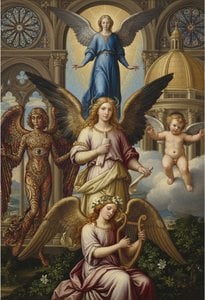
Archangel

Discover 'Archangel' by Guariento d’Arpo – a stunning Renaissance masterpiece! Admire its classical style, intricate details & symbolic elements of good vs. evil. Explore this unique artwork today!

Guariento di Arpo (1310-1370) was a 14th-century Paduan painter bridging Florentine realism & Venetian Gothic styles. Known for frescoes depicting St. Augustine's life, Madonna panels, and his Paradise fresco in the Palazzo Ducale. A pivotal early Re

Ręcznie malowana reprodukcja olejowa

Ręcznie malowany obraz olejny na płótnie, wykonany na zamówienie przez naszych artystów w wybranym przez Ciebie wymiarze i oprawie. (Zamów wydruk Zamów wydrukKup obraz wysokiej rozdzielczości Kup obraz wysokiej rozdzielczości)

Standardowy rozmiar
na wymiar
CM
INCH

Wybierz spośród naszych standardowych rozmiarów, które zachowują oryginalne proporcje dzieła sztuki.

szerokość
wysokość

Możesz wprowadzić własne wymiary, aby dopasować obraz do konkretnej ramy lub przestrzeni. Jeśli wybrany rozmiar nie będzie odpowiadał proporcjom oryginału, przytniecie dzieło sztuki lub rozszerzymy je o dodatkowe elementy, ręcznie domalowane przez artystę. Przed rozpoczęciem produkcji wyślemy projekt cyfrowy do Twojej akceptacji.
Należy pamiętać, że podgląd na ekranie nie odzwierciedla rzeczywistego przycinania ani rozszerzania obrazu. Tylko projekt dokładnie pokaże ostateczną kompozycję.
Choć oferujemy możliwość zamówienia niestandardowych rozmiarów, zalecamy wybór wymiaru z gotowej listy, aby zachować oryginalne proporcje dzieła.

Przykłady możliwych zmian: Zamień twarz na zdjęcie klienta; Dodaj zwierzę domowe (np. zamień kota na psa); Ukryj wiadomość w tle; Zmień krajobraz lub elementy tła.
Po złożeniu zamówienia zespół WahooArt.com skontaktuje się z klientem drogą mailową w celu uzyskania instrukcji i prześle wizualizację projektu

Dostawa na całym świecie () w ciągu 3–4 tygodni zamiast standardowych 5 tygodni. (28 Sierpień). Bez kompromisów w kwestii jakości.

why_choose_icon
Bezpłatna ekspresowa wysyłka na cały świat
why_choose_icon
Wysokiej jakości płótno lniane
why_choose_icon
Pełne ubezpieczenie przesyłki
why_choose_icon
Gwarancja zwrotu należności celnych i podatków importowych
why_choose_icon
Gwarancja wiernego odwzorowania kolorów
why_choose_icon
Polityka 60-dniowego zwrotu (tylko w przypadku wad)
why_choose_icon
Gwarancja 100% zwrotu kosztów
why_choose_icon
Zniżka przy zamówieniu wielu produktów

Suma całkowita

$ 272

reproduction

Archangel

Technika reprodukcji

Wymiary reprodukcji

-

Cena całkowita

$ 272


O artyście

The Master of Padua: The Life and Legacy of Guariento di Arpo

In the vibrant, intellectual atmosphere of fourteenth-century Padua, a transformative artistic voice emerged that would forever alter the trajectory of Venetian painting. Guariento di Arpo (c. 1310–1370) stands as a monumental figure of the Trecento, acting as the essential bridge between the grounded, volumetric realism of Florence and the ethereal, ornamental splendor of the Venetian Gothic tradition. Born into a city flourishing with humanist ideals and Byzantine echoes, Guariento did not merely inherit a style; he synthesized two worlds. His career was defined by an extraordinary ability to marry the structural innovations of the early Renaissance with the decorative grace that would become the hallmark of the Veneto region.

The foundations of Guariento’s genius were laid in the workshops of his contemporaries, where the shadows of masters like Giotto di Bondone and Giovanni Pisano loomed large. From Giotto, Guariento absorbed the revolutionary language of spatial perspective and weight, learning how to imbue figures with a sense of physical presence and psychological depth. Yet, he did not become a mere imitator of the Florentine school. Instead, he infused this new naturalism with a uniquely Venetian sensibility—a penchant for linear elegance and a luminous, almost spiritual abstraction derived from Byzantine influences. This delicate balance allowed his work to possess both a tangible human emotion and a transcendent, heavenly beauty.

A Legacy in Fresco and Panel

Guariento’s most profound contributions to the history of art are etched into the very walls of Padua. His magnum opus remains the breathtaking cycle of frescoes within the choir of the Church of San Bernardino. Commissioned in 1338, these monumental depictions of the life of St. Augustine serve as a masterclass in narrative storytelling. Through these works, one can witness his mastery of volumetric modeling, where figures seem to occupy real space, yet they are draped in a stylistic grace that prevents them from feeling heavy or earthbound. Though much of this cycle was tragically scarred by the bombardments of 1944, the surviving fragments continue to whisper of a lost era of Paduan splendor.

Beyond the expansive reach of his frescoes, Guariento’s skill as a panel painter brought intimacy to the altarpieces of the era. His ability to command precious materials like gold leaf and tempera is evident in several surviving masterpieces held in the world's most prestigious collections:

  • The Coronation of the Virgin (1344): A stunning example of his ability to blend sacred hierarchy with delicate detail, currently housed in the Norton Simon Museum.
  • The Madonna of Humility (1340s): A work that showcases his tender approach to maternal divinity, preserved in the J. Paul Getty Museum.
  • The Madonna and Child (1360s): An exquisite display of late-career refinement, found within the Metropolitan Museum of Art.
  • The Ascension of Christ (1344): A powerful composition that demonstrates his command over dramatic movement, held in the Collezione Vittorio Cini.

Historical Significance and the Venetian Horizon

As his reputation ascended, so too did his influence beyond the borders of Padua. In 1365, the prestige of the Venetian Republic itself beckoned him to the Palazzo Ducale. Tasked with painting a representation of the Coronation of the Virgin, Guariento left an indelible mark on the heart of Venice. In a remarkable twist of art history, his work was only rediscovered in the modern era, hidden beneath the layers of Tintoretto’s later masterpiece, Paradise, during conservation efforts in 1903. This discovery underscored the profound depth of his contribution to the Venetian aesthetic.

Ultimately, the significance of Guariento di Arpo lies in his role as a stylistic pioneer. He was the artist who successfully navigated the transition from the rigid, symbolic forms of the Middle Ages to the more human-centric, three-dimensional reality of the early Renaissance. By weaving together the structural logic of Florence and the decorative lyricism of the Veneto, he provided the blueprint for generations of Venetian painters to follow, ensuring that his name would remain forever entwined with the golden age of Italian art.

guariento d'arpo

guariento d'arpo

1310 - 1370

Krótka nota

  • Artistic Movement Or Style: Early Renaissance; Venetian painting; Gothic art
  • Artists Or Movements Influenced By This Artist:
    • Tintoretto
    • Mantegna
  • Artists Who Influenced This Artist:
    • Giotto di Bondone
    • Marco Polo
  • Date Of Death: 1370
  • Full Name: Guariento di Arpo
  • Nationality: Italian
  • Notable Artworks:
    • Coronation of the Virgin Altarpiece
    • Madonna of Humility
    • Madonna and Child
    • Ascension of Christ
    • Scenes from the Life of Mary Magdalene: The Hermit Zosimus Giving a Cloak to Magdalene
  • Place Of Birth: Padua