The Portrait of John Jay by Gilbert Stuart
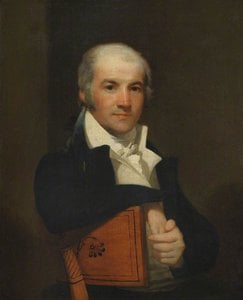
In this oil on canvas, Gilbert Stuart captures the likeness of John Jay, a prominent American statesman. The subject sits with a quiet, heavy presence, his form anchored by the weight of his office. As the first Chief Justice of the United States Supreme Court, Jay carries the gravity of a nascent nation within his steady gaze. The portrait is a study of a man shaped by the foundational movements of a new republic.
The creation of this work spanned decades. Stuart began the painting in 1784, leaving the canvas to evolve alongside the history of the country it depicts. It was not until 1818 that the work reached its final state. This long duration allowed the image to settle, much like the legal structures Jay helped to establish. The brushwork traces the contours of a life dedicated to the complexities of law and governance.
A sense of stillness pervades the scene. The sitter remains caught in a moment of contemplation, his identity tied to the parchment and the books that surround him. Through Stuart's hand, the statesman is rendered not as a distant figure, but as a man of intellect and duty. The paint holds the shadow of a long, unfolding history.
Composition and Visual Elements of the Portrait
The subject sits with a deliberate composure, a stillness that anchors the frame. His gaze is directed downward, eyes cast toward the unseen, appearing lost in contemplation. This downward tilt suggests a mind deeply engaged with complex matters of state, turning inward even as he occupies a position of public weight. There is a sense of dignified restraint in his posture, a quietude that balances his commanding presence.
A rich crimson robe wraps around him, its deep hue punctuated by gold trim. The weight of the fabric suggests the gravity of his office. Light catches the edges of the embroidery, tracing the contours of his form against the shadows. The composition relies on these heavy textures and the steady, unmoving silhouette of the sitter to establish a sense of permanence. The stillness of the man meets the stillness of the room.
Materials and Technical Details of the Work
The portrait is executed in oil on canvas, a medium that allows for the precise rendering of texture and light. The surface captures the heavy weight of wool and the subtle sheen of silk through deliberate brushwork. Every detail, from the fine lines of the paper to the grain of the leather-bound books, is anchored by a controlled application of pigment. The scale of the work measures 128.3 x 101.6cm.
Light enters the composition from the upper left, casting soft shadows that define the contours of the face and the folds of the drapery. This directional illumination creates a sense of volume, pulling the subject forward from the dark, muted background. The interplay of light and shadow provides a structural depth to the sitter's features and the surrounding objects. Color is used to establish a sense of gravity, relying on deep browns, rich reds, and dark greens to ground the figure.
The technical execution relies on a balance of smooth transitions and sharp, defined edges. The skin tones appear luminous, achieved through careful layering of oil paints. This method ensures that the subject's character is captured through the subtle modeling of light across the brow and hands. The paint holds the stillness of the room.
Where to View This Artwork Today
The oil on canvas rests within the National Gallery of Art in Washington, D.C. It belongs to the collection of the National Portrait Gallery, Smithsonian Institution. Visitors may find the subject in the East Gallery, specifically at station 140. The work is cataloged under the object number NPG.74.46.
The frame holds the figure in a quiet space of history. Light falls across the painted surface in the gallery, much like the directional light captured in the brushwork. It remains a steady presence in the hall. The man sits in his stillness.
Pytania i odpowiedzi
W którym roku powstało dzieło "John Jay"?
"John Jay" powstało w 1784 roku. Data ta pozwala umiejscowić dzieło w kontekście twórczości Gilbert Charles Stuart oraz epoki, w której powstało.
Jakie są wymiary oryginalnego dzieła „John Jay” – Gilbert Charles Stuart?
Oryginalne wymiary dzieła „John Jay” to 128.3 x 101.6cm. Znajomość pierwotnej skali może być pomocna przy wyborze odpowiedniego rozmiaru reprodukcji.
Co to za dzieło: "John Jay"?
"John Jay" to WallArt.