A Symphony of Abstraction: Exploring Gerhard Richter’s “Clouds”
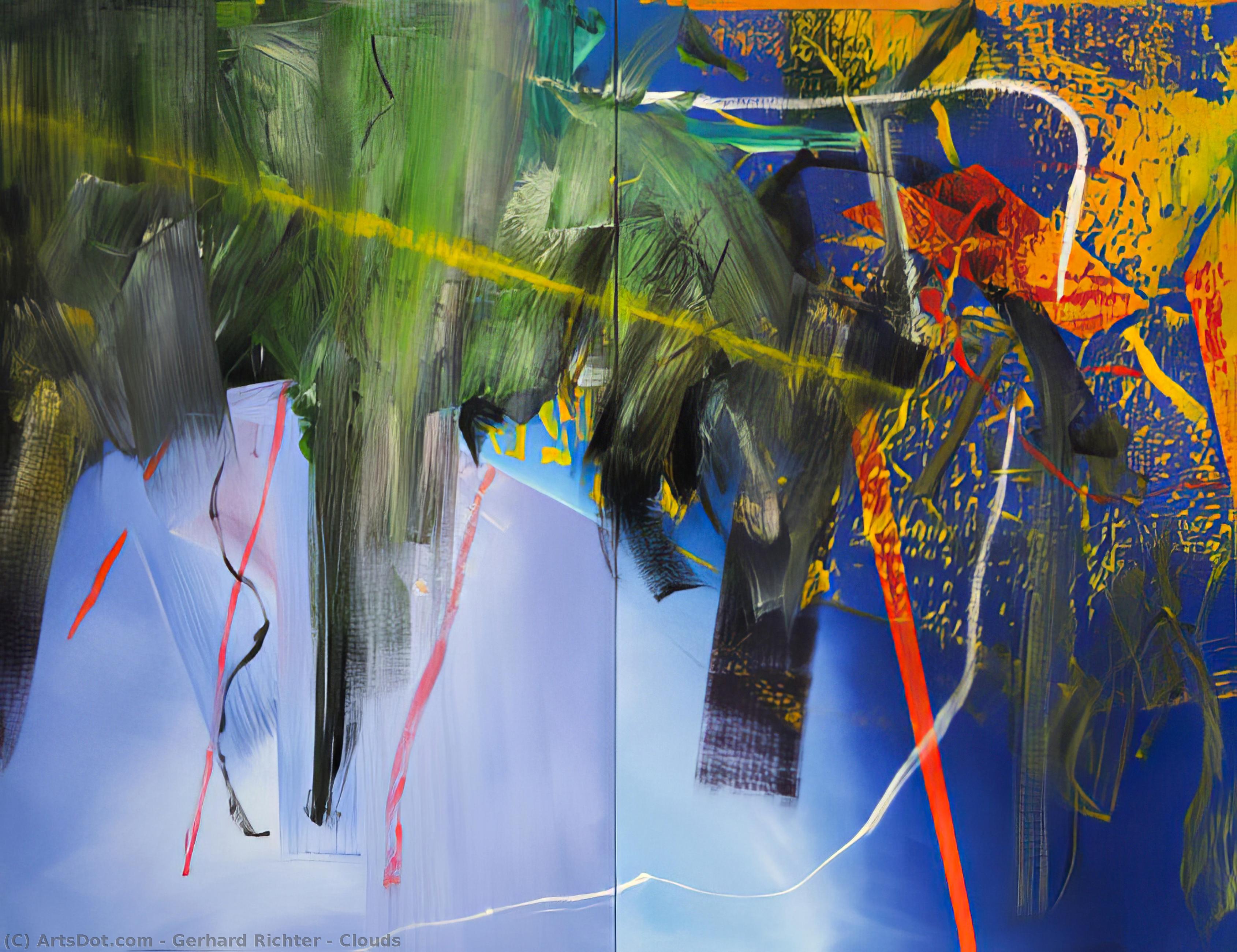
Gerhard Richter's 1982 masterpiece, "Clouds," is a pivotal work in contemporary art, embodying his lifelong exploration of the boundaries between representation and abstraction. This large-scale painting isn't merely an image *of* clouds; it’s an investigation into perception, the act of seeing, and the very nature of painting itself. It invites us to question what we expect from a landscape and revel in the pure visual experience.
Deconstructing Reality: Style & Technique
“Clouds” exemplifies Richter's unique approach – a masterful blend of abstract expressionism with subtle realism. Measuring 200 x 260 cm, the canvas is awash in layered oil paint, applied with bold strokes, scrapes, and smudges. This isn’t precise rendering; it’s an *evocation* of atmosphere. The technique – often described as a form of blurred photorealism pushed to its abstract limits – creates a sense of depth and movement.
- Impasto & Layering: Richter's generous application of paint, visible through the impasto texture, adds physicality and dynamism.
- Color Palette: A vibrant interplay of blues, greens, yellows, reds, and oranges suggests a dynamic sky, perhaps stormy or illuminated by shifting light.
- Gestural Abstraction: The sweeping brushstrokes and blurred forms are not random; they’re carefully constructed to create an immersive visual experience.
Richter's Artistic Journey & Context
Gerhard Richter (born 1932) is a German artist whose career has been defined by stylistic shifts and conceptual rigor. Emerging in the post-war era, he grappled with questions of history, memory, and representation. His work often oscillates between photorealistic paintings – based on photographs – and abstract compositions like “Clouds.” This duality reflects his skepticism towards fixed meanings and a desire to challenge artistic conventions. "Clouds" sits comfortably within this oscillation, playfully disrupting our expectations of what a landscape painting should be. It’s part of a series of cloud paintings Richter created, exploring the ephemeral nature of these atmospheric formations. He began his artistic journey in Dresden during the turbulent years following World War II, absorbing influences from both Expressionism and Surrealism. His early works demonstrated a preoccupation with capturing fleeting moments and conveying emotional resonance—a characteristic that would persist throughout his prolific career.
Symbolism & Emotional Resonance
While seemingly devoid of explicit symbolism, “Clouds” resonates with deeper meanings. The ambiguity inherent in the abstract forms invites individual interpretation. The swirling shapes can evoke feelings of turbulence, vastness, or even a dreamlike state. Richter’s intention wasn't to *tell* us what to feel but to create an experience that allows for personal connection and emotional response.
The painting subtly questions our desire to find concrete meaning in art, suggesting instead that we might simply appreciate the beauty of visual pleasure. It speaks to a broader philosophical inquiry into how perception shapes reality—a core concern within Richter’s oeuvre.
Legacy & Accessibility
“Clouds” is a significant work within Richter’s oeuvre and modern art history. It has been exhibited at prestigious institutions like the Tate Modern in London and currently resides in the collection of the Museum of Modern Art (MoMA) in New York City, solidifying its importance.
- For Collectors: Owning a piece that embodies Richter’s innovative spirit is an investment in art history.
- For Interior Designers: The dynamic composition and vibrant colors of “Clouds” can serve as a striking focal point in any contemporary space, adding depth and sophistication.
- Reproductions Available: Experience the essence of Richter’s genius with high-quality, handmade oil painting reproductions available at WahooArt.com.
Further Exploration
Delve deeper into the world of Gerhard Richter and the history of painting with resources like
Wikipedia’s History of Painting page. “Clouds” is more than just a painting; it's an invitation to contemplate the power of abstraction, the complexities of perception, and the enduring legacy of one of contemporary art’s most influential figures.
Photo Description: --Overall Impression-- The artwork is a large-scale abstract painting divided into two distinct sections. It presents a dynamic and energetic composition characterized by bold brushstrokes, layered colors, and a sense of movement. The style leans towards expressionism with elements of gestural abstraction. The subject matter appears to be an atmospheric depiction of clouds or perhaps a stormy sky, though it’s highly stylized and not representational in a literal sense. The use of lines is prominent – thick, sweeping brushstrokes create diagonal pathways across the canvas, intersecting and overlapping to generate visual complexity. Shapes are largely amorphous and undefined, contributing to the abstract nature of the piece. Textures are heavily emphasized through visible impasto techniques; the paint application is thick and uneven, creating a tactile quality. The lighting appears diffused, suggesting an overcast or atmospheric setting. Perspective is deliberately flattened, lacking traditional depth cues.
Size: 200 x 260 cm
Date: 1982
ARTIST INFORMATION:
==================
Artist: Gerhard Richter
Birth Year: 1932
Death Year: Living
Birth City: Dresden
Birth Country: Germany
Biography:
A Life Shaped by Division: The Early Years and Artistic Formation of Gerhard Richter
Gerhard Richter’s story is inextricably linked to the fractured history of 20th-century Germany. Born in Hospital Dresden-Neustadt in Dresden, Saxony, and grew up in Reichenau (now Bogatynia, Poland), and in Waltersdorf (Zittauer Gebirge), in the Upper Lusatian countryside, where his father worked as a village teacher. Gerhard's mother, Hildegard Schönfelder, gave birth to him at the age of 25. Hildegard's father, Ernst Alfred Schönfelder, at one time was considered a gifted pianist. Ernst moved the family to Dresden after taking up the family enterprise of brewing and eventually went bankrupt. Once in Dresden, Hildegard trained as a bookseller, and in doing so realized a passion for literature and music. Horst and Hildegard were able to remain primarily apolitical due to Reichenau's location in the countryside. Horst, being a teacher, was eventually forced to join the National Socialist Party. He never became an avid supporter of Nazism, and was not required to attend party rallies. When he was 10 years old, Gerhard was conscripted into the Deutsches Jungvolk; the Hitler Youth, was dissolved at the end of the war, before Richter reached the age of enlistment. In 1943, Hildegard moved the family to Waltersdorf, and was later forced to sell her piano. Two brothers of Hildegard died as soldiers in the war and a sister, Gerhard's aunt Marianne, who had schizophrenia, was starved to death in a psychiatric clinic, a victim of the Nazi euthanasia program.\nRichter left school after 10th grade and apprenticed as an advertising and stage-set painter, before studying at the Dresden Academy of Fine Arts. In 1951, he finished vocational high school in Zittau and, between 1951 and 1954, successively worked as a painter. Richter's artistic journey began with a fascination for photography—a medium that would profoundly influence his visual language. He was drawn to the way photographs captured fleeting moments of reality, distilling complex scenes into simplified images. This initial encounter with photography instilled in him a desire to explore similar techniques within painting—specifically, blurring and layering images to create an illusion of depth and atmosphere. Richter's formative years were marked by displacement and hardship, shaping his worldview and fueling his artistic impulse. He honed his skills at the Academy of Fine Arts in Dresden, where he studied under influential teachers like Karl von Appen and Heinz Lohmar—artists who championed both tradition and innovation. Richter’s stylistic evolution reflects a continuous dialogue between opposing forces—a commitment to meticulous observation alongside an embrace of spontaneity and abstraction.",
"type": "wikipedia_search"
}}