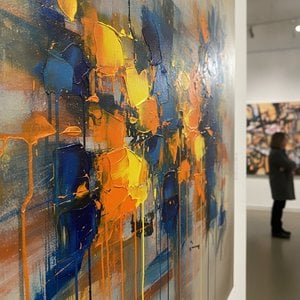
A Fragmented Landscape of Emotion
In the vast, often turbulent landscape of contemporary art, few works command the room with such quiet, brooding intensity as Gerhard Richter’s Untitled (1968). This masterpiece is far more than a mere arrangement of pigment on canvas; it is a visceral distillation of experience, a visual echo of an era defined by political upheaval and profound uncertainty. Measuring a striking 80 x 40 cm, the painting presents a verticality that feels both monumental and intimate, pulling the viewer into a rhythmic, flowing composition that resembles a dark waterfall or a cascading ribbon of shadow. The palette is masterfully restrained, dominated by deep greys and somber blacks, yet it is within these subtle tonal variations that the true soul of the work resides. For the discerning collector or interior designer, this piece offers a sophisticated anchor—a way to introduce depth, gravity, and a sense of contemplative luxury into any curated space.
The power of this work lies in its masterful execution of the wet-on-wet technique, a method that allows for an astonishing fluidity. Richter does not merely paint; he orchestrates a dance of textures. Through thick, heavy impasto strokes, the artist creates a palpable surface that invites tactile engagement, where layers of oil paint overlap and bleed into one another to create a sense of perpetual motion. This spontaneous, gestural approach—reminant of the Abstract Expressionist movement—eschews precise control in favor of raw, emotional impact. The way the light catches the ridges of the dried paint creates soft shadows and highlights, ensuring that the artwork transforms as the ambient lighting of a room shifts throughout the day, making it a dynamic presence in any gallery or private residence.
Echoes of History and the Beauty of Abstraction
To look upon this painting is to witness the visual language of a fractured world. Created in 1968, the work emerged from a Germany still grappling with the traumatic legacies of World War II and the ideological divisions of the Cold War. Richter’s upbringing in Dresden, marked by displacement and the shadows of authoritarianism, instilled in him a lifelong preoccupation with fragmentation and the questioning of reality. In this piece, the absence of recognizable imagery is a deliberate, profound choice. By stripping away the literal, Richter forces us to confront the abstract essence of feeling—the chaos, the flow, and the search for stability amidst a landscape of change.
For those seeking to decorate with intention, Untitled (1968) serves as an exquisite focal point that transcends mere decoration. It embodies a sophisticated minimalism that complements both modern architectural settings and classic, traditional interiors. Its monochromatic elegance allows it to integrate seamlessly with diverse color schemes, while its heavy texture provides the necessary "soul" to prevent a room from feeling sterile. Owning a high-quality reproduction of this work is an opportunity to possess a piece of art history—a fragment of a larger narrative about resilience, memory, and the enduring power of the human spirit to find beauty within the void.
Pytania i odpowiedzi
Jaki nastrój towarzyszy stylowi Abstract Expressionism w dziele „Untitled”?
Reflective emocja dzieła „Untitled” współgra z jego stylem Abstract Expressionism.
Jaka technika została użyta w przypadku "Untitled" i kiedy powstało to dzieło?
"Untitled" powstało w 1968 roku przy użyciu techniki Oil On Canvas. Materiał i data opisują, w jaki sposób oraz kiedy wykonano oryginał.
Jak bardzo znane jest dzieło "Untitled" autorstwa Gerhard Richter?
„Untitled” autorstwa Gerhard Richter ma poziom popularności określony jako Iconic. Klasyfikacja ta odzwierciedla stopień rozpoznawalności dzieła.
Ile lat miał(a) Gerhard Richter, tworząc "Untitled" w 1968 roku?
Gerhard Richter miał 36 lat, tworząc „Untitled” w 1968. Wiek ten został obliczony na podstawie roku urodzenia artysty, 1932.
Kto jest autorem dzieła "Untitled"?
Dzieło "Untitled" przypisuje się Gerhard Richter.
Czy istnieje karta informacyjna o „Untitled” autorstwa Gerhard Richter przeznaczona dla studentów?
Przewodnik po "Untitled" to strona Przewodnik dzieła sztuki – nadrukowalna karta informacyjna prezentująca utwór wraz z podpisem, informacją o autorstwie oraz tabelą danych (artysta, daty, technika, wymiary oryginału, kolekcja).
W którym roku powstało „Untitled” autorstwa Gerhard Richter?
Dzieło „Untitled” autorstwa Gerhard Richter powstało w 1968.



 Zobacz w skali 1:1
 Przełącz na wersję drukowaną
 Wyślij
 Udostępnij
 Szczegóły
 Przewodnik

 Pobierz plik obrazu
 Podobne obiekty
 RTG
RTG Pokaz slajdów
 Statystyki


 Czytaj więcej






































 Opcja ze szkłem jest dostępna wyłącznie w rozmiarach poniżej 110 cm