Druk giclée lub płótno o jakości muzealnej, szybka realizacja i szeroki wybór opcji wykończenia. ( Zamów ręcznie malowaną reprodukcję Kup obraz wysokiej rozdzielczości)





























Wybierz spośród naszych standardowych rozmiarów, które zachowują oryginalne proporcje dzieła sztuki.

Możesz wprowadzić własne wymiary, aby dopasować dzieło do konkretnej ramy lub przestrzeni. Jeśli wybrany rozmiar nie będzie odpowiadał proporcjom oryginalnego obrazu, przytniecie dzieło lub rozszerzymy obraz za pomocą odbicia lustrzanego lub jednolitego wypełnienia krawędzi. Przed rozpoczęciem produkcji prześlemy cyfrową wizualizację do Twojej akceptacji.
Prosimy pamiętać, że podgląd na ekranie nie odzwierciedla faktycznego przycinania ani rozszerzania. Tylko wizualizacja dokładnie pokaże końcową kompozycję.
Mimo dostępności niestandardowych rozmiarów, zalecamy wybór wymiaru z listy zdefiniowanej, aby zachować oryginalne proporcje.
Dostawa na cały świat () w ciągu 2 tygodni zamiast standardowych 4/5 tygodni. (6 Wrzesień)


Man Dining
Wymiary reprodukcji
Georges Pierre Seurat (1859-1891) stands as a monumental figure in the artistic landscape of late 19th century France, irrevocably altering perceptions of painting through his pioneering exploration of Pointillism. More than just a technique—though undeniably revolutionary—Pointillism represented a profound intellectual commitment to scientific principles and an unwavering dedication to capturing optical reality. Seurat’s brief but impactful career wasn't merely about applying pigment; it was about fundamentally reshaping how artists understood the relationship between perception and representation.
Seurat’s intellectual framework was inseparable from his artistic practice. He meticulously studied the work of Henri Poincaré, a mathematician who championed the idea that color perception is not simply how objects appear but rather how they are interpreted by the eye—a concept central to Pointillism's theoretical underpinning. This dedication to scientific rigor distinguishes Seurat’s approach from many of his contemporaries and underscores his conviction that art could benefit from incorporating insights into sensory experience.
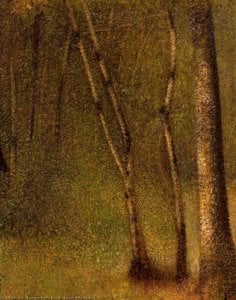
“Man Dining” exemplifies Seurat’s early experiments with Pointillism, demonstrating a willingness to challenge established artistic conventions. While he would later refine the technique—particularly in monumental canvases like ‘A Sunday on La Grande Jatte’—this smaller study remains a testament to his foundational understanding of optical mixing and his unwavering commitment to capturing the essence of visual perception. It stands as an enduring symbol of Seurat's transformative contribution to modern art.
The artwork’s subdued palette and textured surface lend themselves beautifully to interior design projects seeking a calming, contemplative aesthetic. Consider incorporating reproductions in spaces where tranquility is valued—perhaps alongside complementary shades of grey or earthy tones—to evoke the same sense of quiet observation that characterizes Seurat's masterpiece.


1859 - 1891 , Francja

Explore the scientific brilliance of Seurat and Signac. Discover how Pointillism revolutionized color through optical mixing and light, offering a profound look into the Neo-Impressionist movement for true art connoisseurs and collectors.

Explore the vibrant evolution of Post-Impressionism. From Seurat's revolutionary Pointillism to the emotional depth of masters, discover how this movement redefined modern art history through color, structure, and unparalleled creative expression.

 Podgląd w skali
 Wyślij jako kartkę
 Udostępnij
 Szczegóły dzieła

 Pobierz
 Podobne obiekty
 RTG
RTG Pokaz slajdów
 Rozwiń treść







 Opcja ze szkłem jest dostępna wyłącznie w rozmiarach poniżej 110 cm