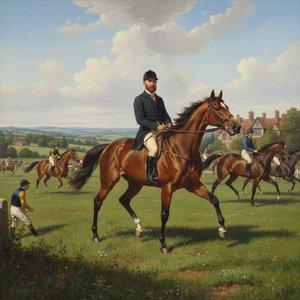
A Vision of Melbourne’s Heart
Frederick McCubbin's "Princess Bridge," painted in 1908, isn't merely a depiction of an iconic Melbourne landmark; it’s a poignant distillation of the Australian spirit. The painting captures the Princess Bridge – then a relatively new and grand structure – bathed in the golden light of late afternoon. More than just architectural detail, McCubbin has imbued the scene with a profound sense of nostalgia and quiet contemplation. The bridge itself, rendered with meticulous precision, becomes a symbol of connection, linking the city to its surrounding landscape. But it’s the subtle details—the fluttering flags, the castle-like structure in the distance reminiscent of European fairy tales, and the scattered figures enjoying the view – that elevate the work beyond simple observation.
The scene is firmly rooted within the Heidelberg School movement, a group of Australian artists who sought to capture the essence of their homeland. Rejecting the academic traditions prevalent at the time, they embraced *plein air* painting—working directly from nature—and developed a distinctive style characterized by loose brushstrokes, vibrant colors, and an intimate portrayal of rural life. McCubbin’s work exemplifies this approach perfectly; he doesn't strive for photographic realism but rather aims to evoke feeling and atmosphere.
The Influence of Turner and the Dawn of Impressionism
McCubbin’s artistic journey was significantly shaped by his exposure to J.M.W. Turner, a pivotal figure in the development of Impressionism. During a trip to Europe in 1907, McCubbin spent time studying Turner's landscapes, particularly his masterful use of light and color. This encounter profoundly impacted McCubbin’s technique, leading him to adopt looser brushwork and prioritize capturing fleeting moments of light and atmosphere. The painting’s hazy quality, the diffused colors, and the emphasis on atmospheric perspective are all hallmarks of this Turner-inspired influence.
Furthermore, "Princess Bridge" anticipates some of the key themes explored by the Heidelberg School – a romanticized vision of the Australian bush, a fascination with pioneering life, and a deep connection to the land. The castle in the background, a fantastical element, adds a layer of mystery and invites viewers to contemplate the relationship between reality and imagination.
Symbolism and Emotional Resonance
Beyond its technical merits, "Princess Bridge" is rich in symbolism. The flags flying above the bridge represent national pride and civic celebration, commemorating the opening of Parliament in 1901. The castle, often interpreted as a symbol of European heritage, subtly contrasts with the rugged Australian landscape, suggesting a dialogue between tradition and modernity. The figures scattered throughout the scene are not merely observers but participants in this shared experience—they represent the diverse communities that make up Melbourne.
Ultimately, "Princess Bridge" evokes a sense of quiet beauty and wistful nostalgia. It’s a painting that invites viewers to slow down, appreciate the simple pleasures of life, and reflect on the enduring spirit of Australia. The soft light, the evocative details, and the underlying symbolism combine to create an artwork that is both visually stunning and emotionally resonant—a true masterpiece of Australian art.
Pytania i odpowiedzi
Jaka technika i styl charakteryzują „Princess Bridge” autorstwa Frederick McCubbin?
W "Princess Bridge" technika Acrylic On Canvas spotyka się z nurtem Heidelberg School.
W jakiej technice wykonano „Princess Bridge” autorstwa Frederick McCubbin?
„Princess Bridge” wykonano w technice Acrylic On Canvas.
Który artysta i jaki styl stoją za "Princess Bridge"?
Frederick McCubbin stworzył "Princess Bridge" w ramach nurtu Heidelberg School.



 Zobacz w skali 1:1
 Przełącz na wersję drukowaną
 Wyślij
 Udostępnij
 Szczegóły
 Przewodnik

 Pobierz plik obrazu
 Podobne obiekty
 RTG
RTG Pokaz slajdów
 Statystyki


 Czytaj więcej






































 Opcja ze szkłem jest dostępna wyłącznie w rozmiarach poniżej 110 cm