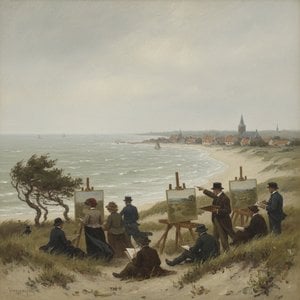
A Moment Frozen in Time: Frederick McCubbin’s Falls Bridge
Frederick McCubbin's “Falls Bridge, Melbourne” isn’t merely a depiction of a river crossing; it’s a poignant snapshot of late 19th-century Australian life. Painted in 1882 during his formative years within the Heidelberg School, this oil on canvas transports us to a serene and familiar landscape – a scene both intimately local and profoundly evocative. The painting captures a fleeting moment: a warm afternoon light bathing the Yarra River, the sturdy Falls Bridge spanning its course, and the quiet activity of daily life unfolding along its banks. McCubbin’s genius lies in his ability to distill this experience into a composition that is simultaneously detailed and deeply atmospheric, inviting the viewer to step directly into the scene.

The painting’s strength resides in its masterful use of light and color. Notice how McCubbin employs loose, expressive brushstrokes – a hallmark of the Heidelberg School – to capture the shimmering reflections on the water's surface. The warm hues of gold and amber dominate, suggesting either a setting sun or rising dawn, imbuing the scene with a sense of tranquility and nostalgia. The artist’s deliberate blurring of details, characteristic of Impressionism, prioritizes mood and atmosphere over photographic accuracy. This technique creates an almost dreamlike quality, drawing us into the heart of the moment.
Technique and Style: Heidelberg's Legacy
McCubbin’s style is a fascinating blend of naturalism and Impressionistic influence. He meticulously observes the details of his subject – the bridge’s construction, the boats navigating below, the figures strolling along the bank – yet he renders them with a loose, painterly approach. This technique, deeply rooted in the Heidelberg School's philosophy, sought to capture the essence of Australian light and landscape rather than creating a strictly realistic representation. The visible brushstrokes aren’t haphazard; they contribute significantly to the painting’s texture and dynamism, suggesting movement and life within the scene.
The composition itself is carefully considered. The horizontal format emphasizes the expanse of the river and the bridge's dominance. The foreground, anchored by a muddy bank and a horse-drawn cart, provides a grounding element while drawing the eye towards the midground – the bustling activity beneath the bridge. The distant hills and hazy sky create a sense of depth and perspective, further enhancing the painting’s immersive quality. McCubbin's use of atmospheric perspective—making distant elements paler and less defined—is particularly effective in conveying the vastness of the landscape.
A Window into Melbourne’s Past
“Falls Bridge, Melbourne” offers more than just a beautiful landscape; it provides a valuable glimpse into the social and cultural fabric of late 19th-century Melbourne. The presence of the bridge itself – a vital link between the city and its surrounding areas – symbolizes progress and connectivity. The figures on the bridge represent everyday life: workers, travelers, perhaps families enjoying a leisurely afternoon. The horse-drawn cart hints at the region’s agricultural roots and the reliance on traditional modes of transport. This painting is not simply about a physical location; it's about capturing the spirit of a community and its relationship to the land.
Furthermore, McCubbin’s work reflects a broader trend in Australian art at the time – a desire to establish a distinctly national identity through depictions of familiar landscapes and scenes. His paintings often explored themes of rural life, pioneering spirit, and the challenges faced by settlers in a new land. “Falls Bridge, Melbourne” stands as a testament to this artistic movement and its enduring legacy.
Bringing McCubbin’s Vision Home: High-Quality Reproductions
For art enthusiasts seeking to experience the beauty and historical significance of “Falls Bridge, Melbourne,” WahooArt.com offers meticulously crafted hand-painted reproductions that faithfully capture the essence of this iconic artwork. Our skilled artists utilize premium materials and techniques to ensure a faithful representation of McCubbin’s original vision, bringing the painting's atmosphere and detail to life in stunning clarity. Explore our collection today and own a piece of Australian art history.
Pytania i odpowiedzi
Czy dzieło „Falls Bridge, Melbourne” autorstwa Frederick McCubbin znajduje się w kraju pochodzenia artysty?
Tak – dzieło znajduje się w kraju pochodzenia artysty. Frederick McCubbin urodził(a) się w Australia, a oryginał dzieła „Falls Bridge, Melbourne” znajduje się w muzeum w Australia.
Jakie nasycenie kolorów ma „Falls Bridge, Melbourne” autorstwa Frederick McCubbin?
Kolory dzieła „Falls Bridge, Melbourne” autorstwa Frederick McCubbin charakteryzują się Balanced Soft nasyceniem. Nasycenie określa, jak żywe lub stonowane są barwy.
W jaki sposób kolory dzieła „Falls Bridge, Melbourne” autorstwa Frederick McCubbin odnoszą się do jego emocjonalnego przekazu?
„Falls Bridge, Melbourne” autorstwa Frederick McCubbin łączy w sobie Neutrals paletę barw z Melancholic tonem.



 Zobacz w skali 1:1
 Kup ręcznie malowany obraz
 Wyślij
 Udostępnij
 Szczegóły
 Przewodnik

 Pobierz plik obrazu
 Podobne obiekty
 RTG
RTG Pokaz slajdów
 Statystyki


 Czytaj więcej






































 Opcja ze szkłem jest dostępna wyłącznie w rozmiarach poniżej 110 cm