Podgląd w skali 1:1 Podgląd AR Zamów ręcznie malowaną reprodukcję Przejdź do wersji cyfrowej Wyślij jako kartkę
Szczegóły dzieła Przewodnik Dodaj do ulubionych Pobierz obraz Podobne obiekty RTG Pokaz slajdów Statystyki

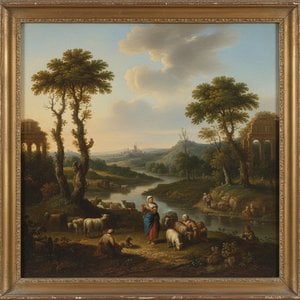
Imaginary Landscape

Explore Francisque Millet's 'Imaginary Landscape,' a serene Belgian Baroque masterpiece inspired by Poussin and Dughet, depicting figures strolling amidst mountains and classical architecture.

Francisque Millet (1642-1679): Flemish-French Baroque painter of serene Italianate landscapes & figures, influenced by Poussin. Discover his legacy & artworks!

Giclée / Wydruk artystyczny

Wydruki giclée lub płótna o jakości muzealnej, szybka realizacja i szeroki wybór opcji wykończenia. ( Zamów ręcznie malowaną reprodukcję Przejdź do wersji cyfrowej)

Corner sample of the P118B picture frame: polistyren formowany, 5 cm wide and 3 cm thick
P118B zł10
Corner sample of the P118H picture frame: polistyren formowany, 5 cm wide and 3 cm thick
P118H zł10
Corner sample of the P118W picture frame: polistyren formowany, 5 cm wide and 3 cm thick
P118W zł10
Corner sample of the P438Z picture frame: polistyren formowany, 5.5 cm wide and 3.5 cm thick
P438Z zł10
Corner sample of the P508JH picture frame: polistyren formowany, 7 cm wide and 3.5 cm thick
P508JH zł12
Corner sample of the P508YH picture frame: polistyren formowany, 7 cm wide and 3.5 cm thick
P508YH zł12
Corner sample of the P805H picture frame: polistyren formowany, 5 cm wide and 3.5 cm thick
P805H zł10
Corner sample of the P805Z picture frame: polistyren formowany, 5 cm wide and 3.5 cm thick
P805Z zł10
Corner sample of the P919BZ picture frame: polistyren formowany, 7 cm wide and 3.5 cm thick
P919BZ zł10
Corner sample of the P919G picture frame: polistyren formowany, 7 cm wide and 3.5 cm thick
P919G zł10
Corner sample of the P919XJ picture frame: polistyren formowany, 7 cm wide and 3.5 cm thick
P919XJ zł10
Corner sample of the P959ZH picture frame: polistyren formowany, 5 cm wide and 3 cm thick
P959ZH zł10
Corner sample of the P968JZ picture frame: polistyren formowany, 6 cm wide and 4 cm thick
P968JZ zł12
Corner sample of the W106C picture frame: lite drewno, 5 cm wide and 3 cm thick
W106C zł8
Corner sample of the W218G picture frame: lite drewno, 5 cm wide and 3 cm thick
W218G zł10
Corner sample of the W218JH picture frame: lite drewno, 5 cm wide and 3 cm thick
W218JH zł8
Corner sample of the W218Y picture frame: lite drewno, 5 cm wide and 3 cm thick
W218Y zł10
Corner sample of the W307PJ picture frame: lite drewno, 6 cm wide and 3 cm thick
W307PJ zł10
Corner sample of the W316G picture frame: lite drewno, 6 cm wide and 3 cm thick
W316G zł10
Corner sample of the W316PJ picture frame: lite drewno, 6 cm wide and 3 cm thick
W316PJ zł8
Corner sample of the W316Y picture frame: lite drewno, 6 cm wide and 3 cm thick
W316Y zł10
Corner sample of the W398PJ picture frame: lite drewno, 5 cm wide and 3 cm thick
W398PJ zł8
Corner sample of the W4111J picture frame: lite drewno, 6.5 cm wide and 3.5 cm thick
W4111J zł10
Corner sample of the W500HY picture frame: lite drewno, 7 cm wide and 5 cm thick
W500HY zł15
Corner sample of the W500JH picture frame: lite drewno, 7 cm wide and 5 cm thick
W500JH zł15
Corner sample of the W692G picture frame: lite drewno, 8 cm wide and 4 cm thick
W692G zł12
Corner sample of the W849H picture frame: lite drewno, 5 cm wide and 3 cm thick
W849H zł8
Corner sample of the W940BG picture frame: lite drewno, 7.5 cm wide and 4.5 cm thick
W940BG zł15
Corner sample of the W953PJ picture frame: lite drewno, 6 cm wide and 3.5 cm thick
W953PJ zł8

Standardowy format
personalizowane
CM
INCH

Wybierz spośród naszych standardowych rozmiarów, które zachowują oryginalne proporcje dzieła sztuki.

szerokość
wysokość

Wpisz wymaganą szerokość i wysokość, aby dopasować grafikę do ramy lub ściany. Wydruk można jedynie przyciąć, nigdy nie powiększając go poza oryginalny obraz, dlatego format o innych proporcjach spowoduje utratę części kompozycji. Przed rozpoczęciem druku prześlemy Ci cyfrowy podgląd do zatwierdzenia. Obraz wyświetlany na tej stronie nie pokazuje rzeczywistego przycięcia — jedynie podgląd oddaje ten efekt.

Dostawa na cały świat () w ciągu 2 tygodni zamiast standardowych 4/5 tygodni. (26 Październik)

Bezpłatna ekspresowa wysyłka na cały świat
Wysokiej jakości płótno lniane
Pełne ubezpieczenie przesyłki
Gwarancja zwrotu należności celnych i podatków importowych
Gwarancja wiernego odwzorowania kolorów
100-dniowa polityka zwrotów (tylko w przypadku wad)
Gwarancja 100% zwrotu pieniędzy
Zniżka przy zakupie wielu sztuk

Suma całkowita

zł 261

Imaginary Landscape

Giclée / Wydruk artystyczny

Wymiary reprodukcji

-

Cena całkowita

zł 261

Najważniejsze informacje

  • Artist: Francisque Millet
  • Influences:
    • Nicolas Poussin
    • Gaspard Dughet
  • Medium: Oil on Canvas
  • Year: 1660
  • Notable elements or techniques: Detailed depiction of classical architecture and vegetation.

Quiz o sztuce

Do każdego pytania dotyczy tylko jedna poprawna odpowiedź.

Pytanie 1:
What artistic style is Francisque Millet’s ‘Imaginary Landscape’ primarily influenced by?
Pytanie 2:
Who served as Francisque Millet's mentor during his artistic training?
Pytanie 3:
What prominent artist’s brother-in-law did Laurentius Frank collaborate with, influencing Millet's artistic vision?
Pytanie 4:
The painting depicts a scene inspired by what geographical location?
Pytanie 5:
What is notable about Francisque Millet’s ability as described by Abraham Genoels?

A Serene Vision of Antiquity: Exploring Francisque Millet’s Imaginary Landscape

Francisque Millet's "Imaginary Landscape," painted in 1660, stands as a testament to the enduring influence of Italianate landscape painting during Louis XIV’s reign. More than just a depiction of scenery, it embodies a profound philosophical statement about humanity’s relationship with nature and its yearning for idealized beauty—a sentiment deeply rooted in the artistic currents sweeping across Europe at the time.
  • Subject Matter: The canvas portrays a tranquil valley bathed in soft sunlight, dominated by a majestic oak tree – a symbol of strength and longevity – beneath which two figures stroll leisurely. A distant bridge adds depth to the composition, hinting at connection and aspiration.
  • Style & Influences: Millet’s style is unmistakably indebted to Nicolas Poussin and Gaspard Dughet, masters of Italianate landscape whose works championed a harmonious blend of observation and imagination. Like his predecessors, Millet sought not merely to represent the external world but to convey an inner state of contemplation and spiritual elevation.
  • Technique: Executed in oil paint on canvas, Millet employed meticulous brushwork—characteristic of the Flemish tradition—to achieve remarkable tonal gradations and textural nuances. The artist skillfully captured the dappled light filtering through the foliage, creating a palpable sense of atmosphere that transports the viewer to a timeless realm of pastoral serenity.
The painting’s historical context is crucial to understanding its significance. Louis XIV's court embraced classical ideals as a means of asserting royal authority and glorifying France’s grandeur. Millet’s landscape reflects this preoccupation with antiquity, presenting a vision of paradise—a carefully constructed illusion designed to inspire awe and reaffirm faith in divine order. The oak tree itself is laden with symbolism; it represents resilience, nobility, and the enduring presence of God's grace – concepts central to Jansenist theology, which profoundly shaped intellectual life during Millet’s era.
  • Symbolism: Beyond its visual beauty, “Imaginary Landscape” speaks volumes about humanist concerns. The figures embody human dignity and tranquility, suggesting a harmonious coexistence with the natural world—a counterpoint to the anxieties of the turbulent political landscape of Louis XIV's France.
Ultimately, Millet’s masterpiece resonates with an emotional depth that transcends its formal conventions. It invites contemplation on themes of beauty, faith, and human aspiration. Its luminous palette and masterful brushwork evoke a feeling of profound peace—a reminder that even amidst worldly concerns, glimpses of idealized perfection can be found in the simplest of landscapes. Reproductions of “Imaginary Landscape” continue to captivate collectors and inspire interior designers seeking to infuse their spaces with an aura of timeless elegance and spiritual serenity.

Pytania i odpowiedzi

Do jakiego etapu kariery Francisque Millet odpowiada data powstania dzieła „Imaginary Landscape” (1660)?

Data powstania dzieła (1660) sytuuje "Imaginary Landscape" w Mature Period rozwoju twórczości Francisque Millet.

Czy „Imaginary Landscape” – Francisque Millet to obraz, rysunek czy grafika?

W katalogu dzieło „Imaginary Landscape” – Francisque Millet zostało sklasyfikowane jako WallArt. Kategoria ta ułatwia odnajdywanie podobnych prac.

Jaki dominujący odcień przenika „Imaginary Landscape” – Francisque Millet?

Dominującym odcieniem w „Imaginary Landscape” – Francisque Millet jest Amber to Saffron.


Biografia artysty

Francisque Millet: Life and Legacy

Early Life and Training

  • Born in Antwerp, Belgium in 1642, Francisque Millet (also known as Jean-François Milée) was the son of a French ivory worker who had settled in the region.
  • He began his artistic training with Laurentius Frank, a cousin of Abraham Genoels.
  • Remarkable Talent: Genoels noted Millet’s extraordinary ability to copy artworks quickly and accurately from memory, without needing to constantly refer to the original.
  • At the age of eighteen, he married his master's daughter, solidifying his position within the artistic community.

Artistic Development and Influences

  • Italianate Landscapes: Millet specialized in Italianate landscapes populated with figures, a style heavily influenced by Nicolas Poussin and his brother-in-law, Gaspard Dughet.
  • His work often depicted serene scenes inspired by the Roman countryside, featuring classical architecture, lush vegetation, and pastoral figures.
  • Travels and Exposure: He traveled extensively throughout France, England, and Holland, gaining exposure to different artistic styles and patrons. However, he was known for spending beyond his means.

Major Works and Style

  • Millet produced a substantial body of work including landscapes with religious themes like “Landscape with Christ and His Disciples” as well as mythological scenes such as "Mercury and Battus".
  • Characteristic Features: His paintings are characterized by their balanced compositions, atmospheric perspective, and meticulous attention to detail.
  • He skillfully integrated figures into his landscapes, creating harmonious and visually appealing scenes.
  • Examples of notable works include “Imaginary Landscape”, “Italian Scene With A Shrine” and "Classical Landscape".

Later Life and Death

  • Millet’s life was tragically cut short in 1679 at the age of 36.
  • Sudden Illness: He succumbed to a sudden high fever that led to insanity, and he died shortly thereafter.
  • He was buried in the St Nicolas-des-Champs church in Paris.

Family Legacy and Historical Significance

  • Jean-François Millet II: His son, also named Jean François Millet (1666–1723), followed in his father’s footsteps and became a member of the Academy of Painting in 1709.
  • The younger Millet consulted artists like Watteau to enhance the figures within his landscapes.
  • Influence on Later Artists: While overshadowed by later artists with the same name, Francisque Millet’s work paved the way for subsequent generations of landscape painters.
  • Mark Twain even drew inspiration from Millet's life (and the confusion surrounding his name) to write the farcical play “Is He Dead?”.
  • Millet’s contribution lies in his skillful execution of Italianate landscapes and his ability to blend classical influences with Baroque sensibilities.
Francisque Millet

Francisque Millet

1642 - 1679 , Belgium

Krótka nota

  • Name: Francisque Millet
  • Movement: Baroque
  • Birth Date: 1642-04-27
  • Death Date: 1679-06-03
  • Influenced:
    • Jean-François Millet II
    • Jean Coustel
  • Birth Place: Antwerp, Belgium
  • Nationality: Flemish-French
  • Date Of Birth: 1642
  • Date Of Death: 1679
  • Influenced By: Nicolas Poussin, Gaspard Dughet
  • Notable Works:
    • Landscape with Christ and His Disciples
    • Imaginary Landscape
    • Mountain Landscape With Lightning
  • Place Of Birth: Antwerp, Belgium