Filippo Rusuti: A Pioneer of Roman Fresco Painting
Filippo Rusuti (c. 1255 – c. 1325) stands as a cornerstone figure in the late thirteenth-century Roman school, an artistic movement that irrevocably transformed European painting and cemented Rome’s position as a center for artistic innovation. While often overshadowed by luminaries like Giotto and Duccio, Rusuti's contribution to Byzantine-influenced fresco decoration offers invaluable insight into the intellectual and aesthetic currents shaping medieval Italy. His legacy resides not merely in stylistic brilliance but also in his role as a catalyst for artistic dialogue and experimentation, marking him as one of the most influential artists of his era.
Information regarding Rusuti’s formative years remains scarce, primarily due to the fragmentary nature of surviving documentation from the period. However, scholars believe he was born in Rome around 1255, likely inheriting a family tradition of craftsmanship—a common characteristic among artists active during this time. His artistic training undoubtedly involved exposure to Byzantine influences prevalent throughout Italy at the outset of the century, as evidenced by stylistic elements found in his early works. The Basilica of St Mary Major mosaic project was Rusoti’s first major commission and it cemented him as a prominent artist of his time.
The Genesis Frescoes: A Testament to Byzantine Tradition
Rusuti's fame rests principally on his participation in the ambitious fresco decoration of St. Mary Major Basilica, undertaken between 1288 and 1297 alongside Jacopo Torriti and Pietro Cavallini. This monumental undertaking represents a pivotal moment in Roman art history—a conscious effort to synthesize Byzantine artistic conventions with emerging Italian sensibilities. The frescoes depict scenes from Genesis, notably the creation of Adam and Eve and perhaps the construction of Noah's Ark. These works demonstrate a profound mastery of narrative, where the rigid, golden formality of the East begins to yield to a more palpable, humanized naturalism.
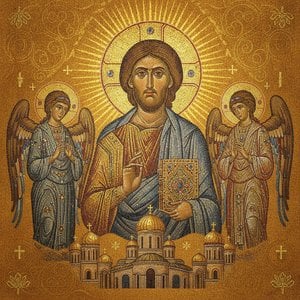
Beyond the grand scale of his frescoes, Rusuti’s hand is visible in other significant religious sites. His work contributed to the spiritual atmosphere of the Church of Santa Maria Donna Regina Vecchia and potentially even the Upper Basilica of San Francesco d'Assisi. In these spaces, he utilized rich colors and intricate geometric designs to guide the viewer's eye toward the divine. One of his most enduring technical achievements is found in the Facade Mosaic, an exquisite Byzantine-style piece depicting Christ and angels. This work showcases a level of detailed craftsmanship that remains a stunning example of religious artwork for collectors and historians alike.
Legacy and Historical Significance
The career of Filippo Rusuti spanned nearly four decades, a period that witnessed a dramatic shift in artistic styles and techniques within Italy. As part of the so-called Roman school, he helped bridge the gap between the static, iconic traditions of the Byzantine era and the burgeoning naturalism that would eventually define the Renaissance. His ability to work across different media—from the enduring permanence of mosaic to the delicate, atmospheric nature of fresco—demonstrates a versatile talent that was essential to the decorative programs of Rome's most sacred basilicas.
To understand the impact of Rusuti is to understand the evolution of the Italian painter. His contributions include:
- The Synthesis of Styles: Merging Byzantine formality with nascent Italian naturalism.
- Monumental Decoration: Executing large-scale narrative cycles in major basilicas like St. Mary Major.
- Technical Versatility: Mastery over both the mosaic medium and fresco painting techniques.
- Foundational Influence: Serving as a precursor to the more celebrated masters of the 14th century.
Though his name may not resonate with the same immediate fame as Giotto, the shadows cast by his frescoes continue to inform our understanding of the late Middle Ages. Rusuti was a painter of transitions, an artist who stood at the threshold of a new era, helping to paint the very foundations of Western art history.



 Zobacz w skali 1:1
 Przełącz na wersję drukowaną
 Wyślij
 Udostępnij
 Szczegóły
 Guide
Guide

 Pobierz plik obrazu
 Podobne obiekty
 RTG
RTG Pokaz slajdów
 Statystyki
 Czytaj więcej






































 Opcja ze szkłem jest dostępna wyłącznie w rozmiarach poniżej 110 cm