Fernand Léger’s “The Outing in the Country”: A Celebration of Modern Leisure
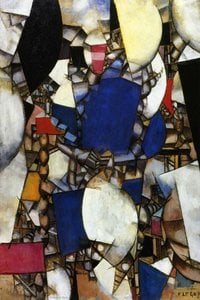
Fernand Léger's "The Outing in the Country," painted in 1954, isn’t merely a depiction of a picnic; it’s a vibrant manifesto for a new kind of modern life. This captivating work, rendered in Léger’s signature “Tubism,” explodes with color and energy, capturing a moment of communal joy amidst a stylized landscape. It's a piece that speaks to the burgeoning optimism of post-war Europe, reflecting a desire to embrace progress while retaining a sense of playful spontaneity. Léger, deeply influenced by the machine age – he’d spent time observing factories and locomotives – sought to integrate its dynamic forms into his art, eschewing traditional representational techniques in favor of simplified geometric shapes and bold, primary colors.
The scene unfolds with remarkable immediacy. A group of figures, rendered in a deliberately rough and unpolished manner, are engaged in various activities: some reclining on chairs, others playing games, while a few seem to be simply enjoying the company of one another. Notice how Léger avoids detailed facial features, opting instead for blocky, almost sculptural representations of the individuals. This simplification wasn’t an attempt at abstraction, but rather a way of conveying the essence of the figures – their presence and their interaction – without getting bogged down in fussy detail. The background, too, is treated with similar disregard for naturalism; trees are depicted as simplified cylinders, and clouds morph into geometric shapes, mirroring Léger's fascination with industrial forms.
Tubism: A Revolutionary Approach to Form
Léger’s “Tubism,” a term he himself coined, represents a pivotal moment in 20th-century art. It emerged as a reaction against the perceived limitations of traditional representation and sought to capture the dynamism and efficiency of modern life. The core principle of Tubism is the reduction of objects and figures to their essential geometric forms – cylinders, cones, spheres, and cubes – arranged in a rhythmic, almost mechanical composition. This approach wasn’t about creating purely abstract art; Léger aimed to represent reality through simplified shapes that conveyed movement, energy, and the underlying structure of the world around him.
The influence of industrial design is palpable throughout “The Outing in the Country.” The figures themselves seem almost like mechanical components, arranged within a carefully constructed tableau. This deliberate juxtaposition of human form and machine-like geometry reflects Léger’s belief that art could not only reflect but also shape our understanding of the modern world. The use of bold black outlines further emphasizes this sense of geometric precision, creating a striking visual impact.
Symbolism and Emotional Resonance
Beyond its formal innovations, “The Outing in the Country” is rich with symbolic meaning. The presence of two clocks – one at the top left corner and another on the right side – subtly underscores the passage of time and the fleeting nature of leisure. The boat in the center of the scene could represent escape, adventure, or simply a connection to the natural world—a vital counterpoint to the increasingly mechanized aspects of modern life. The overall atmosphere is one of relaxed conviviality, suggesting a desire for respite from the pressures of urban existence.
Despite its stylized and simplified forms, “The Outing in the Country” evokes a powerful sense of emotional warmth. It’s not simply a record of a picnic; it's an invitation to participate in a shared moment of joy and connection. Léger masterfully captures the spirit of communal leisure—a fundamental human need that he sought to celebrate through his distinctive artistic vision. Reproductions of this work offer a beautiful glimpse into a pivotal era of artistic experimentation and a reminder of the enduring appeal of simple pleasures.
Bringing “The Outing in the Country” Home
WahooArt offers meticulously crafted, hand-painted reproductions of Fernand Léger’s "The Outing in the Country," allowing you to bring this iconic artwork into your home or office. Our skilled artists faithfully recreate Léger's bold colors and distinctive geometric style, ensuring that every detail is captured with exceptional accuracy. Whether you are an art collector, interior designer, or simply someone who appreciates beautiful art, a WahooArt reproduction of “The Outing in the Country” will add a touch of modern elegance and artistic flair to any space.
Pytania i odpowiedzi
Czy obraz „The Outing in the country” – Fernand Léger można swobodnie reprodukować?
Status praw autorskich dla „The Outing in the country” – Fernand Léger: dzieło znajduje się w należy do domeny publicznej – autorskie prawa majątkowe wygasły. Określa to, czy reprodukcje obrazu mogą być sporządzane swobodnie.
Do jakiego nurtu i epoki zalicza się „The Outing in the country” – Fernand Léger?
"The Outing in the country" należy do nurtu Tubism, a jego twórca tworzył w epoce Modernizm.
Kiedy powstało dzieło "The Outing in the country" i do jakiego nurtu należy?
„The Outing in the country” – Fernand Léger datowane jest na 1954 rok i reprezentuje nurt Tubism.



 Podgląd w skali 1:1
 Przełącz na wydania drukowane
 Wyślij jako kartkę
 Udostępnij
 Szczegóły dzieła
 Przewodnik

 Pobierz obraz
 Podobne obiekty
 RTG
RTG Pokaz slajdów
 Q&A
Q&A Statystyki

 Rozwiń treść