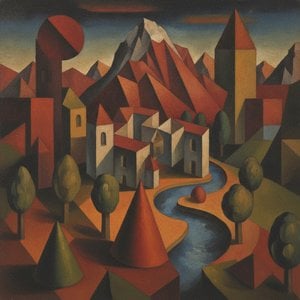
Fernand Léger: A Pioneer of Cubism and ‘Tubism’ – Exploring the Soul of Modernity
Fernand Léger (1881–1955) stands as a monumental figure in the trajectory of modern art, irrevocably altering perceptions of form and color. Born Joseph Fernand Henri Léger amidst the tranquil landscapes of Argentan, Normandy, his artistic journey transcends mere observation; it embodies an unwavering commitment to capturing the essence of the burgeoning machine age – a fascination that distinguishes him from many contemporaries who retreated into abstraction as a refuge from representational concerns.
His formative years, steeped in the physicality of rural labor and agricultural life, provided a crucial counterpoint to the industrialized future he would passionately portray. Initially drawn to architecture, Léger’s path swiftly pivoted towards painting after arriving in Paris around 1900, fueled by an encounter with Impressionism's luminous palette and expressive brushstrokes. This initial exposure instilled within him a foundational understanding of capturing fleeting moments and conveying emotion through color – principles that would permeate his subsequent artistic endeavors.
The Genesis of Cubism: Challenging Perspective
Léger’s breakthrough arrived in 1907, coinciding with his immersion into the revolutionary ideas championed by Pablo Picasso and Georges Braque. The influence of Cézanne's geometric simplification proved transformative, propelling Léger toward the development of “Tubism,” a distinctive variant of Cubism that prioritized cylindrical forms and bold, vibrant hues. Unlike traditional Cubist approaches which dissected objects into fragmented planes, Tubism sought to synthesize these fragments into unified structures – an audacious experiment in visual language.
Considered a cornerstone of artistic innovation, Tubism’s aesthetic resonated deeply with the anxieties and aspirations of the era. Léger's canvases depict scenes from urban life—factories, trains, and cityscapes—rendered with meticulous attention to detail yet imbued with an underlying dynamism that reflects the relentless pace of industrial progress. The deliberate flattening of perspective contributes to a sense of immediacy, inviting viewers into the heart of these mechanized environments.
A Bold Embrace of Color: Beyond Monochrome
While Léger’s early works often favored muted tones—primarily gray and black—his artistic vision matured during World War I, prompting him to explore richer chromatic palettes. This shift mirrored the broader cultural landscape of the time, where artists wrestled with themes of trauma and resilience. Léger's paintings from this period showcase a masterful command of color theory, utilizing hues like crimson, ochre, and turquoise to convey emotional intensity and heighten visual impact.
His oeuvre extends beyond monumental canvases; Léger also experimented with sculpture, ceramics, and filmmaking—demonstrating an unparalleled versatility that cemented his legacy as one of the most influential artists of the 20th century. Léger’s enduring appeal lies not merely in his stylistic innovations but in his profound engagement with the spirit of his time – a testament to his ability to transform observation into artistic expression.
Legacy and Influence: Pop Art's Forefather
Fernand Léger’s pioneering approach to Cubism profoundly impacted subsequent generations of artists, notably paving the way for the emergence of Pop Art in the 1960s. Artists like Andy Warhol recognized Léger’s willingness to embrace simplified forms and bold colors as a radical departure from traditional artistic conventions—a courageous assertion of visual language that mirrored the ethos of popular culture.
Today, Léger's artwork continues to inspire collectors and interior designers alike, offering a captivating glimpse into the formative years of modern art. Reproductions of his iconic paintings – such as “Nudes in the Forest” and “The Card Players” – adorn homes and galleries worldwide, ensuring that Léger’s visionary aesthetic persists as a beacon of artistic innovation.
Pytania i odpowiedzi
Jaki poziom kontrastu prezentuje „Nie tytuł (6854)” autorstwa Fernand Léger?
Kontrast jasności w dziele "Nie tytuł (6854)" wynosi Oświadczenie. Kontrast określa stopień zróżnicowania między obszarami jasnymi a ciemnymi.
Jakie miejsce zajmuje „Nie tytuł (6854)” wśród powracających motywów w twórczości Fernand Léger?
„Nie tytuł (6854)” przedstawia geometric shapes, modern art, cubism, industrial design, musical performance, black and white, abstract expression, podczas gdy utrwalone motywy Fernand Léger to futurist aesthetic, industrial revolution, musical symbolism, geometric abstraction, artist legacy. Porównanie tych dwóch elementów ukazuje, jak dzieło odnosi się do typowej dla tego artysty tematyki.
Jaki nastrój oddaje „Nie tytuł (6854)” autorstwa Fernand Léger w ramach nurtu Cubist Painting?
"Nie tytuł (6854)" niesie ze sobą Melancholijny wydźwięk emocjonalny w obrębie nurtu Cubist Painting.



 Zobacz w skali 1:1
 Kup ręcznie malowany obraz
 Wyślij
 Udostępnij
 Szczegóły
 Przewodnik

 Pobierz plik obrazu
 Podobne obiekty
 RTG
RTG Pokaz slajdów
 Statystyki
 Czytaj więcej






































 Opcja ze szkłem jest dostępna wyłącznie w rozmiarach poniżej 110 cm