early life and career
ferdinand guillaumin, a french impressionist painter and lithographer, was born on february 16, 1841. his artistic journey began in the mid-19th century, a time when impressionism was gaining momentum in france. Armand Guillaumin’s formative years were marked by a dedication to mastering traditional techniques alongside an emerging fascination with capturing fleeting moments of beauty—a duality that would define his distinctive style. He honed his skills through diligent study and experimentation, preparing himself for the revolutionary artistic landscape unfolding around him.
contribution to impressionism
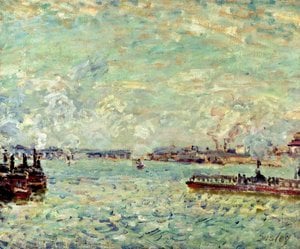
Guillaumin’s contribution to impressionism was profound; he wasn't merely a participant but an active architect of its aesthetic ideals. Like many fellow artists of his era, he embraced the movement’s core principle: prioritizing sensory experience over meticulous detail. Exhibitions became crucial platforms for showcasing his vision—a vision characterized by luminous color palettes and loose brushstrokes that sought to convey not just what was seen but how it felt.
- His canvases frequently depicted serene landscapes bathed in soft, diffused light – a stylistic choice perfectly aligned with impressionism’s preoccupation with capturing the ephemeral qualities of nature.
- Guillaumin's masterful manipulation of color—particularly his ability to blend hues seamlessly—added to the movement’s hallmark spontaneity and immediacy.
notable works and associations
Guillaumin’s artistic collaborations extended beyond mere exhibitions; he forged enduring friendships with luminaries like claude monet, whose influence permeated his oeuvre. Monet's unwavering belief in capturing light and atmosphere served as a guiding force for Guillaumin, fostering a shared pursuit of artistic innovation.
Furthermore, Guillaumin drew inspiration from symbolism—a movement that explored the realm of dreams and subconsciousness—evident in his bold color choices and emotionally resonant subjects. This stylistic blend elevated his paintings beyond mere visual representations, imbuing them with layers of psychological depth.
Mount Holyoke College Art Museum stands as a testament to Guillaumin’s legacy—housing an impressive collection of his artworks and ensuring that his artistic vision continues to inspire generations.
style and influences
Guillaumin's distinctive style can be characterized by its ethereal beauty and subtle tonal harmonies. He skillfully employed glazing techniques, layering translucent washes of color over textured surfaces to achieve remarkable luminosity and depth—a technique championed by artists like paul cézanne and vincent van gogh.
His landscapes are imbued with a palpable sense of tranquility, reflecting the profound impact of nature on his artistic sensibility. Guillaumin’s meticulous observation of light and shadow—combined with his expressive brushwork—established him as one of impressionism's foremost practitioners.
historical significance
Ferdinand Guillaumin’s work solidified impressionism’s position as a pivotal movement in 19th-century art history. By prioritizing subjective perception and embracing the transformative power of color, he challenged academic conventions and ushered in an era of artistic experimentation.
His enduring influence can be discerned in subsequent generations of painters who sought to emulate his masterful technique and capture the essence of fleeting moments—a testament to Guillaumin’s indelible mark on the trajectory of art. Explore more of Guillaumin's works and the impressionist movement on
WahooArt: Ferdinand Guillaumin | 3 artworks impressionism art movement



 Zobacz w skali 1:1
 Przełącz na wersję drukowaną
 Wyślij
 Udostępnij
 Szczegóły
 Przewodnik

 Pobierz plik obrazu
 Podobne obiekty
 RTG
RTG Pokaz slajdów
 Statystyki


 Czytaj więcej






































 Opcja ze szkłem jest dostępna wyłącznie w rozmiarach poniżej 110 cm