DARMOWA KONSULTACJA ARTYSTYCZNA

x
Zamów wydruk Zamów wydrukKup cyfrowy obraz Kup cyfrowy obraz UdostępnijUdostępnij
SzczegółySzczegóły Dodaj do ulubionych Dodaj do ulubionych PobierzPobierz Podobne obiektyPodobne obiekty RTGRTG Pokaz slajdówPokaz slajdów

stepsin paris

Discover 'Steps in Paris,' a captivating painting by Edward Hopper. Explore its somber mood, striking diagonal composition & muted palette. Own a hand-painted reproduction of this iconic artwork today!

Edward Hopper – mistrz amerykańskiego realizmu, maluje samotność i miejski krajobraz z wyczarującym światłem i cieniem. Odkryj jego ikoniczne obrazy, takie jak Nighthawks!

Ręcznie malowana reprodukcja olejowa

Ręcznie malowany olej na płótnie w Twoim wymiarze i ramie, tworzony na zamówienie przez naszych artystów.

P118B $10
P118H $10
P118W $10
P438Z $10
P508JH $12
P508YH $12
P805H $10
P805Z $10
P919BZ $10
P919G $10
P919XJ $10
P959ZH $10
P968JZ $12
W106C $8
W218G $10
W218JH $8
W218Y $10
W307PJ $10
W316G $10
W316PJ $8
W316Y $10
W398PJ $8
W4111J $10
W500HY $15
W500JH $15
W692G $12
W849H $8
W940BG $15
W953PJ $8

Standard
custom
CM
INCH

Wybierz spośród naszych predefiniowanych rozmiarów, które zachowują oryginalne proporcje dzieła sztuki.

szerokość
wysokość

Możesz wprowadzić własne wymiary, aby dopasować obraz do konkretnej ramy lub przestrzeni. Jeśli wybrany rozmiar nie będzie odpowiadał proporcjom oryginału, przytniecie dzieło sztuki lub rozszerzymy je o dodatkowe elementy, ręcznie domalowane przez artystę. Przed rozpoczęciem produkcji wyślemy projekt cyfrowy do Twojej akceptacji.
Należy pamiętać, że podgląd na ekranie nie odzwierciedla rzeczywistego przycinania ani rozszerzania obrazu. Tylko projekt dokładnie pokaże ostateczną kompozycję.
Choć oferujemy możliwość zamówienia niestandardowych rozmiarów, zalecamy wybór wymiaru z gotowej listy, aby zachować oryginalne proporcje dzieła.

Przykłady możliwych zmian: Zamień twarz na zdjęcie klienta; Dodaj zwierzę domowe (np. zamień kota na psa); Ukryj wiadomość w tle; Zmień krajobraz lub elementy tła.
Po złożeniu zamówienia zespół WahooArt.com skontaktuje się z klientem drogą mailową w celu uzyskania instrukcji i prześle wizualizację projektu

Dostawa na całym świecie () w ciągu 3/4 tygodni zamiast standardowych 5 tygodni. (2 Lipiec). Bez kompromisów w kwestii jakości.

why_choose_icon
Bezpłatna ekspresowa wysyłka na cały świat
why_choose_icon
Wysokiej jakości płótno lniane
why_choose_icon
Pełne ubezpieczenie przesyłki
why_choose_icon
Gwarancja zwrotu należności celnych
why_choose_icon
Gwarancja pełnego zgodności kolorystycznej
why_choose_icon
Polityka 60-dniowego zwrotu (tylko w przypadku wad)
why_choose_icon
Gwarancja 100% zwrotu pieniędzy
why_choose_icon
Zniżka przy większych zamówieniach

Suma całkowita

-

reproduction

stepsin paris

Technika reprodukcji

Wymiary reprodukcji

-

Cena całkowita

-

Szybkie fakty

  • artist: Edward Hopper
  • style: Impressionism / Post-Impressionism
  • influences: Impressionism
  • title: Steps in Paris
  • notable elements: Diagonal composition, muted color palette, atmospheric perspective, shadow and light contrast

Quiz o sztuce

Na każde pytanie istnieje tylko jedna poprawna odpowiedź.

Pytanie 1:
What is a dominant visual element in Edward Hopper's 'Steps in Paris'?
Pytanie 2:
Which artistic movements most influenced the style of 'Steps in Paris'?
Pytanie 3:
The color palette used in 'Steps in Paris' can best be described as:
Pytanie 4:
What mood or feeling does the artwork primarily evoke?

Opis dzieła

A Quiet Ascent: Exploring Solitude and Urban Space

This evocative painting captures a seemingly ordinary scene – a stone staircase ascending into shadow – yet imbues it with a profound sense of quietude and introspection. Rendered in a masterful blend of realism and atmospheric suggestion, the artwork invites viewers to contemplate themes of isolation, transition, and the subtle poetry found within urban landscapes.

Artistic Style & Influences

The work demonstrates clear influences from late 19th and early 20th-century movements like Impressionism and Post-Impressionism. While not strictly adhering to either style’s tenets, it shares their emphasis on capturing light and atmosphere through visible brushwork and a restrained color palette. The artist's approach leans towards realism, yet avoids meticulous detail in favor of conveying mood and emotional resonance. This stylistic choice places the artwork within a tradition of American Realism that sought to depict modern life with honesty and psychological depth.

Technique & Materials

Executed likely in oil on canvas, the painting showcases a skillful handling of texture and tone. Noticeable brushstrokes build up the surface, particularly on the steps, suggesting the rough materiality of stone. The artist employs atmospheric perspective – softening colors and details as they recede into the distance – to create a convincing illusion of depth and shadow. This technique draws the eye upwards along the diagonal staircase while simultaneously emphasizing the ambiguity of what lies beyond.

Symbolism & Emotional Resonance

Staircases are potent symbols, often representing ascent, progress, or escape. However, in this instance, the upward journey feels less triumphant and more ambiguous. The darkness at the top, combined with the absence of human figures, evokes a sense of loneliness and perhaps even melancholy. The cropped composition – we don’t see where the stairs begin or end – reinforces this feeling of incompleteness and isolation. It's a space caught between worlds, inviting contemplation on themes of transition and the unknown.

Historical Context & Artistic Intent

While the precise date of creation is unknown, the artwork aligns with a period of rapid urbanization and social change. The early 20th century witnessed increasing feelings of alienation and anonymity within modern cities. This painting can be interpreted as a visual expression of these anxieties, capturing a fleeting moment of quiet desperation amidst the bustling energy of urban life. It speaks to the universal human experience of solitude and the search for meaning in an increasingly complex world.

A Versatile Addition to Any Collection

This artwork’s subdued color palette – blending pinks, oranges, purples, and golds within a predominantly neutral scheme – makes it remarkably versatile. It would complement a range of interior design styles, from minimalist modern spaces to more traditional settings. Its contemplative mood lends itself well to bedrooms, studies, or living areas where a sense of calm and introspection is desired. A high-quality reproduction allows art lovers and collectors alike to experience the emotional power and artistic merit of this compelling work.

Podobne dzieła sztuki


Biografia artysty

A Solitude Observed: The Life and Art of Edward Hopper

Edward Hopper, a name inextricably linked to the quietude and subtle melancholy that permeated 20th-century American life, wasn’t simply a painter of scenes; he was a poet of light and shadow, a chronicler of modern isolation. Born in Nyack, New York, in 1882, to middle-class parents of Dutch ancestry, Hopper's early years provided a stable upbringing that nurtured his artistic inclinations. From childhood sketches meticulously dated and signed, it became evident that keen observation and an innate talent for drawing were central to his being. Though initially encouraged towards commercial illustration – a pragmatic suggestion from his parents – Hopper’s ambitions leaned toward fine art, leading him to the New York School of Art where he studied under William Merritt Chase and Robert Henri. These formative years instilled not only technical skill but also an appreciation for realism and a commitment to depicting the world as he saw it—unvarnished and honest. The writings of Ralph Waldo Emerson resonated deeply with Hopper, reinforcing his sense of individualism and acute observation – qualities that would become hallmarks of his artistic vision. Early travels to Paris exposed him to Impressionism, yet Hopper quickly diverged from its fleeting brushstrokes, forging a path uniquely his own.

Finding His Voice: Realism and the American Scene

Hopper’s artistic journey wasn't immediate or effortless. He grappled with discovering his distinctive voice, experimenting with various styles before settling into the realism that would define his career. This wasn’t mere replication of reality; it was a distillation of its essence, stripping away extraneous detail to reveal underlying emotional truths. His paintings began to focus on everyday scenes – houses, diners, offices, hotel rooms – imbued with a sense of stillness and often, loneliness. He possessed an extraordinary ability to capture the psychological states of his subjects, hinting at narratives without explicitly stating them. The precise rendering of light and shadow became crucial, not merely as descriptive elements but as emotional cues, creating atmospheres that were both captivating and unsettling. House by the Railroad (1925), an early masterpiece, exemplifies this approach—a seemingly simple composition radiating a profound sense of isolation and mystery. Hopper’s printmaking, often overlooked, ran parallel to his painting, sharing similar themes and stylistic qualities, demonstrating his mastery across mediums. He wasn't interested in grand historical narratives or allegorical symbolism; he focused on the mundane, elevating it through careful observation and emotional resonance.

Iconic Visions: Nighthawks and Beyond

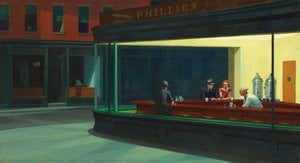
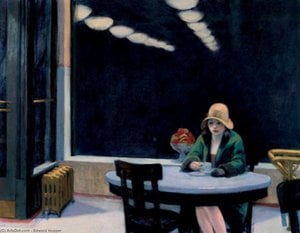
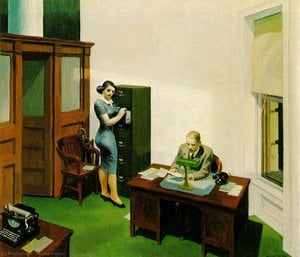
While Hopper’s career unfolded gradually, certain works catapulted him to widespread recognition. Nighthawks (1942), arguably his most famous painting, became an instant icon of American culture. The late-night diner scene, bathed in stark fluorescent light, perfectly encapsulates the alienation and anonymity of modern urban life. The figures within are lost in their own thoughts, disconnected from one another despite their proximity—a poignant commentary on the human condition. Gas (1940), with its striking portrayal of a roadside gas station, showcases Hopper’s fascination with American landscapes and the burgeoning automobile culture. Other notable works like *Automat*, *Office in a Small City*, and *Summertime* each offer unique insights into the complexities of 20th-century American society. These paintings weren't merely depictions of places; they were explorations of mood, psychology, and the subtle dramas unfolding within ordinary settings. His wife, Josephine Nivison Hopper, played a vital role not only as his lifelong companion but also as a frequent model, contributing significantly to the characterization of his female figures.

Themes and Legacy: A Lasting Influence

Several recurring themes permeate Hopper’s oeuvre. Urban isolation is perhaps the most prominent—the sense of loneliness experienced by individuals even amidst crowds. He explored the American landscape, both rural and urban, often emphasizing its starkness and emptiness. His work delves into psychological realism, probing the inner lives of his subjects with a sensitivity that transcends mere representation. There’s also an undercurrent of nostalgia for a simpler past, juxtaposed with an acknowledgement of the complexities and anxieties of modern life. Hopper's influence on subsequent artists is undeniable. His unique style has inspired countless painters, including Pierre Sanford Ross, and continues to resonate with contemporary artists seeking to capture the essence of human experience. His paintings remain highly sought after by collectors and are exhibited in major museums worldwide, solidifying his place as a pivotal figure in American art history. More than just an artist, Edward Hopper was a visual philosopher, offering profound insights into the human condition through his masterful use of light, shadow, and composition.
  • His legacy lies not only in the beauty of his paintings but also in their enduring ability to provoke thought, evoke emotion, and remind us of the quiet solitude that often defines our lives.
  • Hopper’s work continues to captivate audiences because it speaks to universal themes of loneliness, isolation, and the search for meaning in a rapidly changing world.
  • His paintings have become iconic representations of American culture, often used to symbolize the anxieties and aspirations of the 20th century—and beyond.
  • Hopper’s aesthetic has profoundly influenced filmmakers (like Alfred Hitchcock) and writers, inspiring countless works that explore similar themes of alienation and psychological tension.
Edward Hopper's ability to capture the essence of modern American life with honesty, sensitivity, and a distinctive artistic vision ensures his place as one of the most important artists of the 20th century.
Edward Hopper

Edward Hopper

1931 - 1967 , Stany Zjednoczone

Kluczowe informacje

  • Artistic Movement Or Style: Realizm
  • Artists Or Movements Influenced By This Artist: ['Ross']
  • Artists Who Influenced This Artist:
    • Chase
    • Henri
  • Date Of Birth: 22 lipca 1882
  • Date Of Death: 15 maja 1967
  • Full Name: Edward Hopper
  • Nationality: Amerykański
  • Notable Artworks:
    • Nighthawks
    • Dom samotny
    • Gas
  • Place Of Birth: Nyack, USA
Odkryj dzieła sztuki uporządkowane według tematów, stylów i cech charakterystycznych.