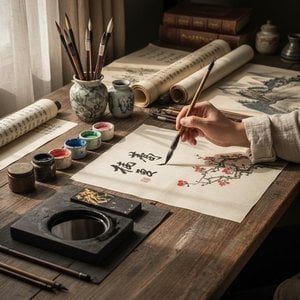
A Legacy of Serenity and Color
Born in the historic city of Nanjing, China, in 1958, Dayou Lu has emerged as a profound voice within the realm of Chinese New Ink Art. His artistic journey began amidst the transformative decades of modern China, a period that deeply informed his perspective on the intersection of cultural heritage and contemporary expression. With a dedication to mastering the ancient, meditative techniques of ink painting that has spanned over fifty years, Lu has cultivated a prolific body of work that serves as a bridge between tradition and modernity. His compositions are celebrated for their breathtaking double-colored water-ink mastery, capturing the ephemeral essence of nature with a clarity that feels both timeless and immediate.
The foundation of Lu’s technical brilliance was laid through rigorous academic training at the prestigious Central Academy of Painting in Beijing. It was within these hallowed halls that he honed his skills in traditional Chinese painting styles, developing a deep-seated appreciation for meticulous observation and the profound weight of symbolism. This formative period instilled in him an understanding of how a single brushstroke can convey complex emotional landscapes. His education at the Suzhou Fine Arts School and the Central Academy of Fine Arts provided him with the structural discipline required to later innovate upon the very traditions he studied so intently.
The Alchemy of Ink and Pigment
What truly distinguishes Dayou Lu in the contemporary art world is his signature approach to the medium, specifically his mastery of double-color water-ink paintings. In this technique, Lu achieves a remarkable feat of alchemy by blending the deep, soulful shadows of traditional black ink with vibrant, luminous watercolor pigments. This method allows him to achieve an extraordinary tonal depth and luminosity that preserves the raw integrity of the ink while introducing a modern, atmospheric brilliance. Through this delicate balance, he is able to enhance the mood and narrative of his scenes, creating works that seem to breathe with light.
His artistic philosophy is deeply rooted in the pursuit of a simple, natural, and elegant style. While his work is grounded in the reality of the subjects he depicts, it is never merely a literal representation. Instead, Lu seeks to capture the aura and poetic mood of his subjects, utilizing sketching as a source of vitality to ensure that every creature and petal is imbued with the rhythm of life. His paintings are not just images; they are environments designed to offer the viewer a sense of freshness, liveliness, and spiritual respite.
Symbolism and the Taoist Spirit
The recurring themes in Lu’s oeuvre reflect a profound connection to the heritage of Chinese landscape painting and the core tenets of Taoist philosophy. He frequently returns to the imagery of lotus ponds, a subject that allows him to explore the interplay of light, water, and flora. In his hands, the lotus becomes more than a botanical specimen; it is a symbol of purity and resilience. Alongside these scenes, he often incorporates birds, branches, and the delicate presence of dew, each element serving as a metaphor for harmony and the cyclical rhythms of existence.
This thematic focus creates a sense of "environment" within his work—a space where the viewer can find peace amidst the chaos of the modern world. By focusing on the subtle beauty of the natural world, Lu invites a meditative state, encouraging an appreciation for the interconnectedness of all living things. His ability to translate these philosophical concepts into visual splendor has earned him significant recognition both in China and internationally.
A Distinguished Career and Global Reach
Dayou Lu’s contributions to the art world extend far beyond his technical prowess; he is a vital participant in the preservation and evolution of Chinese ink painting as a living, breathing art form. His professional accolades are numerous and reflect his high standing within the global artistic community:
- Member of the Chinese Artists Association (CAA), contributing to the national dialogue on contemporary aesthetics.
- Vice President of the Academy of Fine Art of the Central Committee of China National Democratic Construction Association.
- Recipient of the "Outstanding Talent of Contemporary Chinese Painting" award by the Chinese Ministry of Personnel in 2002.
- Global Exhibitor, with his works showcased in diverse cultural landscapes including the USA, Canada, Japan, Belgium, Russia, and Sweden.
Throughout his career, Lu has held hundreds of solo and group exhibitions worldwide, demonstrating a tireless commitment to sharing the beauty of Chinese New Ink Art with a global audience. From his influential roles in various painting institutes in Jiangsu and Nanjing to his status as a visiting professor, Dayou Lu continues to inspire new generations of artists to look toward tradition as a source of infinite innovation.



 Zobacz w skali 1:1
 Przełącz na wersję drukowaną
 Wyślij
 Udostępnij
 Szczegóły
 Przewodnik

 Pobierz plik obrazu
 Podobne obiekty
 RTG
RTG Pokaz slajdów
 Statystyki


 Czytaj więcej






































 Opcja ze szkłem jest dostępna wyłącznie w rozmiarach poniżej 110 cm