A Life Immersed in Light: The World of Claude Monet
Oscar-Claude Monet, a name synonymous with Impressionism, wasn't merely a painter of landscapes; he was a chronicler of fleeting moments, a poet of light and color. Born in Paris on November 14, 1840, his early life took an unexpected turn when his family relocated to Le Havre, Normandy, at the age of five. While initially destined for a commercial career by his father, Claude Adolphe Monet (1800–1871), young Claude’s innate artistic talent quickly surfaced, manifesting first in charcoal caricatures sold locally — a testament to both his skill and entrepreneurial spirit.
His mother, Louise-Justine Aubrée Monet (1805–1857), supported Monet’s ambition to be a painter. Although she died tragically young in January 1857, leaving him orphaned at sixteen, Marie-Jeanne Lecadre, his aunt and guardian, provided invaluable support for his artistic pursuits.
A pivotal encounter occurred when Monet met Eugène Boudin, who profoundly influenced his artistic vision. Boudin championed the revolutionary concept of painting en plein air—directly from nature—a practice that would become the cornerstone of Monet’s entire creative journey. Boudin didn't just teach Monet *how* to paint; he instilled within him a fundamental understanding of capturing the essence of light and atmosphere—a radical departure from academic conventions.
Subject & Composition: Nature’s Serenity
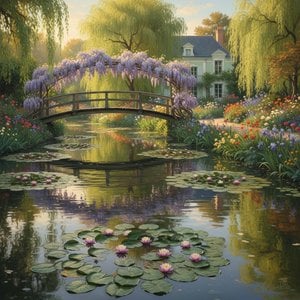
Monet’s artistic focus centered on portraying the beauty of the natural world, particularly water lilies in tranquil ponds. He meticulously observed how sunlight transformed color and form throughout the day, striving to convey not a literal depiction but rather an impression—a sensory experience—of that particular moment.
His compositions were predominantly horizontal, drawing the viewer’s gaze across the expanse of water and reflecting the sky above. Lily pads and blossoms densely populated the surface, creating a rich tapestry of organic forms. Monet deliberately avoided panoramic vistas; instead, he opted for intimate perspectives, inviting contemplation and fostering a connection with the serene environment.
Style & Technique: The Impressionist Touch
“acid core alpha” exemplifies the defining characteristics of Impressionism. Loose, visible brushstrokes—a hallmark of Monet’s later work—were paramount, prioritizing capturing the fleeting effects of light and movement over precise detail. Monet achieved this remarkable feat through layering thin washes of oil paint, meticulously blending colors to create a luminous quality that seemed to emanate from within the canvas.
The lines were soft and flowing, mirroring the gentle ripples on the water’s surface and reflecting the delicate contours of the blossoms. This wasn't about photographic realism; it was about conveying emotion—a feeling of tranquility and wonder—inspired by the beauty of nature.
Historical Context: A Revolutionary Approach
Monet emerged as a leader in a transformative artistic movement that challenged established traditions. Artists like Renoir, Degas, and Pissarro rejected academic conventions, prioritizing subjective perception over objective representation. Monet’s unwavering dedication to plein air painting—a practice championed by Boudin—was crucial to this paradigm shift.
The Impressionist movement arose in response to the rigid rules of the Salon, the official art exhibition held annually in Paris. Artists sought to express their immediate impressions of a scene, capturing the nuances of light and color as they perceived them—a radical departure from the idealized depictions favored by academic painters.
Symbolism & Emotional Impact: Purity and Transience
Water lilies have long held symbolic significance throughout art history, representing purity, serenity, and rebirth. Monet’s masterful rendering of these blossoms transcends mere visual beauty; it evokes a deeper resonance—a contemplation of life's ephemeral nature.
The diffused lighting suggests a quiet, contemplative mood, inviting viewers to find solace in the stillness of the pond and appreciate the fleeting splendor of the flowers. “acid core alpha” isn’t simply aesthetically pleasing; it communicates an emotional depth—a profound appreciation for the restorative power of nature and its ability to inspire awe.
Collecting & Interior Design
A reproduction of “acid core alpha” brings a touch of Impressionist elegance to any interior space. Its muted color palette and serene subject matter create a harmonious backdrop for relaxation—ideal for bedrooms or living rooms seeking tranquility.
The painting’s horizontal format lends itself well to larger walls, establishing a focal point that draws the eye and encourages contemplation. Whether adorning your home or inspiring artistic endeavors, Monet’s masterpiece remains an enduring testament to beauty and timeless inspiration.



 Podgląd w skali
 Zamów ręcznie malowaną reprodukcję
 Wyślij jako kartkę
 Udostępnij
 Szczegóły dzieła

 Pobierz
 Podobne obiekty
 RTG
RTG Pokaz slajdów

 Rozwiń treść






































 Opcja ze szkłem jest dostępna wyłącznie w rozmiarach poniżej 110 cm