A Tempestuous Vision of Sublime Terror
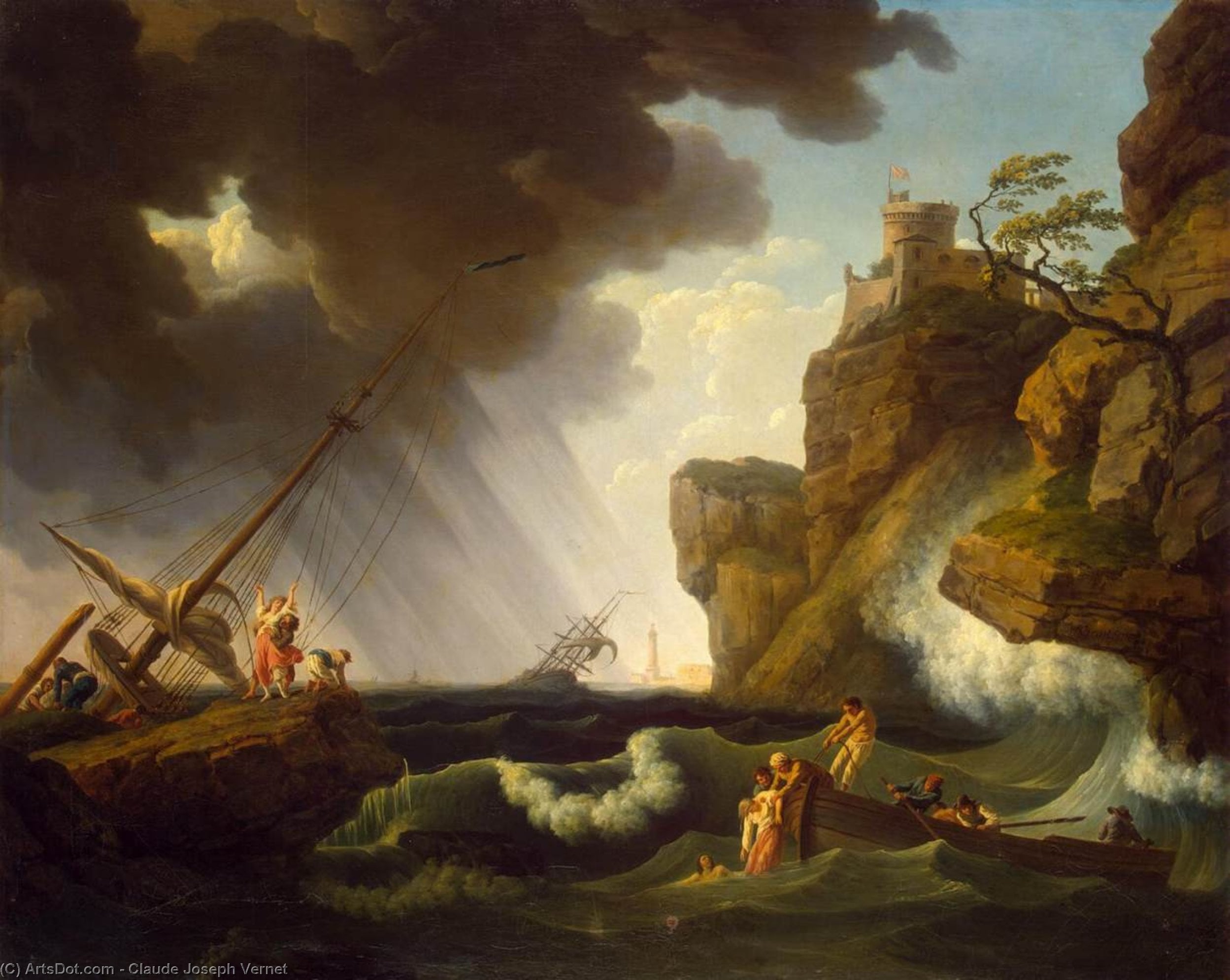
Claude Joseph Vernet’s “Shipwreck” is far more than a mere depiction of maritime disaster; it is a profound cornerstone of Romantic landscape painting that captures the very essence of human vulnerability. Completed in 1763, this oil on canvas masterpiece invites viewers into a world where the boundaries between awe and terror dissolve. The scene unfolds with a panoramic intensity, dominated by turbulent, churning seas and brooding, heavy skies that seem to press down upon the frantic figures below. As one gazes upon the work, the sheer scale of the ocean’s fury becomes palpable, establishing a sense of sublime drama that was revolutionary for its era. The composition is masterfully orchestrated to guide the eye through the chaos, from the splintering wood of the vessel to the desperate movements of the crew, creating a visceral experience that resonates long after the first encounter.
The technical brilliance of Vernet lies in his ability to translate raw, elemental energy into tangible paint. Eschewing the polished, idealized surfaces favored by Neoclassical contemporaries, Vernet embraced a more expressive and textured approach. He utilizes chiarosc lately—the dramatic interplay between piercing light and deep, swallowing shadows—to sculpt the forms of the ship and its passengers against the immense backdrop of the storm. His brushwork is notably loose and energetic, employing thick layers of impasto to mimic the frothing whitecaps of the waves and the heavy, moisture-laden atmosphere of a tempest. This tactile quality adds a layer of physical realism to the scene, making the spray of the salt water and the weight of the wind feel almost touchable to the observer.
The Philosophy of the Sublime and Historical Resonance
To understand “Shipwreck,” one must look toward the intellectual currents of the Enlightenment. During this period, philosophers such as Edmund Burke were deeply preoccupied with the concept of the sublime—the idea that beauty could be found in things that are simultaneously terrifying and overwhelming. Vernet’s work serves as a visual manifesto for this philosophy. By presenting the small, frantic figures of the shipwrecked crew against the infinite, uncontrollable power of nature, he highlights the fragility of human existence. The painting does not merely document a nautical accident; it explores the psychological state of confronting an immense force that is indifferent to human life. This tension between the monumental landscape and the minute, struggling human element provides a profound emotional depth that continues to captivate modern audiences.
For the discerning collector or interior designer, “Shipwreck” offers more than just aesthetic beauty; it brings a commanding presence and a narrative soul to any space. The painting’s dramatic tonal range—from charcoal grays to brilliant, light-pierced crests—allows it to serve as a powerful focal point in sophisticated settings. Whether placed in a grand library or a contemporary living space, the artwork evokes a sense of history, adventure, and deep contemplation. A high-quality reproduction of this masterpiece allows one to possess a fragment of the Romantic era, bringing the timeless, haunting beauty of Vernet’s maritime vision into the modern home, where it can continue to inspire awe and wonder.
Pytania i odpowiedzi
Jaką harmonię kolorów prezentuje „Shipwreck” – Klaus Dżozef Warnet?
Harmonia kolorystyczna dzieła "Shipwreck" została określona jako Strong Color Unity.
Czy dzieło „Shipwreck” – Klaus Dżozef Warnet, znajdujące się w zbiorach Muzeum Ermitażu, może być legalnie reprodukowane?
Dzieło „Shipwreck” – Klaus Dżozef Warnet, znajdujące się w zbiorach Muzeum Ermitażu, znajduje się w należy do domeny publicznej – autorskie prawa majątkowe wygasły. Status ten określa, czy możliwe jest tworzenie reprodukcji obrazu.
Gdzie można kupić ręcznie malowane reprodukcje dzieła „Shipwreck” – Klaus Dżozef Warnet?
Ręcznie malowaną reprodukcję dzieła „Shipwreck” – Klaus Dżozef Warnet można zamówić bezpośrednio na stronie Ręcznie malowana reprodukcja: ręcznie malowana reprodukcja olejowa na płótnie lnianym, tworzoną na specjalne zamówienie.


 Podgląd w skali 1:1
 Zamów ręcznie malowaną reprodukcję
 Wyślij jako kartkę
 Udostępnij
 Szczegóły dzieła
 Przewodnik

 Pobierz obraz
 Podobne obiekty
 RTG
RTG Pokaz slajdów
 Statystyki


 Rozwiń treść






































 Opcja ze szkłem jest dostępna wyłącznie w rozmiarach poniżej 110 cm


