early life and education
Charles Henry Buckius Demuth, an american watercolorist, was born on november 8, 1883, in lancaster, pennsylvania. he developed a unique style of painting known as precisionism, which would later become a significant contribution to the american art scene. demuth's early education took place at franklin & marshall academy, followed by studies at drexel university and the prestigious pennsylvania academy of fine arts in philadelphia. it was during his time at pafa that he met william carlos williams, with whom he formed a lasting friendship. Demuth’s family established the oldest continuing tobacco shop and snuff factory in America. His father, Ferdinand, was an amateur photographer and both his grandmother and aunt were painters. He was found to have diabetes as an adult, and he became one of the first people to take insulin injections (and as frequently as every two hours). At the age of five, Demuth developed a hip illness, later known as Perthes, a common hip disease boys of that time developed at that age. Due to his chronic hip problem as a young boy, Demuth became very introverted and very close to his mother, Augusta. He tended to always play with the girls in grade school because his mother and aunt believed that the boys at school would play too rough and cause his hip injury to worsen. After receiving average math and science scores and superior grades in english, history, and language, his family finally realized that his true interest was in art. Demuth graduated from Franklin and Marshall Academy in June of 1901, and after that he lived at home for the next two years until October of 1903 when he enrolled in Drexel Institute of Art, Science, and Industry in Philadelphia. During his time at Drexel, he studied with Howard Pyle who inspired him to focus much of his early artistic works on the topics of illustration field and graphic producing. He returned to Paris for five months in 1907–08 where he met Henri Matisse, Georges Braque, André Derain, Raol Dufy, and Maurice de Vlaminck. He returned to the French capital from 1912 to 1914 and studied at three academies––Julian, Modern, and Colarossi––with side trips to London and Berlin. His evolving style became individual, imaginative, and modern as he adopted some of the techniques of Paul Cézanne, Odilon Redon and James Abbott McNeill Whistler. He was also influenced by Japanese prints, which were characterized by flat chromatic surfaces, as well as the works of Impressionists and, later, Vincent van Gogh, Paul Gauguin, Henri de Toulouse-Lautrec, and Auguste Rodin.
career and influences
Demuth’s artistic career began to take shape after his studies in the united states. He later attended académie colarossi and académie julian in paris, where he became an integral part of the avant-garde art scene. The city's acceptance of his homosexuality also had a profound impact on his work. Upon returning to america, demuth retained aspects of cubism in many of his works, reflecting the influence of his time in paris. His fondness for lancaster is evident in the subject matter of numerous works, showcasing industrial features like bridges, smoke stacks, and skyscrapers. Demuth was also one of the few artists whom all other artists liked as a real friend, a rare case indeed.— Marcel Duchamp. He befriended Arthur G. Dove, Marsden Hartley, John Marin, Paul Strand, Georgia O’Keeffe, and Alfred Stieglitz during his time in New York. He explored many themes and subjects throughout his life, from portraits of fellow artists to landscapes of industrial America and rural Pennsylvania.
notable works and precisionism
Demuth's most famous painting,
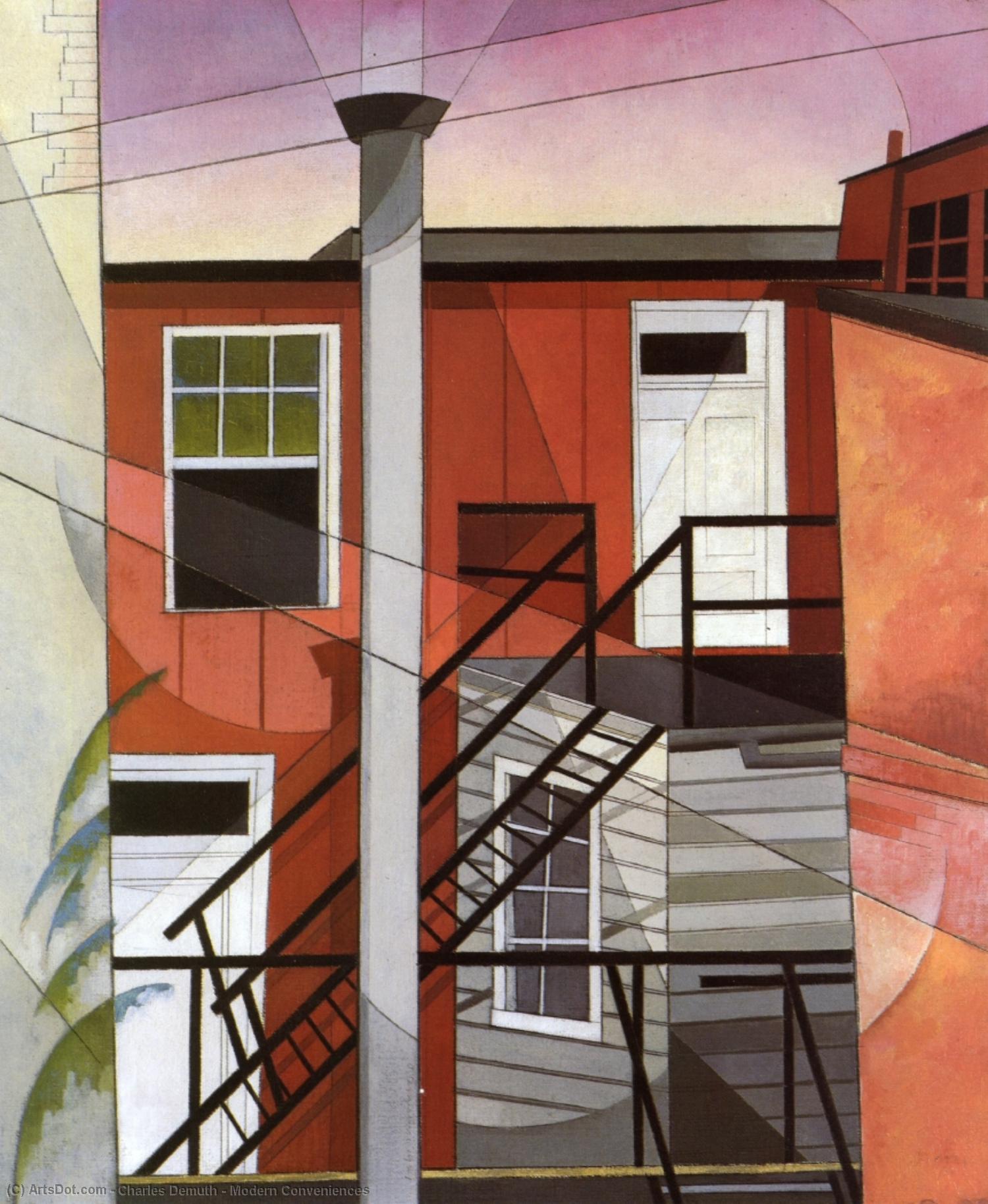
the figure five in gold, was inspired by william carlos williams's poem "the great figure." This work is a prime example of demuth’s unique style, which he termed “precisionism.” Other notable works include his "poster portraits," dedicated to artists and writers like georgia o’keeffe, arthur dove, and eugene o’neill. Demuth's distinctive approach to painting—characterized by quasi-cubist techniques, sharply defined lines, and a focus on industrial landscapes—established him as a pivotal figure in American Modernism. He captured the essence of his surroundings with remarkable accuracy and subtlety, creating images that resonate with both visual beauty and intellectual contemplation.
key characteristics of precisionism: - quasi-cubist, sharply defined manner
- urban and rural landscapes with industrial features
- highly structured scenes lacking figures
- depiction of an industrial setting with sharp linearity
legacy and museum quality replicas at WahooArt
Demuth’s contributions to the precisionist art movement have left a lasting impact on american modernism. At WahooArt.com, you can find museum-quality replicas of his works, including
the figure five in gold and other notable pieces. Explore the world of precisionism with WahooArt's extensive collection: /pl/art/show/art-d3cl2x-pl/


 Podgląd w skali 1:1
 Zamów ręcznie malowaną reprodukcję
 Wyślij jako kartkę
 Udostępnij
 Szczegóły dzieła
 Przewodnik

 Pobierz obraz
 Podobne obiekty
 RTG
RTG Pokaz slajdów
 Statystyki
 Rozwiń treść






































 Opcja ze szkłem jest dostępna wyłącznie w rozmiarach poniżej 110 cm


