Druk giclée lub płótno o jakości muzealnej, szybka realizacja i szeroki wybór opcji wykończenia. ( Zamów ręcznie malowaną reprodukcję Kup obraz wysokiej rozdzielczości)
Wybierz spośród naszych standardowych rozmiarów, które zachowują oryginalne proporcje dzieła sztuki.

Możesz wprowadzić własne wymiary, aby dopasować dzieło do konkretnej ramy lub przestrzeni. Jeśli wybrany rozmiar nie będzie odpowiadał proporcjom oryginalnego obrazu, przytniecie dzieło lub rozszerzymy obraz za pomocą odbicia lustrzanego lub jednolitego wypełnienia krawędzi. Przed rozpoczęciem produkcji prześlemy cyfrową wizualizację do Twojej akceptacji.
Prosimy pamiętać, że podgląd na ekranie nie odzwierciedla faktycznego przycinania ani rozszerzania. Tylko wizualizacja dokładnie pokaże końcową kompozycję.
Mimo dostępności niestandardowych rozmiarów, zalecamy wybór wymiaru z listy zdefiniowanej, aby zachować oryginalne proporcje.
Dostawa na cały świat () w ciągu 2 tygodni zamiast standardowych 4/5 tygodni. (7 Wrzesień)


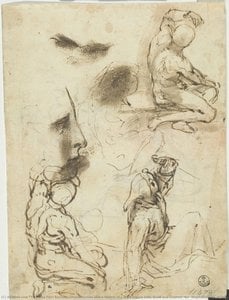
Four Canephori
Wymiary reprodukcji

In the vibrant, shifting landscape of the late Italian Renaissance, few artists captured the tension between classical order and Mannerist artifice as delicately as Carlo Urbino. Born in the Lombard town of Crema around 1525, Urbino emerged from a period of profound intellectual ferment, where the rigid structures of the High Renaissance were beginning to dissolve into the more expressive, elongated, and dramatic forms of Mannerism. His journey was one of both artistic refinement and scientific inquiry, a path that saw him move through the influential circles of Venice and Milan, leaving behind a trail of frescoes and drawings that bridge the gap between the grace of the 16 th century and the burgeoning energy of the Baroque.
Urbino’s early development was deeply rooted in the aesthetic currents of the Veneto. Training amidst the luminous traditions of Venice, he absorbed a mastery of light and color that would later define his approach to composition. However, it was his connection to the Campi family—specifically the masters Antonio, Bernardino, and Giulio Cambi—that provided the stylistic scaffolding for his career. This lineage instilled in him a penchant for complex, often crowded arrangements and a fascination with the human form in motion. His work does not merely depict a scene; it orchestrates a visual drama, utilizing sfumato and dynamic gestures to guide the viewer’s eye through intricate religious narratives.
What truly distinguishes Carlo Urbino from his contemporaries was his profound intellectual curiosity, which extended far beyond the boundaries of the canvas. He was a true Renaissance man, possessing a mind that sought to find the underlying geometry in all things. This passion for structure led to a remarkable collaboration with the mathematician and engineer Camillo Agrippa. Together, they worked on the Codex Huygens, a monumental endeavor that explored the intersection of art, proportion, and the science of armaments. Through this work, Urbino demonstrated that his interest in perspective was not merely a tool for illusion, but a way to understand the very mechanics of the physical world.
This scientific rigor is often visible in his preparatory drawings and sketches. Whether working with ink, sanguine, or pen, Urbino possessed an ability to distill complex anatomical truths into elegant lines. His studies for religious compositions were not merely blueprints but explorations of weight, balance, and tension. This duality—the ability to be both a dreamer of divine visions and a student of mathematical precision—allowed him to create works that felt both spiritually transcendent and physically grounded.
As his reputation grew, Urbino’s career found its most significant momentum in Milan, where he secured prestigious commissions from the era's most influential patrons. His work for Vespasiano Gonzaga and Alessandro Sforza placed him at the heart of Lombard political and religious life. In the sacred spaces of Milan, such as the Church of Santa Maria della Passione, his frescoes breathed life into the walls, showcasing a command of perspective that could transform a flat surface into an expansive, heavenly realm. His contributions to the St. Joseph’s Chapel remain a testament to his ability to handle large-scale religious iconography with both solemnity and grace.
The breadth of his artistic output can be seen in several key areas of his career:
By the time of his death in 1585, Carlo Urbino had helped establish a stylistic bridge that would support the weight of the coming Baroque era. He left behind an oeuvre that serves as a vital link in the history of Italian art—a legacy defined by the seamless integration of the eye's beauty and the mind's logic. His ability to navigate the transition from the balanced ideals of the Renaissance to the emotive complexity of Mannerism ensures his place as a pivotal figure in the evolution of European painting.

1525 - 1585 , Italy

Elevate your artistry with this definitive expert guide to mastering charcoal. Designed for art students, learn professional techniques for capturing profound depth, intricate textures, and dramatic shadows through advanced blending and chiaroscuro methods.

Elevate your artistic practice with this expert guide to mastering the line. Discover advanced techniques in graphite, charcoal, and contour drawing designed for art students seeking technical precision and expressive depth in their fine art studies.

Explore the profound artistry of graphite drawing. Discover professional techniques for mastering depth, texture, and detail through a lens of art history, from classical sketches to modern masterpieces. Elevate your understanding of the pencil medium with our expert guide.

Explore the profound beauty of the sketch. Discover how masters use charcoal and graphite to capture raw emotion, anatomical precision, and fluid movement, bridging the gap between ephemeral marks and eternal oil masterpieces.
Explore the profound elegance of pencil and charcoal sketching. Discover how masters use line, shadow, and chiaroscuro to capture light and texture, bridging the gap between preparatory studies and timeless fine art masterpieces.

 Podgląd w skali
 Wyślij jako kartkę
 Udostępnij
 Szczegóły dzieła

 Pobierz
 Podobne obiekty
 RTG
RTG Pokaz slajdów
 Rozwiń treść




































 Opcja ze szkłem jest dostępna wyłącznie w rozmiarach poniżej 110 cm