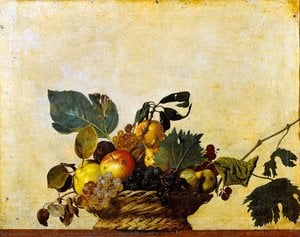
The Dramatic Embrace: Caravaggio’s Bacchus
Michelangelo Merisi da Caravaggio's "Bacchus," painted in 1596, isn't merely a portrait; it’s an explosion of Baroque drama captured on canvas. This oil-on-canvas masterpiece, currently residing within the Galleria degli Uffizi in Florence, immediately commands attention with its masterful use of light and shadow – a technique known as chiaroscuro – that defines Caravaggio’s signature style. The painting depicts a youthful Bacchus, the Roman god of wine, reclining languidly against a simple stone table, an embodiment of sensual pleasure and decadent abundance. It's a scene brimming with both invitation and a subtle undercurrent of transgression, instantly captivating the viewer and drawing them into its intoxicating world.
The composition is remarkably dynamic. Bacchus’s pose, reminiscent of classical sculpture – specifically, echoes of Hadrian’s statue of Antinous – speaks to the Renaissance revival of interest in antiquity. He's not idealized; his physique is robust, almost virile, with a slightly awkward, youthful quality that grounds the divine figure in earthly reality. His fingers playfully manipulate the drawstring of his loosely draped robe, while his gaze meets the viewer’s directly, creating an immediate and intimate connection. The surrounding details – the overflowing bowl of fruit, the carafe of red wine, the scattered grape leaves adorning his hair – are rendered with astonishing realism, each element contributing to a sense of palpable richness and indulgence.
The Genius of Tenebrism
Caravaggio’s innovation lies not just in his subject matter but fundamentally in his technique. The painting is a prime example of tenebrism, a dramatic lighting style where stark contrasts between light and dark dominate the scene. A single, powerful beam of light illuminates Bacchus and the immediate surroundings, while the background plunges into deep shadow. This deliberate manipulation of light isn’t merely aesthetic; it serves to heighten the emotional intensity of the image, drawing our attention to the central figure and amplifying his sensuality. The shadows themselves seem to possess a life of their own, hinting at hidden desires and unspoken temptations.
Notice how Caravaggio uses this technique to sculpt Bacchus’s form – the light emphasizes the musculature of his arms and torso, while the darkness obscures details, creating an aura of mystery. The absence of shadow behind the table further intensifies the effect, drawing our focus entirely onto the reclining god. This masterful control over light and dark is what truly elevates "Bacchus" beyond a simple portrait; it transforms it into a powerful theatrical experience.
Historical Context & Caravaggio’s Influence
"Bacchus" was commissioned by Cardinal Francesco Maria del Monte, a prominent patron of the arts in Rome. This early work demonstrates Caravaggio's burgeoning talent and his willingness to depart from the idealized representations prevalent during the High Renaissance. Unlike the polished grace of earlier portraits, Caravaggio presents a raw, unvarnished depiction of human physicality – a bold move that would become characteristic of his style.
The painting’s impact on subsequent generations of artists is undeniable. Caravaggio's innovations in lighting and realism profoundly influenced figures like Peter Paul Rubens, Jusepe de Ribera, Gian Lorenzo Bernini, and even Rembrandt van Rijn. The term "Caravaggisti" – followers of Caravaggio’s style – emerged to describe this group of artists who adopted his dramatic techniques and subject matter. “Bacchus” stands as a cornerstone of Baroque art, demonstrating the shift towards emotional intensity, realism, and theatricality that defined the era.
A Timeless Appeal
Despite experiencing periods of relative obscurity in the centuries following Caravaggio’s death, "Bacchus" has enjoyed a remarkable revival in recent decades. Its potent combination of sensuality, drama, and technical brilliance continues to resonate with audiences today. Reproductions like those offered by WahooArt.com allow us to experience this masterpiece firsthand, capturing its vibrant colors and dramatic lighting with exceptional fidelity. “Bacchus” is more than just a painting; it’s a window into the mind of a revolutionary artist – a testament to the enduring power of light, shadow, and the timeless allure of human desire.
Pytania i odpowiedzi
Czy dostępny jest wysokiej rozdzielczości plik do pobrania dla "Bacchus"?
"Bacchus" is available as wysokiej rozdzielczości cyfrowe zdjęcie do pobrania, purchased directly on its Digital Image page.
Jakie miejsce w historii sztuki zajmuje „Bacchus” autorstwa K Caravaggio?
Klasyfikacja historii sztuki dla dzieła „Bacchus” autorstwa K Caravaggio to Baroque Painting, z okresu Nowoczesność.
W którym roku powstało „Bacchus” autorstwa K Caravaggio?
Dzieło „Bacchus” autorstwa K Caravaggio powstało w 1596.



 Zobacz w skali 1:1
 Kup ręcznie malowany obraz
 Wyślij
 Udostępnij
 Szczegóły
 Przewodnik

 Pobierz plik obrazu
 Podobne obiekty
 RTG
RTG Pokaz slajdów
 Statystyki


 Czytaj więcej






































 Opcja ze szkłem jest dostępna wyłącznie w rozmiarach poniżej 110 cm