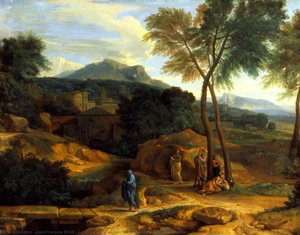
Antonio Diziani: A Venetian Visionary Capturing the Spirit of His Time
Antonio Diziani (1737-1797) stands as a significant figure in eighteenth-century Venetian painting, particularly celebrated for his masterful depictions of Venice and its surrounding landscapes. Born into a rich artistic lineage, he was the son of Gaspare Diziani, a respected Rococo artist whose influence provided Antonio with an early predisposition toward visual storytelling. While history often places him in the shadow of titans like Canaletto, Diziani carved out a distinctive niche within the Venetian art scene, producing works that offered a unique blend of meticulous observation and imaginative embellishment.
His artistic journey was shaped by the shifting stylistic currents of Europe, moving from the ornate flourishes of the Rococo toward the structured elegance of Neoclassicism. This evolution is deeply embedded in his technique and composition. Under the tutelage of masters such as Francesco Zuccarelli and Giuseppe Zais, Diziani learned to balance classical grandeur with a certain Venetian charm. His education allowed him to master the art of the vedute—panoramic views that served not merely as topographical records but as atmospheric windows into the soul of the city.
The Art of the Veduta and Atmospheric Mastery
Diziani’s fame rests primarily on his prolific output of landscapes and vistas. Unlike the rigorous, almost photographic realism practiced by Canaletto, Diziani’s canvases often embraced subtle distortions and idealized perspectives. He sought to convey a sense of emotion and atmosphere that elevated his work beyond mere documentation. In his hands, the architectural landmarks of Venice—such as the Doge's Palace and Piazza San Marco—became stages for light and shadow, where the play of sun on stone could evoke a profound sense of nostalgia or tranquility.
His versatility was evident across various mediums, ranging from detailed etchings to sweeping oil paintings. A notable example of his ability to blend narrative with landscape can be seen in works like "Hunting Capriccio," where he transports the viewer to a serene riverbank. In such pieces, he demonstrates a mastery of several key elements:
- Compositional Balance: The seamless integration of human figures, such as horseback riders and strolling gentlemen, within vast, lush landscapes.
- Light and Texture: A sophisticated use of oil painting techniques that adds depth to foliage and creates a sense of distance through atmospheric perspective.
- Color Palette: An earthy foundation accented by cooler tones, often suggesting the soft, diffused light of an overcast Venetian day.
Legacy and Recognition in the Venetian Academy
The significance of Diziani’s contribution to the Venetian school was formally recognized in 1774 when he was elected a member of the Accademia di Belle Arti in Venice. This prestigious appointment solidified his status among the elite artists of his era and reflected his mastery of both the painting and sculpture disciplines. His work captured a pivotal moment in history, documenting the grandeur of the Venetian Republic before its eventual decline, preserving the pageantry of events like the Feast of Corpus Christi for future generations.
Ultimately, Antonio Diziani remains an essential figure for understanding the transition of Italian art during the late eighteenth century. His ability to bridge the gap between the decorative whimsy of the Rococo and the intellectual rigor of Neoclassicism ensures his place in the canon of great landscape painters. Through his eyes, we do not just see the architecture of Venice; we feel the pulse of a city caught in a beautiful, fleeting moment of historical splendor.



 Podgląd w skali
 Zamów ręcznie malowaną reprodukcję
 Wyślij jako kartkę
 Udostępnij
 Szczegóły dzieła

 Pobierz
 Podobne obiekty
 RTG
RTG Pokaz slajdów
 Statystyki
 Rozwiń treść






































 Opcja ze szkłem jest dostępna wyłącznie w rozmiarach poniżej 110 cm