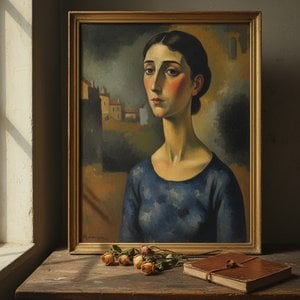
The Haunting Beauty of Longing: An Exploration of Modigliani's "Two Girls"
Amedeo Modigliani’s “Two Girls,” painted in 1918, isn’t merely a portrait; it’s a distilled essence of the artist’s deeply felt worldview. This oil on canvas, measuring a modest 100 x 65 cm, immediately draws the viewer into a space of quiet contemplation and subtle sorrow. The painting depicts two young women seated side-by-side, their gazes averted, lost in private worlds. Yet, despite the apparent stillness, there’s an undeniable current of emotion – a palpable sense of longing that permeates the scene, reflecting Modigliani's own life marked by unfulfilled desires and artistic struggle.
The figures themselves are rendered with Modigliani’s signature elongated forms, a stylistic hallmark born from his fascination with classical sculpture and a desire to capture the underlying structure of the human body. The faces, particularly that of the girl on the left, possess an almost mask-like quality, their features subtly distorted yet undeniably expressive. This deliberate manipulation of form isn't about realism; it’s about conveying inner states – a sense of detachment, vulnerability, and perhaps even a touch of despair. The muted palette—primarily creams, whites, and subtle browns—further enhances the painting’s melancholic mood, creating an atmosphere of quiet intimacy and understated drama.
Expressionism and the Capture of Inner Life
“Two Girls” firmly places Modigliani within the burgeoning Expressionist movement. While he predates many of its key figures, his work shares a common thread: a rejection of academic realism in favor of portraying subjective experience. The painting’s distortion of features and the use of color to evoke emotion are hallmarks of this approach. Modigliani wasn't interested in simply depicting what he *saw*; he sought to capture what he *felt*. This is evident in the way the figures seem to exist outside of a conventional spatial relationship, almost floating within their environment – a technique that contributes significantly to the painting’s dreamlike quality.
The background, sparsely populated with three indistinct individuals, serves not as a distraction but as a subtle reinforcement of the central theme. These peripheral figures suggest a world beyond the girls' immediate experience, hinting at loneliness and isolation – themes frequently explored by Modigliani in his work. The positioning of the chairs, close together yet maintaining a sense of separation, mirrors this duality: proximity without genuine connection.
A Window into the Artist’s World
Understanding “Two Girls” requires acknowledging the context of Amedeo Modigliani's life. Born in Livorno, Italy, in 1884, his early years were marked by illness and financial instability – factors that undoubtedly shaped his artistic vision. His personal relationships were often fraught with difficulty, contributing to a pervasive sense of melancholy that resonates throughout his oeuvre. The painting can be interpreted as a reflection on these experiences—a poignant exploration of beauty, loneliness, and the elusive nature of connection.
Modigliani’s work was initially met with indifference during his lifetime, but it has since been recognized as a pivotal contribution to modern art. Reproductions like those offered by WahooArt.com allow us to appreciate the nuances of this remarkable painting, bringing its haunting beauty and profound emotional depth into our homes. Consider how the subtle shifts in tone and form invite repeated viewing – each encounter revealing new layers of meaning within this enduring masterpiece.



 Zobacz w skali 1:1
 Przełącz na wersję drukowaną
 Wyślij
 Udostępnij
 Szczegóły
 Przewodnik

 Pobierz plik obrazu
 Podobne obiekty
 RTG
RTG Pokaz slajdów
 Statystyki


 Czytaj więcej






































 Opcja ze szkłem jest dostępna wyłącznie w rozmiarach poniżej 110 cm