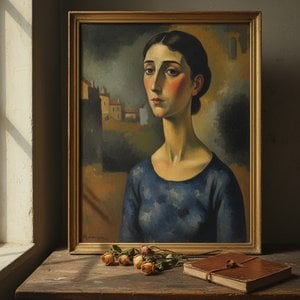
A Portrait of Quietude and Melancholy: Exploring Modigliani’s “The Little Peasant”
Amedeo Modigliani's "The Little Peasant," painted in 1918, is not merely a depiction of a young boy; it’s a poignant distillation of the artist’s own emotional landscape – a world steeped in longing and shadowed by an underlying sadness. This intimate portrait, currently residing within the Tate Gallery in London, offers a rare glimpse into Modigliani's expressive vision during a turbulent period in his life. The painting immediately draws the viewer in with its muted palette of earthy tones, dominated by grays, browns, and the arresting red of the boy’s chair. This deliberate choice of color creates a sense of quiet contemplation, mirroring the subject’s apparent stillness.
The young figure, seated on the simple red chair, is rendered with Modigliani's signature elongated features – a characteristic that became synonymous with his style. His head is slightly turned, as if lost in thought, and his gaze seems distant, hinting at an inner world beyond the confines of the canvas. The hat and jacket, though suggesting a degree of formality, don’t entirely dispel the sense of vulnerability; they feel almost like borrowed garments, adding to the overall impression of quiet isolation. The background – a plain gray wall with a window – serves not as a distraction but rather as a subtle reinforcement of the boy's contained space, emphasizing his solitude.
Expressionist Brushstrokes and the Language of Emotion
Technically, “The Little Peasant” is a prime example of Modigliani’s evolving expressionistic style. The brushwork is loose and deliberately unrefined; lines flow organically across the canvas, conveying movement and capturing the fleeting quality of emotion. Unlike the precise detailing often found in academic portraiture, Modigliani eschews meticulous rendering in favor of suggesting form through color and texture. This technique isn’t simply about depicting reality but rather about translating an internal state onto the surface of the painting. The fluidity of the brushstrokes mirrors the boy's potential restlessness or perhaps a suppressed yearning – elements that resonate deeply within the viewer.
The use of red, particularly in the chair, is strategically significant. Red often symbolizes passion, energy, and even danger, yet here it’s deployed with restraint, highlighting the boy as the focal point without overwhelming the composition. It's a subtle assertion of presence amidst a muted backdrop, drawing our attention to his quiet contemplation.
A Window into Modigliani’s World
Painted in 1918, “The Little Peasant” was created during a particularly challenging period for Modigliani. His personal life was marked by illness and heartbreak – the loss of his muse Jeanne Hébuterne in 1919 profoundly impacted him. While biographical details are scarce, art historians often interpret this work as an exploration of themes of loneliness, vulnerability, and the transient nature of beauty—themes that would continue to dominate his oeuvre. The painting can be viewed as a reflection of Modigliani’s own emotional state, projecting his personal struggles onto the innocent figure before him.
Considering Modigliani's life, “The Little Peasant” transcends its simple subject matter and becomes a powerful meditation on human experience. It is a testament to the artist’s ability to imbue even the most unassuming scene with profound emotional depth. A reproduction of this evocative work offers an opportunity to bring this poignant portrait into your home, inviting contemplation and sparking conversation.
Bringing “The Little Peasant” Home
WahooArt.com is proud to offer meticulously crafted hand-painted reproductions of Amedeo Modigliani’s "The Little Peasant." Our artists replicate the painting's distinctive style – the elongated forms, the expressive brushwork, and the carefully considered color palette – with exceptional attention to detail. Available in a range of sizes, our reproductions provide an authentic representation of this iconic artwork, allowing you to appreciate its beauty and emotional resonance within your own space. Whether for a study, a gallery wall, or simply as a cherished piece of art, a WahooArt.com reproduction of “The Little Peasant” is a timeless addition to any collection.
Pytania i odpowiedzi
Jaki format i orientacja druku są sugerowane dla „The Little Peasant” – Amedeo Modigliani?
Rozmiar Large, orientacja Tall: to sugerowane parametry druku dla dzieła „The Little Peasant” – Amedeo Modigliani.
Czy "The Little Peasant" to jedno z najpopularniejszych dzieł Amedeo Modigliani?
"The Little Peasant" jest klasyfikowane jako Iconic.
Ile lat miał Amedeo Modigliani, gdy powstało dzieło „The Little Peasant”?
Amedeo Modigliani miał 34 lat w momencie powstania „The Little Peasant” w 1918. Wiek ten obliczono na podstawie roku urodzenia artysty, 1884.



 Podgląd w skali 1:1
 Zamów ręcznie malowaną reprodukcję
 Wyślij jako kartkę
 Udostępnij
 Szczegóły dzieła
 Przewodnik

 Pobierz obraz
 Podobne obiekty
 RTG
RTG Pokaz slajdów
 Q&A
Q&A Statystyki


 Rozwiń treść






































 Opcja ze szkłem jest dostępna wyłącznie w rozmiarach poniżej 110 cm